How did we achieve 117.11% revenue growth for GymBeam, an e-commerce business in the fitness industry?
How to establish and optimize ROI for a fitness e-commerce brand entering the Polish market during the pandemic?

- Services
- Google Ads
- Website
- https://gymbeam.pl/
- Market
-
 Poland
- Industry
- e-commerce

73.20%
increase in site traffic

117.11%
growth in revenue

28.35%
boost in conversion rates

Need a similar strategy?
About the Client
GymBeam is a rapidly growing e-commerce brand in the fitness and healthy lifestyle sector, operating in more than 15 countries across Central and Eastern Europe. It offers over 3,000 products — from dietary supplements and functional foods to sports accessories and apparel. In 2020, GymBeam decided to enter the Polish market — and that is when its cooperation with MTA Digital began.
Challenges

GymBeam launched sales in the Polish market just before the outbreak of the pandemic. The introduction of lockdowns and the closure of gyms completely changed consumers’ everyday lives – almost overnight, traditional shopping channels disappeared, while online sales came to the fore. For a new brand, this meant the need to quickly adapt to a dynamically changing reality.

The growing volume of data and products placed new demands on the team managing campaigns. Initially, manual ad management was sufficient, but as the scale of operations grew, more advanced solutions were needed – automation, process optimization, and better use of product data to maintain efficiency and growing profitability.
Polish consumers already had access to well-known online stores offering supplements and fitness products. Gaining their trust required not only an attractive offer, but also precisely tailored communication and an effective advertising strategy. It was essential to prove that GymBeam could deliver new value – both in terms of product quality and the shopping experience.

The goal was ambitious: to achieve profitability as quickly as possible while competing with one of the 100 largest e-commerce companies in Poland. At the same time, we had to respond to the rapidly growing home workout trend, which was taking the internet by storm.
Our Solutions
The main premise of our strategy was to allocate the highest possible budget to Google Ads campaigns with the potential to generate the highest return. We therefore launched:
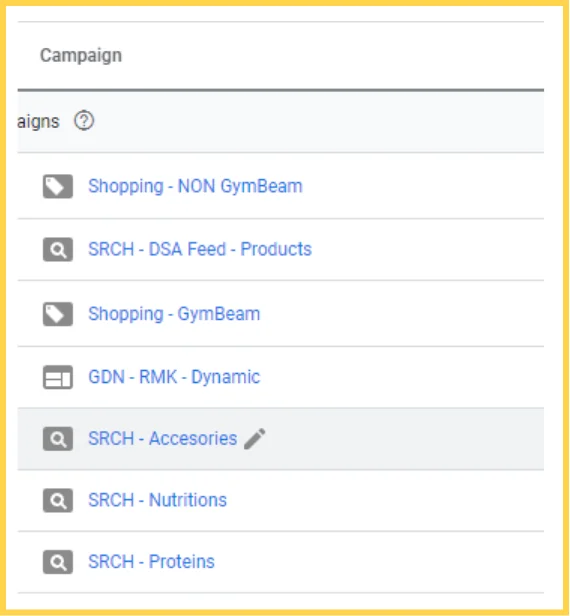 Product campaigns — divided into GymBeam branded products and non-branded products.
- Search campaigns — targeting the most important phrases related to product categories, as well as DSA campaigns (dynamic search ads), based on indexed subpages and a dedicated file containing links to products.
- Google Display Network remarketing campaigns — targeting users who added products to their cart but did not complete a purchase. In the following months, we also launched remarketing campaigns targeting previous buyers.
To ensure the highest quality of cooperation and full transparency, we agreed on a schedule of regular meetings with Martin at the very beginning of the project. At the start of each month, we held video calls during which we summarized the activities from the previous 30 days.
We also remained in constant email contact — discussing results, campaign optimizations, and emerging challenges on an ongoing basis, which allowed us to react quickly and maintain a high pace of work.
At the same time, we implemented solutions that helped automate and improve the activities we were running:
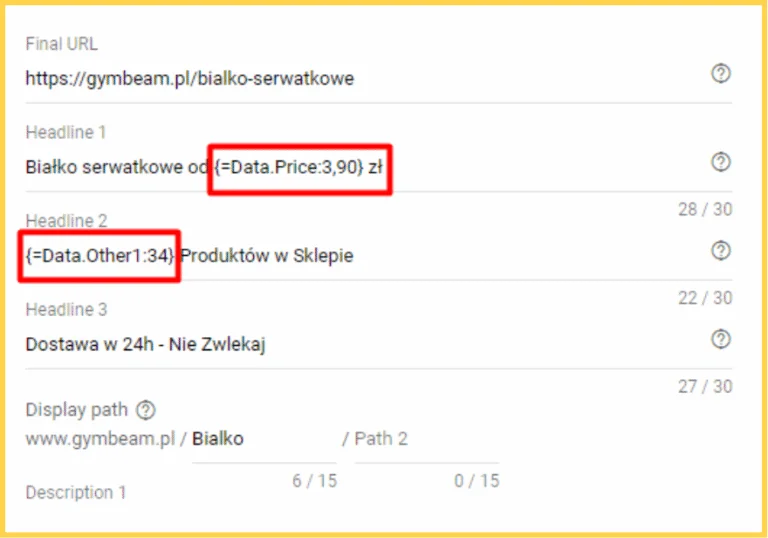 Connecting the product feed with search ads. We integrated the product feed with Google Ads — both in Google Shopping campaigns and text ads. By using dynamic variables, data on prices, availability, and other product parameters was automatically updated four times aday.
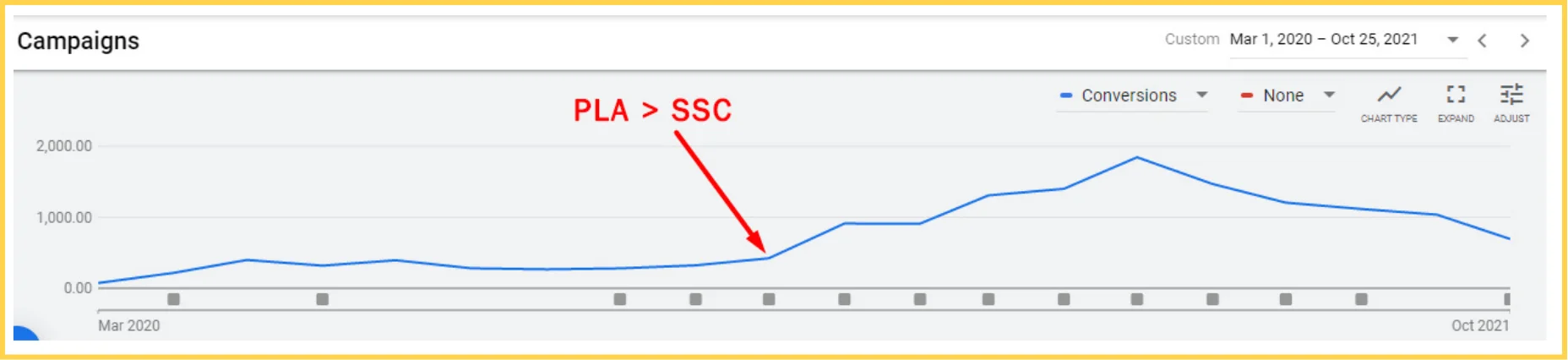
- Implementing Smart Shopping campaigns as a modern alternative to outdated PLA campaigns (Product Listing Ads). The account was generating several hundred conversions per month, whichallowed us to confidently entrust sales optimization to Google Ads algorithms. We used the time freed up in this way for strategic analysis and macro-level optimization. As a result, we were able to precisely define the required ROI level for each campaign.
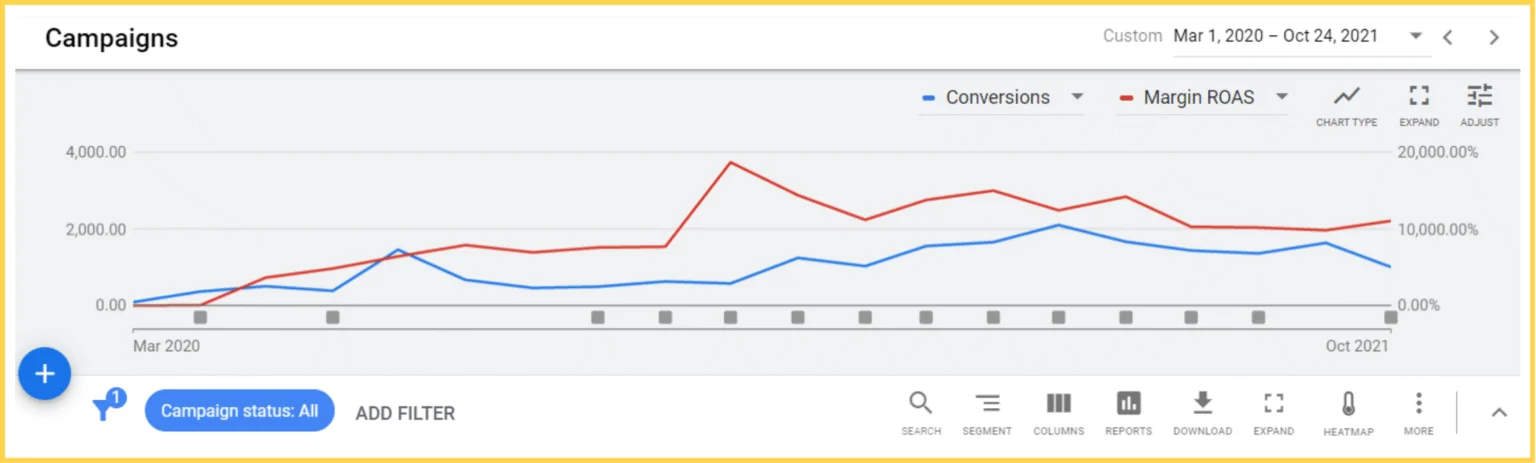
- Integrating profitability and ROI data directly into the Google Ads panel. The client sent profitability data for individual products directly to the website source, which allowed us to assess campaign effectiveness almost in real time. This approach completely changed the way we measured performance — from that point on, we knew exactly what ROAS (Return on Ad Spend) level was required for a campaign to be profitable.
In the meantime, GymBeam was actively running sales-supporting activities on the client side. In parallel with our campaign work, the team developed blog content, optimized product descriptions, and improved the category structure in the online store.
A strong emphasis was also placed on influencer marketing. The brand established cooperation with online content creators — including Monika Kołakowska, who runs one of the largest Polish Instagram and YouTube accounts dedicated to home workouts. This made it possible to effectively reach a new audience group and further strengthen the advertising activities.
Results
After less than a year and a half of cooperation, in July 2021, we had gathered enough data to change the main conversion in the campaigns. Instead of optimizing for revenue, we focused on return on investment (ROI).
The results exceeded our expectations — by October, we could state with full confidence that Google Ads campaigns were generating a stable return at a level that ensured profitability. At the same time, spending increased by 174%, while the number of monthly orders grew by as much as 510%.
The effects of our work are best reflected in Google Analytics data. Since January is a key month in the fitness industry, we compared the results from January 2021 and January 2022. In the first case, all campaigns were optimized for ROAS, while in the second — for ROI:
- the number of users visiting the website increased by 73.20%,
- the conversion rate increased by 28.35%.
Such significant results were achieved primarily thanks to changing the conversion type in Google Ads. During this time, we did not launch many new campaigns — instead, we focused on making the most of the potential of the existing ones.
This is a strong example of the enormous impact data quality can have on business growth, as well as the role it plays in effective marketing optimization.
Summary
In our case, the use of data made it possible to precisely define the target ROI level and effectively scale activities — in line with the client’s main goal from the very beginning of the cooperation. Google Ads algorithms need time to “learn” based on the data provided. In the case of the change discussed above, introduced in July 2021, the full transition to ROI-based optimization took around three months.
Automation became the foundation of our work on a large account. Connecting product feed data with Google text ads allowed us to create a complete campaign structure for the future in one step — and within a single tool. As a result, we were able to focus on building an effective strategy at the macro level.
Competition should not be a reason for concern — even when we are talking about the biggest players in the industry and across the entire country. A properly selected strategy, based on precise data and technical expertise, means that every goal is within reach — even if achieving it requires time and patience.