How to boost the conversion rate in the Home & Garden industry by 76.17% using weather-based marketing?
How to boost the conversion rate in the Home & Garden industry by 76.17% using weather-based marketing?
- Services
- Programmatic
- Market
-
 Germany
 United Kingdom
- Industry
- Home&Garden

76.17%
Increase in Conversion Rate

39.32%
Decrease in Cost Per Acquisition (CPA)

Need a similar strategy?
“We have a weekly call to talk about what was accomplished the past seven days and what we’re going to work on in the next seven. They’re very responsive; communication is really great compared to the agency we worked with before. If there’s a need for an ad hoc call, we use a chat channel or email.”

Grilling Products Company
CRM Manager, Grilling Products Company

About the Client
The client is a global manufacturer of garden and patio equipment, actively operating in 19 markets—across Europe, the USA, Australia, the developed economies of Asia, New Zealand, the United Arab Emirates, and Central America.
Its offer includes over 1,000 products, all bearing its own brand. The target audience consists of people who value spending time outdoors and appreciate the highest quality of garden and patio equipment. The client’s products belong to the premium segment—they are durable, solid, and covered by a multi-year warranty. A characteristic feature of the client’s business is seasonality—the most intensive marketing and sales period falls between March and July.
Challenges

Campaign activations could only take place in specific weather—clear skies and a temperature above a predetermined threshold. Initially, in April, the limit was 15°C, but as the weather warmed up, it had to be raised regularly. By July, the threshold was already higher, to match the seasonal changes. This required constant monitoring and quick reactions from the team.

The limited testing windows often caused delays in launching the campaign or interrupted its operation. This irregularity made it harder for the algorithm to learn and optimize, which negatively affected results. It required additional adjustments and constant oversight to keep the campaign on track.
Our Solutions
The initiative and the idea to create this campaign came from our project team. We wanted to try a less obvious and more unconventional approach. The starting point was a simple observation: since the product belongs to the home & garden category, sales should rise during periods of warm, sunny weather. Inspired by the concept of weather-based marketing, we proposed a campaign in which ads are displayed only in favorable weather conditions, so as to increase clicks and sales. The client embraced our idea enthusiastically and decided to test it in two markets that were key for them:
in the United Kingdom – where changeable weather creates ideal conditions for testing,
in Germany – the brand’s most important sales market.
The campaign was launched in DV360 and was based on weather data collected in real time, which automatically activated the ads at the right moments.
For the campaign, we used the OpenWeather API, which provides weather updates every 2–4 hours, covering, among other things, temperature, cloud cover, and the probability of precipitation. This data was integrated with the Display & Video 360 platform, so that the campaign could be automatically launched or paused depending on the current weather conditions. The ads appeared only during nice weather, and the creatives used were identical to those used in the control group, which allowed us to objectively compare the impact of the weather alone on campaign results. To compare the results of the tests in the control group with those of the weather-based campaign, we used key indicators such as CTR and conversion rate, which allowed us to accurately measure the effectiveness of the strategy.

In the United Kingdom—where the weather is exceptionally unpredictable—precise targeting was a challenge, which is why we focused on selected locations. In Germany, on the other hand, we applied a more detailed approach, dividing the campaigns across 16 regions (states), which made it possible to more accurately match the ads to local weather conditions.
The key factors for a campaign based on changing weather conditions turned out to be ongoing adjustments and modifications, such as raising the minimum temperature threshold as the weather warmed up. All of this was done to better meet customers’ expectations. This approach shows that using weather data and analytics can significantly improve ad targeting and results, even for premium products with a longer purchase cycle.
In the United Kingdom, we divided the country into four regions: Scotland, England, Northern Ireland, and Wales. The campaigns were launched when the sky was clear or lightly clouded and when the temperature was at least 17°C—so as to increase interest in products for outdoor use, such as grills. The campaign ran from April 22 to May 17, and for it we used the three best-converting audience groups from the standard campaign, while keeping the same creative materials. However, the unfavorable weather (very few sunny days) during the testing period had a negative impact on the campaign’s results.
In Germany, we also tailored the campaign to selected regions—including Bavaria, Baden-Württemberg, North Rhine-Westphalia, and Berlin. We defined the conditions for launching the ads as: a clear sky, a minimum temperature of 17°C, and no precipitation. This allowed us to directly compare the effectiveness of the weather-based campaign with its standard version, which ran regardless of weather conditions. To simplify campaign management, in each region we focused on a single, best-converting audience group. The test ran from May 13 to May 31.
Results
To measure the real impact of the weather-based campaigns, we ran A/B tests, comparing the weather-based campaigns with standard always-on campaigns.
The results turned out to be very promising:
in the United Kingdom, the weather-based campaigns achieved a 76.17% higher conversion rate,
in Germany, the increase was 28.37%.
This is clear evidence that tailoring the message to weather conditions genuinely translates into better campaign results.
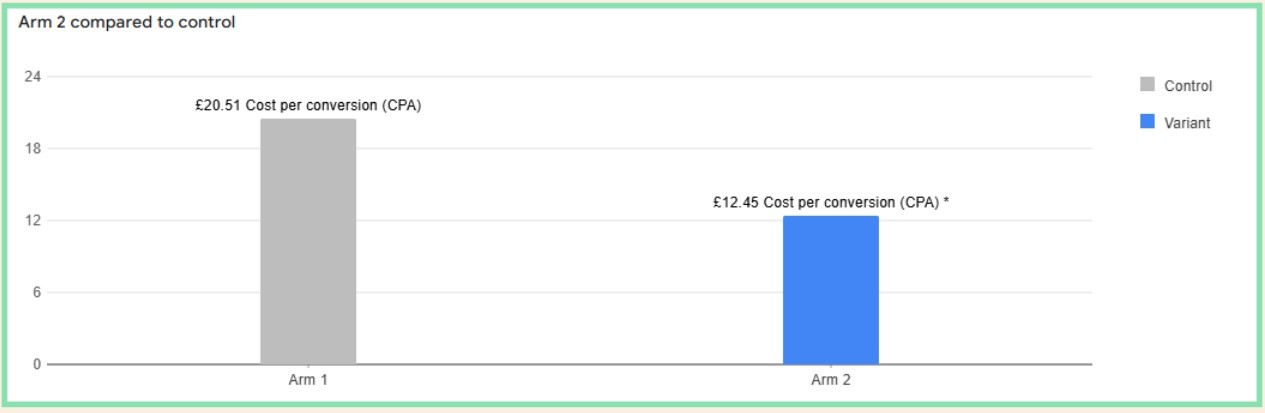
In the United Kingdom, the weather-based campaign reduced the Cost Per Acquisition (CPA) by 39.32% compared to the standard campaign. In Germany, on the other hand, the standard campaign achieved a lower cost per acquisition (CPA) than the weather-based campaign. At the same time, weather-based marketing recorded a 28.37% higher conversion rate compared to the standard approach, at a 90% confidence level. This shows that tailoring marketing activities to favorable weather conditions can particularly improve effectiveness in countries with a variable and unpredictable climate, such as the one in the United Kingdom.
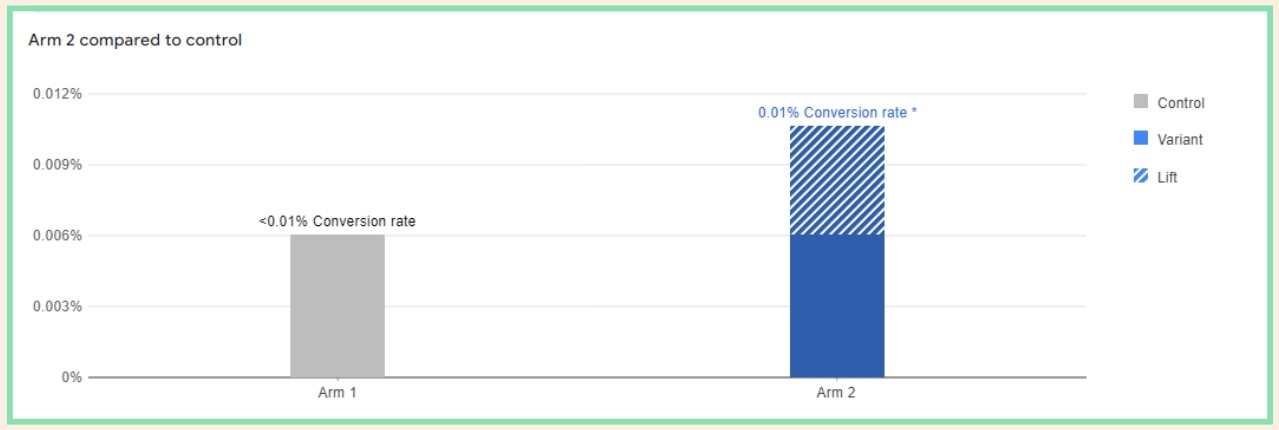
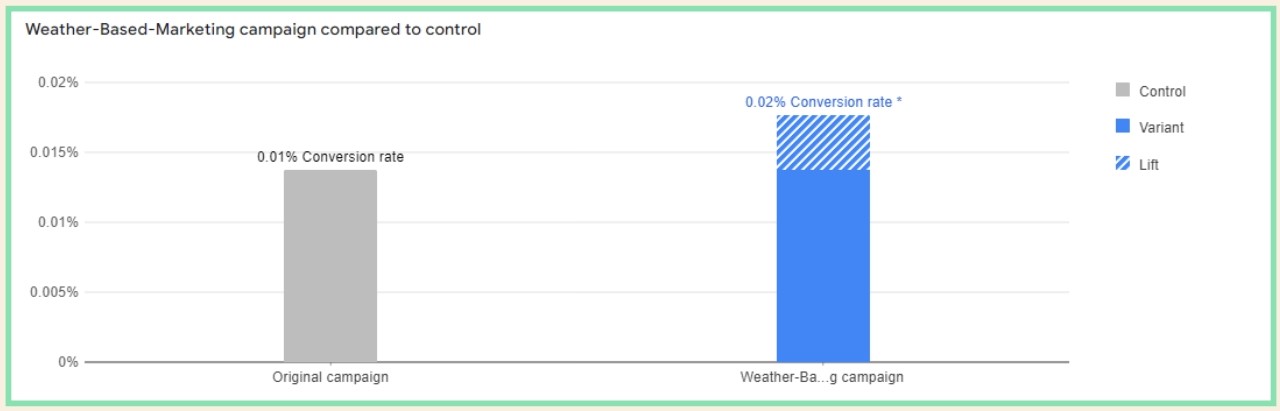
The weather-based campaign revealed an interesting relationship between the click-through rate (CTR) and the conversion rate (CR). Although the CTR was lower—probably due to the intermittent nature of the campaign, which made it harder to fully optimize the algorithm—the conversion rate turned out to be significantly higher than in standard campaigns.
The Cost Per Acquisition (CPA) results showed differences between markets. In the United Kingdom, the weather-based campaign brought a 39% drop in CPA compared to the standard campaign, which confirms its high cost-effectiveness. In Germany, the cost of acquisition was slightly higher than in the standard campaign, but the conversion rate rose by 28.37%, which shows that even at higher costs, the campaign was able to engage users more effectively and generate valuable actions.
Summary
Despite the unfavorable weather in the United Kingdom, this year’s tests of campaigns operating on the basis of weather conditions delivered promising results. We achieved a lower cost per conversion and thus proved to the client that the chosen strategy made sense—and, what’s more, that it turned out to be effective and practical. In the next season, we plan to continue testing and refining the strategy so that we can achieve even better results.