How much did we improve the organization of processes in GetResponse?
How to enhance digital marketing efficiency through strategic process organization?

- Services
- Bing AdsGoogle AdsLinkedIn AdsMeta Ads
- Website
- https://www.getresponse.com/
- Market
-
 Poland
- Industry
- SaaS

More efficient reporting

Streamlined campaign management

Well-structured advertising campaigns

Need a similar strategy?
“I really felt like they are a part of our team. Thanks to MTA Digital, the client unified their conversion tracking on all of their PPC platforms. They had a great workflow, using Jira and Slack to manage the project and communicate their progress. Moreover, the team’s knowledge and understanding of the client’s product proved their dedication.”

Renata Zajdel
GetResponse, Performance Marketing Lead

About the Client
GetResponse is a leading SaaS company headquartered in Gdańsk, Poland, specializing in marketing automation. Its platform helps businesses manage email marketing, webinars, and sales funnels, serving more than 350,000 customers across 183 countries.
Challenges

GetResponse was running more than 200 PPC campaigns in Google Ads, which required a significant amount of time and effort to manage and understand their individual goals. This made it difficult to get a clear, consistent view of marketing activities and identify areas for improvement.

Marketing activities involved as many as 10 teams on the client’s side, each expecting tailored reports. Creating them became so time-consuming that it started to take focus away from key strategic initiatives.

Campaigns were grouped thematically, without accounting for system features or user intent. This limited precise targeting and made it harder to align budgets with actual conversion potential.
Different advertising channels used separate tracking systems, while landing pages were not integrated with one another. The lack of a consistent reporting model made it difficult to assess performance and limited optimization opportunities.
Our Solutions
While supporting the client in campaign execution, we did not limit our work to operating within the existing advertising account structure. We identified areas where the key challenge was not only campaign management itself, but also the optimization of marketing processes and the implementation of a new, transparent operational structure.
That is why, together with GetResponse, we introduced a series of changes that significantly improved their digital marketing operations:
- We standardized campaign naming conventions and organized the methodology for managing and analyzing PPC activities.
- We created universal dashboards covering all client teams. Thanks to consistent nomenclature, they made it possible to monitor campaign performance efficiently in one place.
- In terms of reporting, we replaced numerous separate reports with one consistent tool covering all activities.
- Real-time reporting allowed our specialists to react faster and optimize campaigns more effectively, while giving the client a clearer view of overall performance.
- We also created a separate dashboard for monitoring advertising spend across individual channels, improving budget transparency.
The Google Ads campaign structure was thoroughly rebuilt according to a new, more efficient model:
- Instead of one campaign, we introduced a division based on tCPA levels, meaning target customer acquisition cost, and functions, meaning user roles.
- After a detailed analysis of the client’s business data, we moved away from the previous non-brand campaign structure, which had been based mainly on geographic segmentation.
- Instead, all English-language campaigns were organized into seven tiers based on target customer acquisition cost. CAC was estimated using the average revenue in each country and a standard conversion rate.
- In each campaign, we also included tCPA as an indicator of target CAC. To do this, we grouped keywords according to the functions users were looking for, such as email marketing, automation, and landing pages. We understood that different GetResponse features could translate into different customer lifetime value depending on user needs.
- As a result, the final campaign structure was based on two variables: geographic segmentation, meaning market tier, and thematic segmentation, meaning features and keyword groups. This allowed for more precise targeting and more effective advertising budget optimization.
We also created a universal system of landing pages, event tracking, and conversion tracking for GetResponse.
In addition to standard tracking, we unified the measurement systems for Facebook Ads, Google Ads, and LinkedIn Ads, integrating them into one coherent environment. As a result, all data became easily accessible and available for analysis in one place, significantly improving reporting and decision-making.
Results
Thanks to our know-how, we streamlined and organized GetResponse’s marketing activities, which directly translated into stronger campaign performance and higher operational efficiency.
- We reduced the number of Google Ads accounts from 11 to 3 — improving data consistency, simplifying management, and significantly reducing the PPC team’s operational workload. By implementing a unified naming system, we also simplified the rebilling process.
- On the global advertising account, we reduced the number of campaigns from 201 to 114 — bringing more structure to the account and improving spend optimization. We also audited older Facebook campaigns and introduced only essential adjustments across 10 accounts, which helped improve performance.
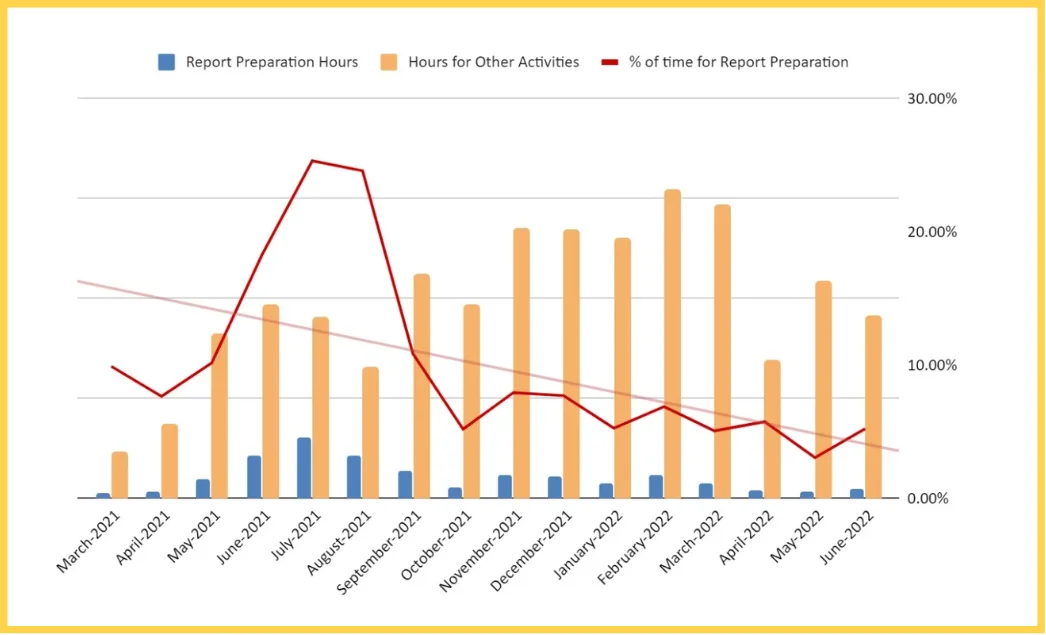
As a result, the time spent on reporting decreased from as much as 30 hours per month to around 7 hours. The resources saved could then be redirected toward activities that created real value for the client.
The progress in reducing report preparation time is shown in the chart below.
Summary
Our collaboration with GetResponse evolved over time. It began with digital marketing campaigns and gradually expanded to include support in developing digital marketing processes and standardizing analytics.