How did we decrease the Cost Per Purchase by 54.70% for Multikino (VUE), a major player in the entertainment industry?
How to transition Poland’s largest cinema chain from brand awareness to performance marketing?

- Services
- Google AdsMeta Ads
- Website
- https://multikino.pl/
- Market
-
 Poland
- Industry
- Entertainment

32.32%
increase in ad impressions

17.46%
increase in ticket purchases

54.70%
decrease in cost per purchase

Need a similar strategy?
“I was impressed with the effectiveness of campaigns. They’re organized and accommodating. Their team adapted their workflow, centering it around the variable cinema market in Poland.”

Elżbieta Polkowska
Manager, Multikino

About the Client
Multikino is the largest cinema chain in Poland and part of Vue International, one of Europe’s leading cinema groups. In 2022, the network operated 44 cinemas and 316 screens across 37 cities nationwide.
It is a brand recognized by every cinema lover, but the entertainment it offers goes far beyond films. Multikino’s offer also includes live broadcasts of concerts, sports events, and theatre performances.
Our collaboration began in 2017 with an ambitious goal from the very start: to build a performance marketing strategy that would not only support brand image, but above all deliver measurable results in ticket sales, both online and offline.
Challenges

Before our collaboration, campaigns were fragmented and inconsistent. They lacked structure, a clear division of roles and tasks within the sales funnel, and precise targeting. The goal was to create a clear performance marketing strategy that would be scalable and easy for the client’s entire team to understand.

We started almost from scratch. The lack of data from previous campaigns meant we had to build the foundations for future optimization ourselves — through testing, analysis, and gradual refinement of assumptions in real time.
Until the start of our collaboration, Multikino’s marketing activities had focused primarily on building brand awareness. Our task was to design a strategy based on data and translate advertising messages into real, measurable results — especially in the context of ticket sales.

The cinema market was one of the sectors most affected by lockdowns during the pandemic. Cinemas were closed and reopened at irregular intervals, while participation rules, restrictions, and public sentiment kept changing. All of this required exceptional flexibility and the ability to react quickly.
Our Solutions
Our approach is built on three pillars: transparency, operational excellence, and client education. We believe that true partnerships are built not only on growing conversion numbers, but also on growing expertise on both sides. That is why, from the very beginning of our collaboration with Multikino, we focused on sharing knowledge—both through our day-to-day cooperation and dedicated training sessions. Our goal was not only for the client to see the results, but also to understand how and why they were achieved.
The beginning was not without challenges. The client had no access to data from previous campaigns—there were no advertising accounts, historical performance data, or clear documentation of earlier marketing activities. We therefore dedicated the first weeks to understanding the client’s internal processes, identifying key priorities, and designing a system tailored to both strategic and operational needs.
At the same time, we launched the first campaigns, which initially did not deliver the expected results. This is a natural part of a test-and-learn approach. Rather than becoming discouraged, we worked closely with the client to identify the most effective operating model. We held brainstorming sessions, tested new campaign settings, and continuously refined the account structure. Multikino’s involvement proved invaluable—they shared insights, observations, and industry knowledge that helped us better understand the specifics of the cinema market.
On our side, we introduced the Multikino team to the world of performance marketing. We showed them how to leverage Google Ads and Meta Ads, analyze campaign data, interpret results, and make data-driven decisions. Together, we tested different strategies, ad formats, and audience segments. Over time, thanks to patience, mutual trust, and continuous optimization, these efforts began delivering measurable business results.
Results
Initial performance metrics were far from satisfactory. In October 2017, CPC campaigns accounted for only 3.82% of all purchases and 4.39% of total users. We knew there was a significant amount of work ahead.
Instead of looking for quick wins, we focused on building strong foundations—transparency, continuous testing, client education, and systematic optimization. Within a year, the campaigns had reached a stable and efficient level of performance. In the months that followed, we began seeing substantial growth. By April 2022, the share of purchases attributed to CPC campaigns had increased to 5.10%, while their share of total users had grown to 12.41%.
Google Ads
Our Google Ads strategy focused on Search and Display campaigns. By combining different targeting methods, we reached users who were genuinely interested in visiting the cinema—whether for blockbuster premieres or less mainstream productions.
Not every movie was promoted through Google Ads. We managed a mix of evergreen, seasonal, and one-off campaigns, with precision being the key principle. We continuously evaluated keyword performance and refined campaign structures, including the transition from the SKAG (Single Keyword Ad Group) model to STAG (Single Topic Ad Group). We also introduced Performance Max campaigns, which by June 2022 were responsible for 62.33% of all purchases generated through the account.
We also implemented Dynamic Search Ads (DSA), enabling us to respond quickly to new movie releases, even when they were not supported by dedicated campaigns.
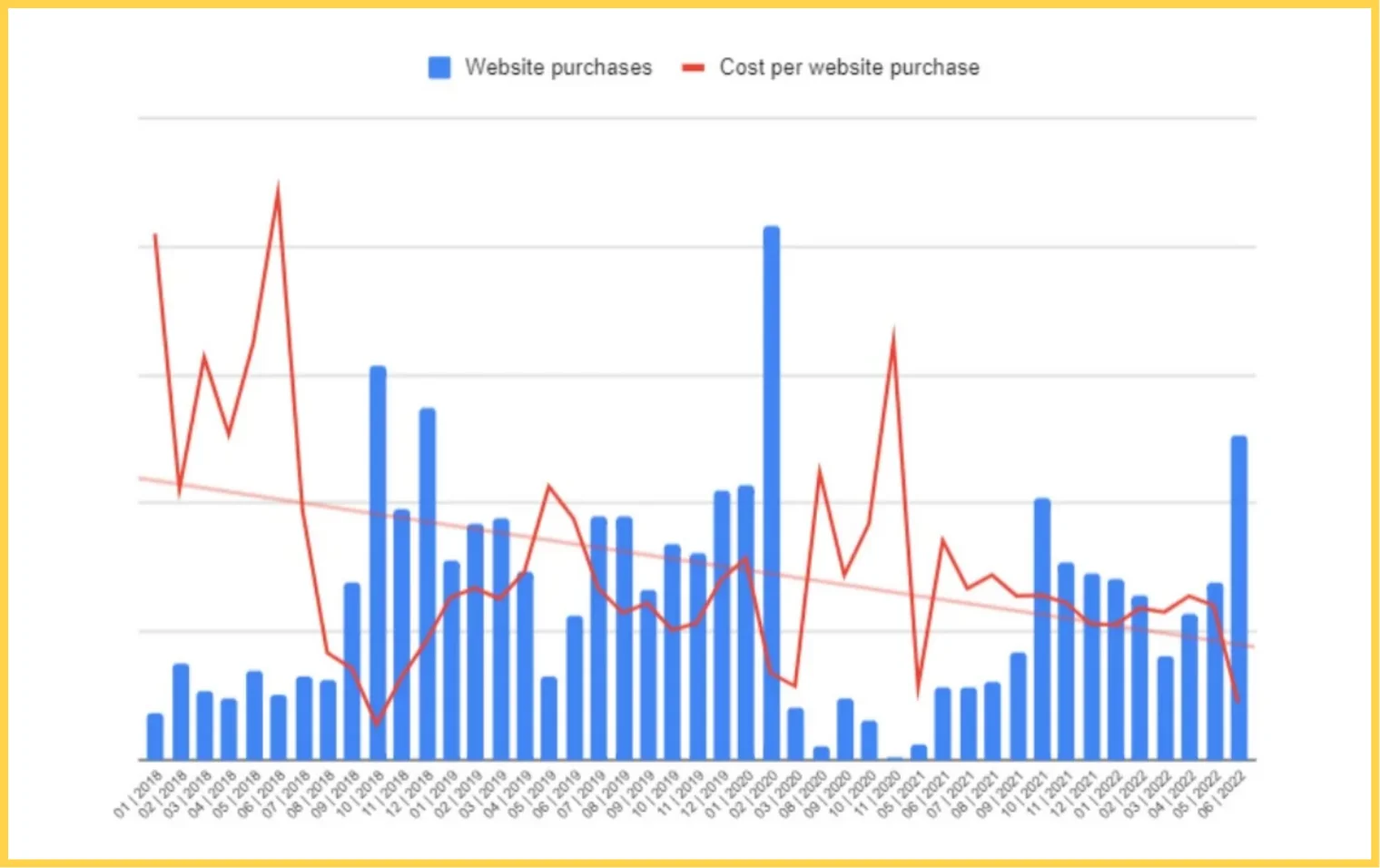
The progress achieved during the pandemic is best reflected in the reduction of Google Ads acquisition costs:
- In November 2020, the average website purchase cost was PLN 16.32.
- By June 2022, we had reduced it to just PLN 2.25.
The scale of this improvement is further illustrated in the chart below. Between January 2018 and April 2022, we reduced the average cost per purchase by 68.78%.
Meta (Facebook) Ads
In June 2019, we expanded our scope to include post boosting, transforming organic content into paid advertisements. From that point onward, we managed Multikino’s entire Facebook advertising ecosystem.
Comparing May 2019 with April 2022, we achieved:
- 32.32% more ad impressions.
- A total advertising reach of 11,406,613 people.
- 17.46% growth in ticket purchases, despite the attribution model changing from 28+1 to 7+1.
- An overall increase in ticket purchases of more than 401.53%.
- Despite higher budgets and significantly more transactions, the average cost per purchase decreased by 54.70%.
In addition, although the primary objective of boosted posts was to increase reach, they consistently generated ticket sales as well. This supported our performance campaigns while driving additional traffic to the website. The increased traffic enabled us to build larger remarketing audiences and create more advanced audience segmentation, directly improving the effectiveness of future campaigns.
Summary
During our collaboration, we managed an impressive scale of activity across Multikino’s advertising accounts:
- 3,711 campaigns,
- 509,002 ads,
- 4,267 ad sets,
- 146,153 ad groups,
- 184,577 keywords.
From the very beginning, our partnership with Multikino was built on transparency, commitment, knowledge sharing, and continuous optimization. We were fortunate to work with a client team that was not only open to growth but actively helped shape the entire process—testing, learning, and improving alongside us.
It was this relationship that allowed us to implement new ideas with complete trust and shared ownership. We were never simply working *for* the client—we were working *with* the client. And it is partnerships like these that deliver the strongest long-term results.