How we helped Marpur grow revenue by 62.55% while reducing its advertising budget
How do you build a stable source of sales for a brand with a long purchase cycle, without increasing the advertising budget?

- Services
- CreativesGoogle AdsMeta Ads
- Website
- https://marpur.pl/
- Market
-
 Poland
- Industry
- Home & Garden

-5,12%
advertising budget year on year

+62.55%
revenue across the entire business

+74.09%
average ROAS

Need a similar strategy?
“Working with MTA runs very smoothly and at a high standard. The team is committed, communication is quick and to the point, and everything is delivered on time. The results of our joint work are clearly visible – sales are growing steadily, and the marketing and sales activities we undertake bring measurable results. We are pleased with the cooperation and look forward to growing together and to further successes.“


About the Client
Marpur is a Polish brand and manufacturer of mattresses and beds, offering complete bedroom solutions. The company runs a single physical showroom in Kepno and sells mostly online, reaching customers across Poland. The brand is also growing on the German market, expanding its presence beyond the country’s borders.
Challenges

For a long time, the client had been unable to break through a certain revenue ceiling from new customers, despite earlier evidence that higher results were achievable. He knew the business could perform better, but could not diagnose what was blocking growth. Regular website fixes and SEO work, meant to increase both traffic volume and conversion rate, were not helping either and never translated into any real improvement in results.

The client’s sales relied mainly on returning customers and referrals rather than on effective advertising campaigns. There was no channel that would predictably account for a solid share of revenue from new customers. Our challenge at the start of the cooperation was to build a new, stable source of sales from scratch, one the business could safely rely on.

Marpur’s products require time to think the decision through, which translates into a long decision window between the first contact with the brand and the final purchase. As a result, precise attribution of sales to specific performance channels was difficult – many conversions were spread over time and fell between different brand touchpoints, making it harder to clearly assess the effectiveness of individual advertising activities.
Paid activity was run mainly in Google, while the Meta budget, despite the channel’s potential, was limited to far smaller amounts and had been reduced even further just before the cooperation began. There was no coherent cross-channel strategy that would allow the budget to be allocated effectively.
Our Solutions
Our team began by thoroughly restructuring the entire account rather than looking for minor optimisations on the surface of the problem. We wanted to stop the drop in sales quickly and, at the same time, build the foundations for further, safe scaling.
Restructuring the Google Ads campaigns
The client’s campaigns were competing against each other. One shared Performance Max campaign handled both mattresses, the true core of the business, and beds, which accounted for only a fraction of sales yet consumed budget on a par with the main product. The algorithm had no clear signal about what it should promote, and we had no control over which ads actually reached customers.
The first step was therefore to split Performance Max into separate structures – one responsible for mattresses and one dedicated to beds. As a result, the campaigns stopped competing for budget and started pursuing a clearly defined goal, while we gained real influence over which products were promoted.
Simplifying and segmenting Meta Ads
On Meta the problem looked different, but it called for an equally decisive approach. The previous structure was extensive and heavily focused on remarketing – the client kept returning to the same, already interested people instead of building demand among new users.
We simplified everything into a single Advantage+ campaign, within which we carefully arranged audience segments so that we knew exactly who the communication was reaching. We deliberately moved away from the previously dominant remarketing towards broader reach and new customer acquisition, because that is where we saw the greatest untapped potential. While the budget was still low, instead of scaling immediately, we gave the algorithm time to learn.
Gradual and responsible budget scaling
Rather than diving into the deep end, we first let the campaigns gather enough data for stable optimisation. We then watched how ROAS behaved with small, controlled budget increases, and only on that basis did we make further decisions.
Importantly, we did not look solely at attribution from the advertising platforms themselves, but above all at the return across the entire store. That was our ultimate test of whether a given budget mix really paid off. This approach allowed us to avoid unnecessary risk: month after month we built evidence that the product and the campaigns were ready for bolder moves.
Adjusting activity to seasonality
When the client signalled that peak season was approaching, we were already prepared to react decisively. We increased budgets in both Google Ads and Meta Ads, based on the data gathered during the previous, quieter months. That moment showed that the earlier patience and the gradual building of foundations had been worth it. When the time came for aggressive scaling, we were confident the budget would be spent effectively.
Launching advertising on TikTok
Using the client’s existing content, we launched advertising activity on TikTok. We did not treat this channel as a direct source of sales, but as a brand-building element – a way to show the brand and its products to a wider audience and to support the remaining advertising channels.
Refreshing the creatives
In parallel, we worked on visual communication. Together with the client we introduced more video material, UGC content and dynamic product ads (DPA), using a tool that supports their automation and visual quality. When we noticed the first signs of creative fatigue – declining performance despite an unchanged budget – we reacted quickly with new video material. That creative, tested and confirmed by data, later became the driver behind further budget scaling on Meta.
A billing model based on shared responsibility
Right at the start of the cooperation we proposed a billing model in which our remuneration grew alongside the real growth of the client’s revenue, instead of being based purely on a percentage of the budget spent. This approach showed that we were ready to share the risk and build results together with him, not merely settle up for the budget spent.
Results

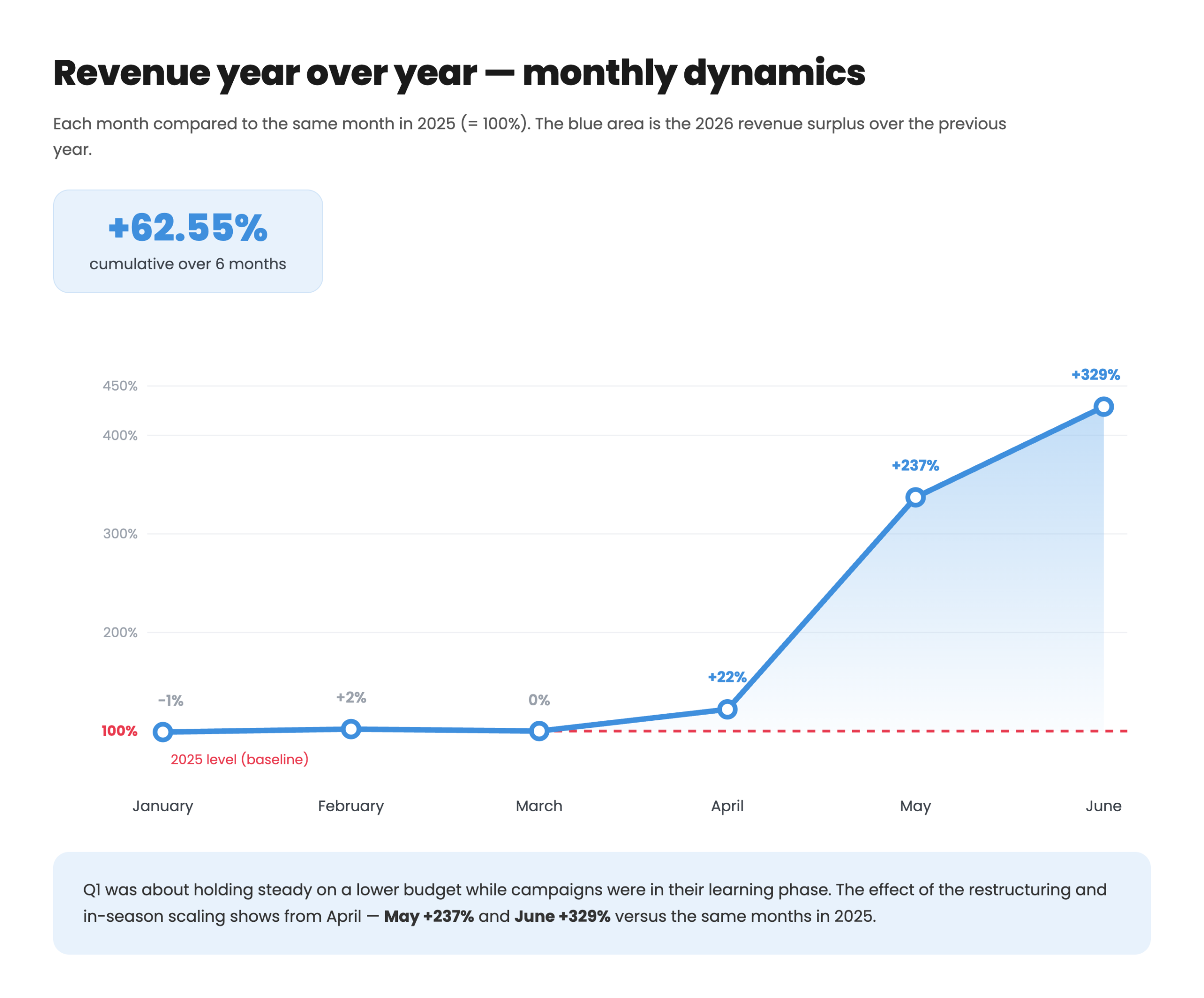
The activities we introduced brought the client a significant improvement in results. The effects of this strategy are best seen in the year-on-year comparison:
- Despite reducing the advertising budget by 5.12%, we achieved revenue growth across the entire business of as much as 62.55%. This result confirms that the campaigns started working far more efficiently than before, generating real sales growth at lower financial outlay.
- Over the same period, the average return (ROAS) across the whole business rose by 74.09% year on year. This showed us that the improvement was not limited to advertising attribution alone, but genuinely translated into the condition of the entire store.
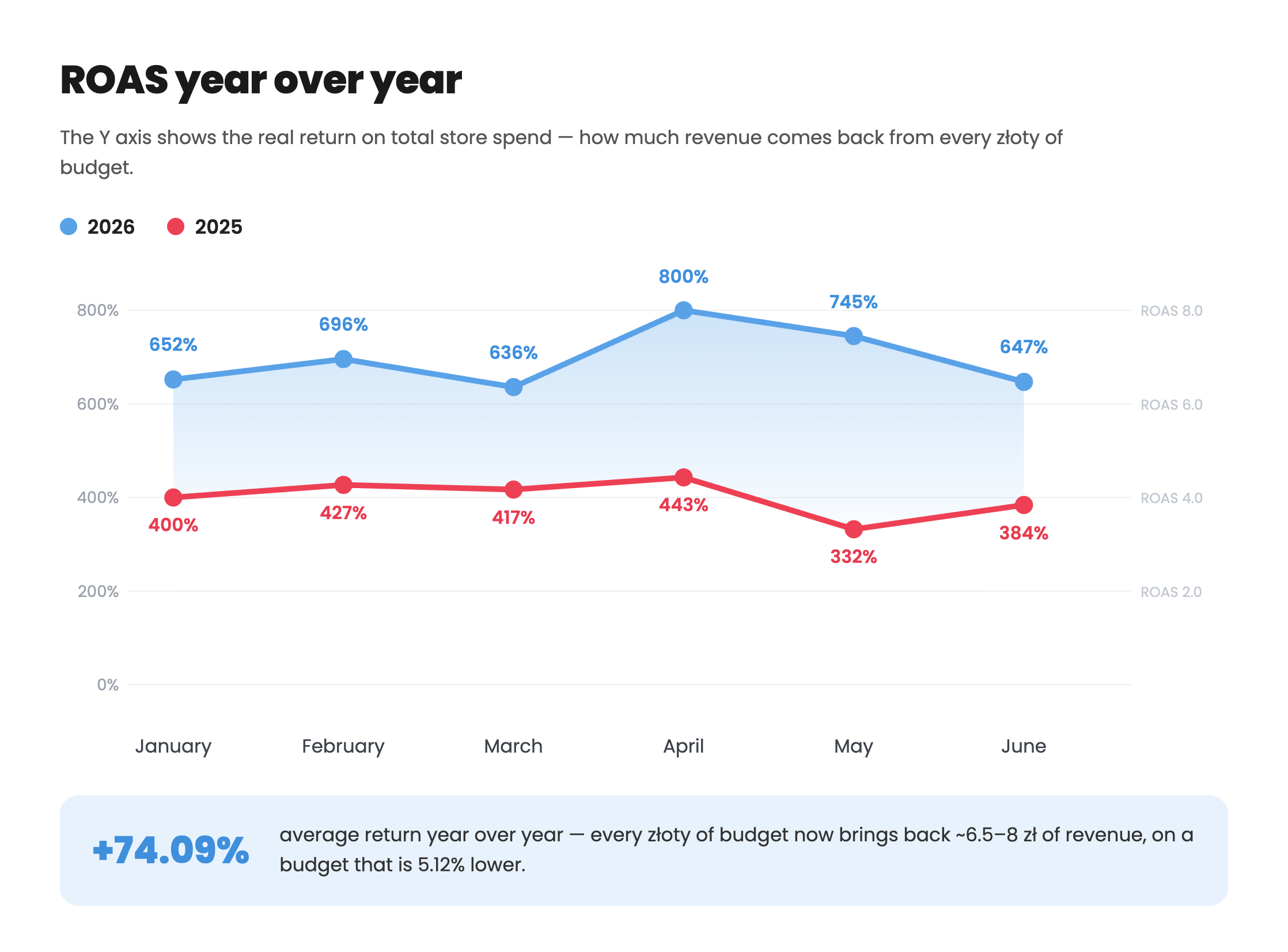
These results are the best proof that a well-considered campaign restructure and careful, data-driven budget scaling really do pay off – even when you start from a very low base.
Summary
Our cooperation with Marpur is now entering a phase of international expansion. The client has been selling in Germany through marketplaces, including Amazon, for some time, and has just translated his own store into German – a signal that it is time to move from being present on the market to genuinely entering it.
That is why, over the coming months, we are placing greater emphasis on content and creatives, because these are what scale best. Our aim is to actively generate demand rather than simply capture what already exists – building brand awareness and showing the products to German audiences who are only just discovering the brand.