82% more leads at a 17% lower CPL for the Żak school network
How a simpler account structure and creative testing lowered the cost per lead in two consecutive enrollment seasons

- Services
- CreativesMeta AdsSocial Media
- Website
- https://zak.edu.pl/
- Market
-
 Poland
- Industry
- Education

+82%
increase in leads

−17%
lower cost per lead (CPL)

Need a similar strategy?
“Working with MTA Digital has helped us reduce our CPL on Meta Ads campaigns and generate more leads. The team understands our needs and knows how to translate them into effective campaigns. We appreciate their commitment, creative approach to challenges, and proactive attitude — they come up with solutions and take initiative whenever they receive a clear brief.
MTA Digital also delivers comprehensive projects, including website design and management, as well as advertising campaigns across Google Ads, Meta Ads, and TikTok.“


About the Client
Żak is a nationwide network of schools for adults, offering part-time and online education. It operates in 80 cities across Poland and has specialized in adult education for years: from general secondary schools and post-secondary colleges, through medical schools, to vocational and specialist courses.
Żak combines flexible forms of learning with a practical approach and a simple enrollment system. Thanks to a broad course offering, everyone can find a development path that fits their lifestyle and career goals.
What makes the client’s business specific are two enrollment seasons per year: the summer enrollment (May–October) and the winter enrollment (November–March). Each has its own dynamics, volume and budget expectations — which means advertising performance has to be evaluated in enrollment cycles, not calendar quarters.
The partnership grew in stages: we started with a website project for one of the client’s sub-products, then ran the first TikTok campaigns, and ultimately took over full Meta Ads management along with creative production and organic social media channels.
Challenges

Żak simultaneously runs medical, vocational and upskilling courses, secondary schools and post-secondary colleges. The ‘one campaign = one program’ model meant dozens of separate structures and dozens of creatives needed — and creative production couldn’t keep up with covering every type of program.

Previous campaigns generated too high a cost per lead, making the activity unprofitable. There was no creative testing and no testing of messaging angles, and in early 2025 the account was running dozens of campaigns that didn’t match the client’s real business goals.

Campaigns often relied on a single graphic used for months for a given course, which made it impossible to reliably assess message effectiveness. They were launched once — with no iteration and no follow-up analysis of results.

Every landing page operated as a separate unit with its own pixel, which scattered the data and made aggregation difficult. A fragmented structure and manually set targeting for each program meant the algorithms never had enough data — and the cost per lead kept rising.
Our Solutions
The client defined the priorities very clearly: lower the CPL and, thanks to that, generate more leads from the same budget. It wasn’t about cutting spend — it was about spending it effectively, so that every zloty in Meta Ads translated into a real prospective student contact.
We started with a thorough restructuring — of the campaign structure as well as analytics, reporting and the approach to creatives. The goal was to build a scalable, transparent advertising system that allows real CPL optimization and keeps results under control in both enrollment seasons.
Campaign restructuring
Previous activity ran on a “one campaign = one program” model, which — with limited budgets — resulted in low efficiency: each campaign collected too little data for the algorithm to learn anything.
We rebuilt the entire system, grouping campaigns by product category rather than individual programs. As a result, each campaign gathered significantly more lead data, which sped up the exit from the learning phase and improved optimization. Campaigns started learning faster and delivering better results on the same budget.
Unified analytics
In response to the fragmented analytics, we implemented a unified measurement system: one pixel tracking the same events across all landing pages. This allowed us to compare data consistently — apples to apples, not apples to oranges — and draw conclusions about the effectiveness of individual activities on a common basis.
Targeting with creatives instead of interest targeting
This was one of the most important breakthroughs. Previously, every program had its own manually set targeting — the floristry course was targeted at people interested in flowers, the medical course at people interested in medicine, and so on. This split the budget across dozens of tiny audiences.
We changed the approach: the creative itself says who it’s for (“floristry course”, “medical receptionist”), and audience selection is left to Meta’s algorithms, which can read creatives. This allowed us to consolidate campaigns, increase the volume of data at campaign and ad set level, and — as a consequence — significantly shorten the learning phase and lower the cost per lead.
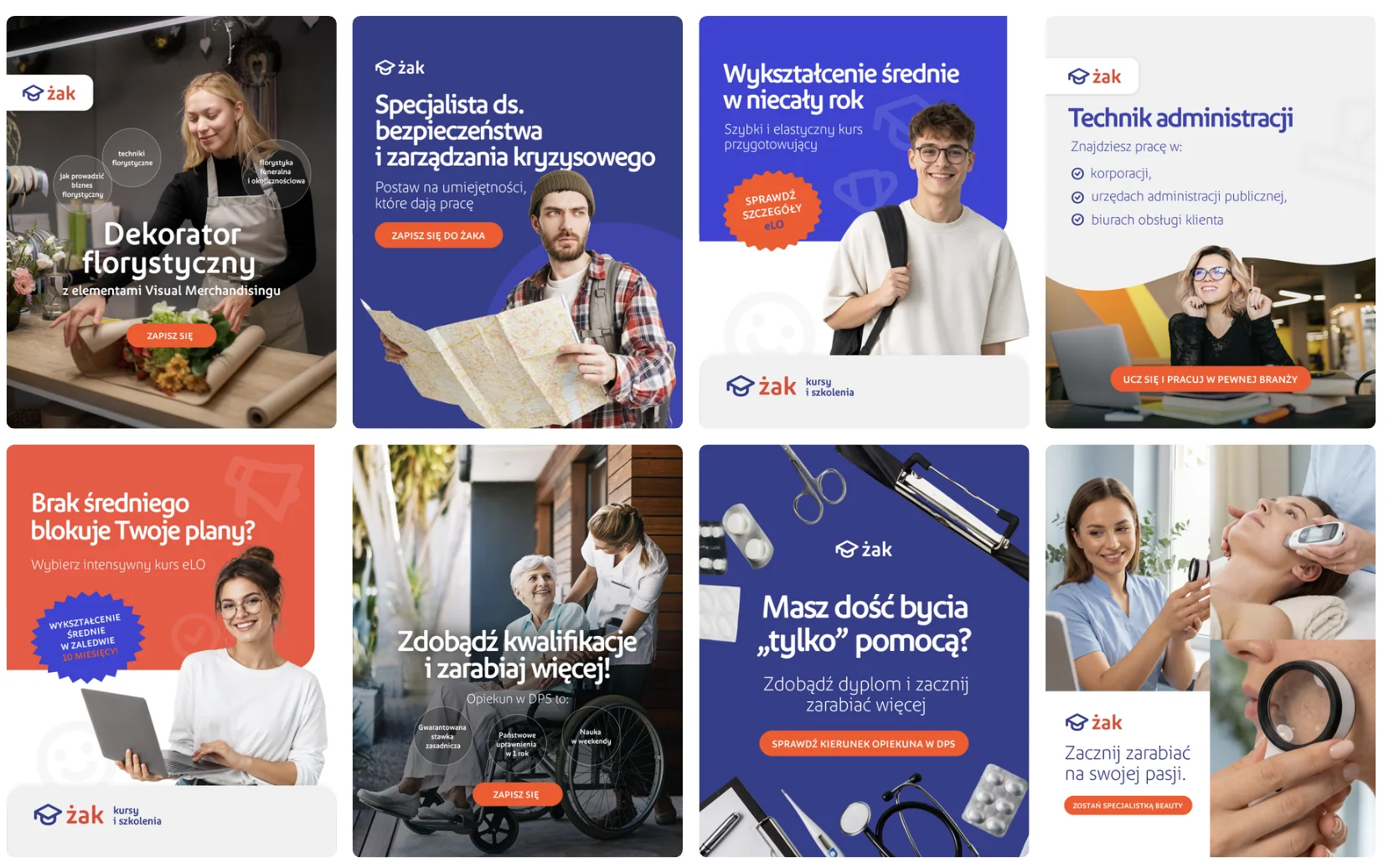
A new system for working with creatives
Instead of one graphic used throughout the whole season, we introduced regular rotation and creative testing. The creative team prepared sets of new graphics and messages, tested and optimized based on results.
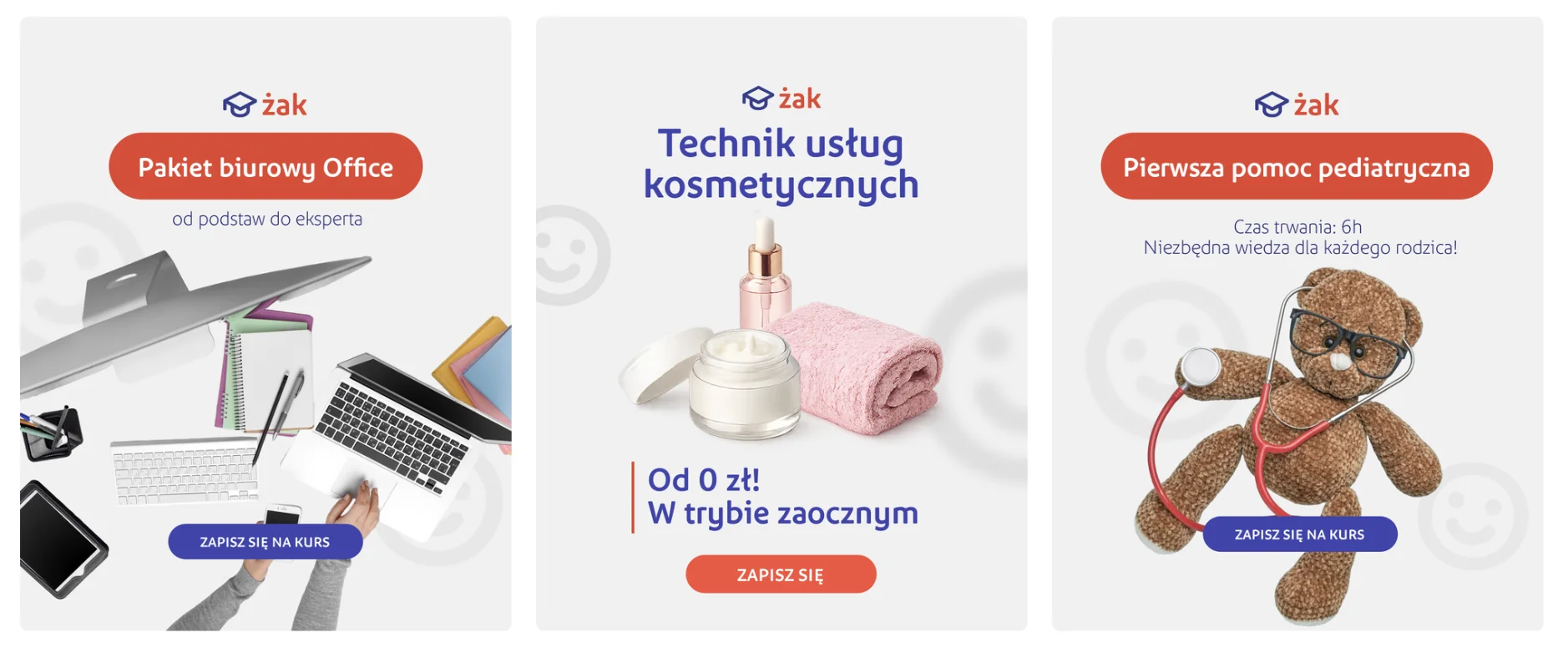
We tested different levels of messaging:
- category creatives (e.g. “medical programs at Żak”), where users pick a program from the offer themselves,
- program-specific creatives for individual courses,
- UGC-format creatives, which in many cases turned out to be the most effective.
Additionally, since we run the client’s organic channels in parallel, we could use organic posts as an early test of a messaging direction — creatives that earned strong engagement later made their way into paid campaigns. The same designer worked on ad creatives and social media content, which ensured message consistency and faster iteration.

Prioritization: leads over likes
We dropped campaigns with low business impact — reach- and click-oriented ones — and focused the budget exclusively on lead generation. We agreed on a clear priority with the client: the number and cost of leads matter more than the number of likes.
A three-layer reporting system
We introduced a reporting system that gives different teams on the client’s side the information they need:
- Overall level — total leads and CPL.
- Product level — data broken down into main categories (post-secondary colleges, one-year courses, medical schools, e-secondary school, online and offline courses), enabling budget allocation decisions.
- Program level — the performance of individual programs (e.g. floristry, nail styling), showing which ones are worth developing.
Over time we extended the reporting with destination type (dedicated landing page vs homepage) and age cohorts within each category. Reporting per creative and per program is the foundation that lets us react mid-season — if we see performance dropping, we shift budget without waiting for the end of the month.
Audience segmentation and message personalization
We introduced a split between new and remarketing traffic and — more importantly in this project — differentiated the messaging at category level. Different creatives reached people interested in floristry courses, others reached candidates for medical schools. With this many programs, it was the diversity of messages, not micro-targeting, that improved message relevance.
Gradual scaling
In the first stage, we focused on the most popular programs indicated by the client, to limit risk and build a stable base of results. Once results became repeatable, we started testing new programs and categories, which allowed us to scale up while keeping the target CPL.
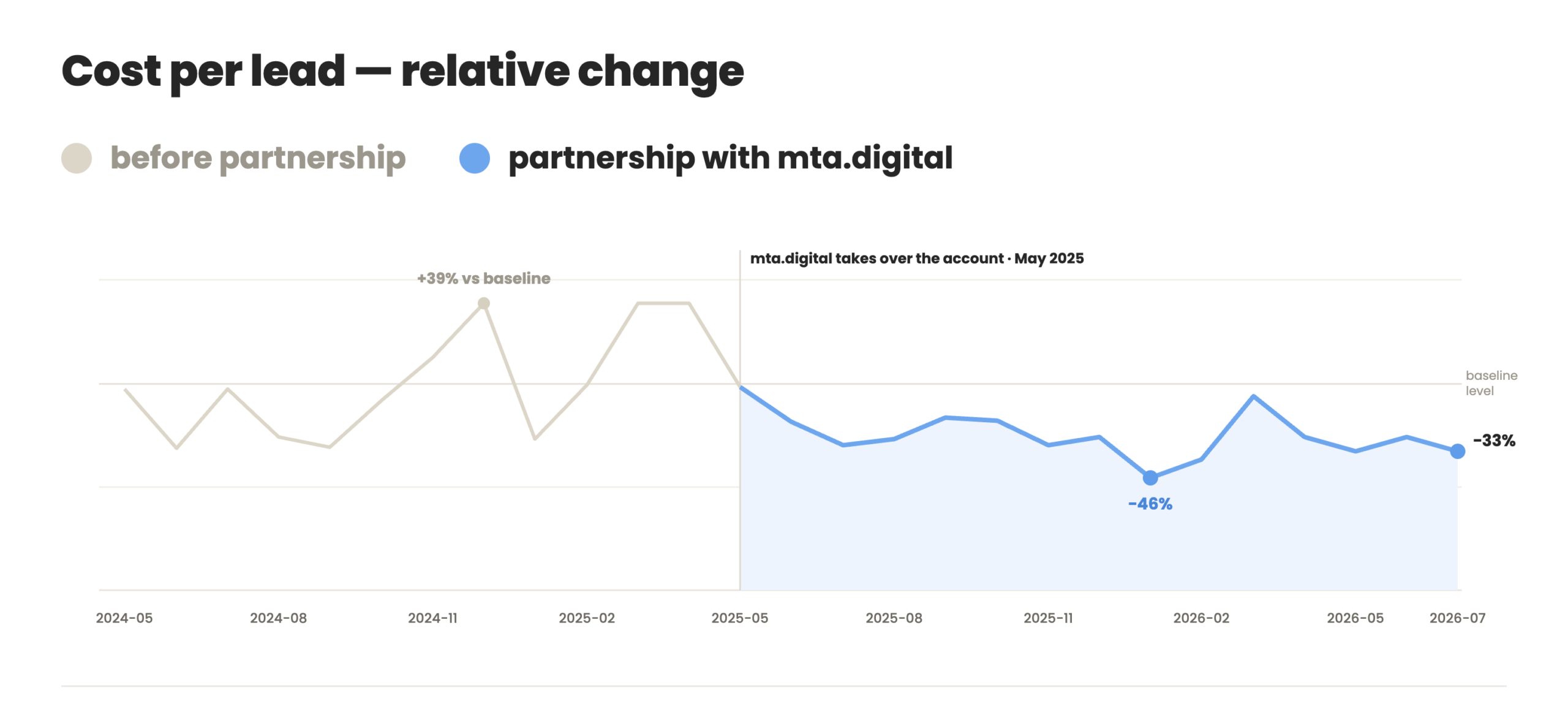
Scaling went hand in hand with the client’s growing trust: the budget we manage in the peak month of the season is now 2.5 times bigger than before the partnership started — while the cost per lead has dropped by nearly a third.
Results
We analyze results in enrollment cycles and always on a like-for-like basis: Meta Ads vs Meta Ads, season vs the same season a year earlier.
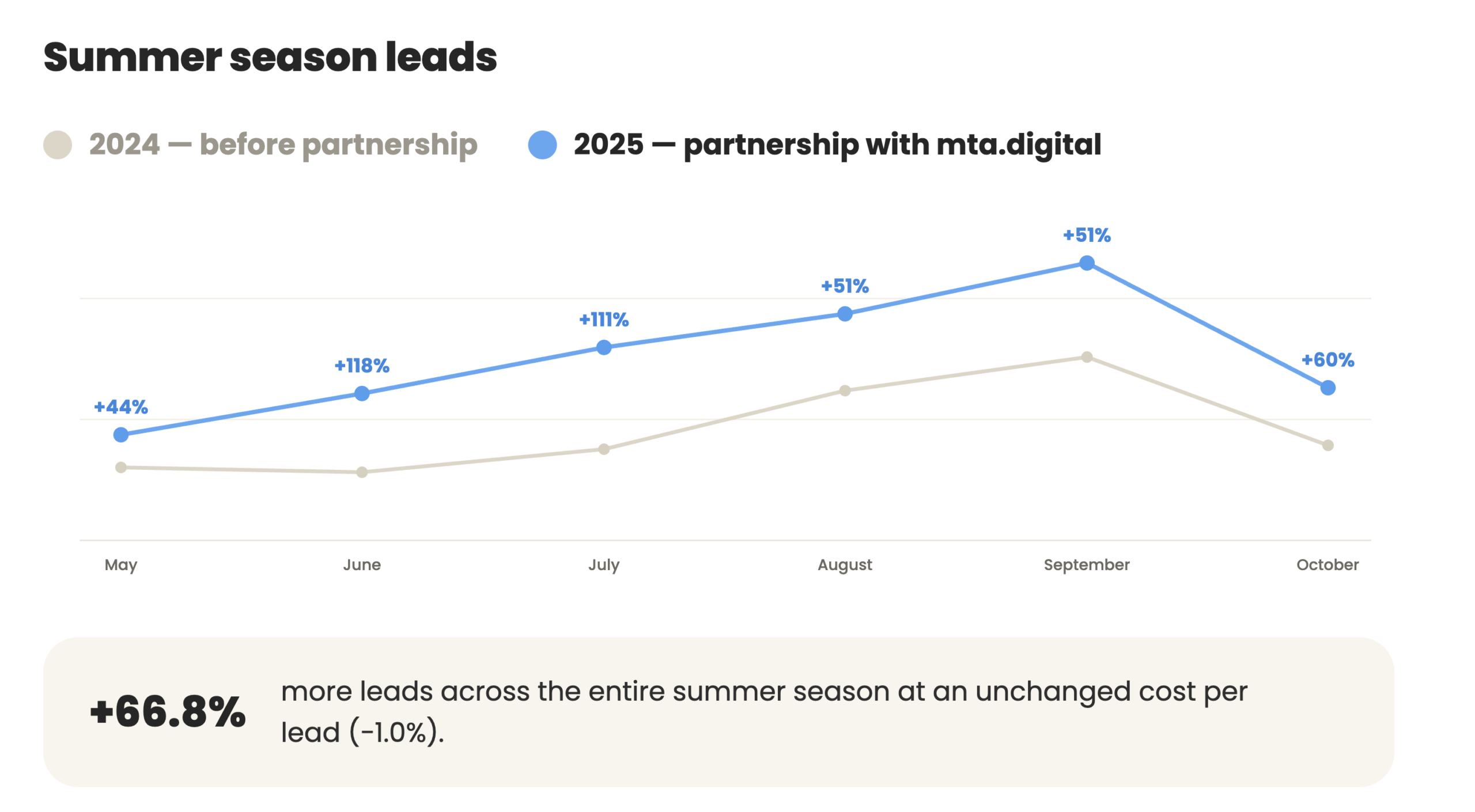
Summer enrollment: May–October 2025 vs May–October 2024
This was our first enrollment season on the newly taken-over account — and the first test of whether the new structure could handle scaling.
The key observation: we increased the budget by 65% and kept the cost per lead at the same level. In practice, this means the account scaled linearly — a rarity with such a jump in spend, especially in the season of highest market pressure. The number of leads grew exactly in proportion to the budget, even though the first weeks of the season were consumed by restructuring and the learning phase of the new campaigns.
Winter enrollment: November 2025–March 2026 vs November 2024–March 2025
The second enrollment season showed the full effect of the changes introduced in the summer — this time the season started on an already well-organized account.
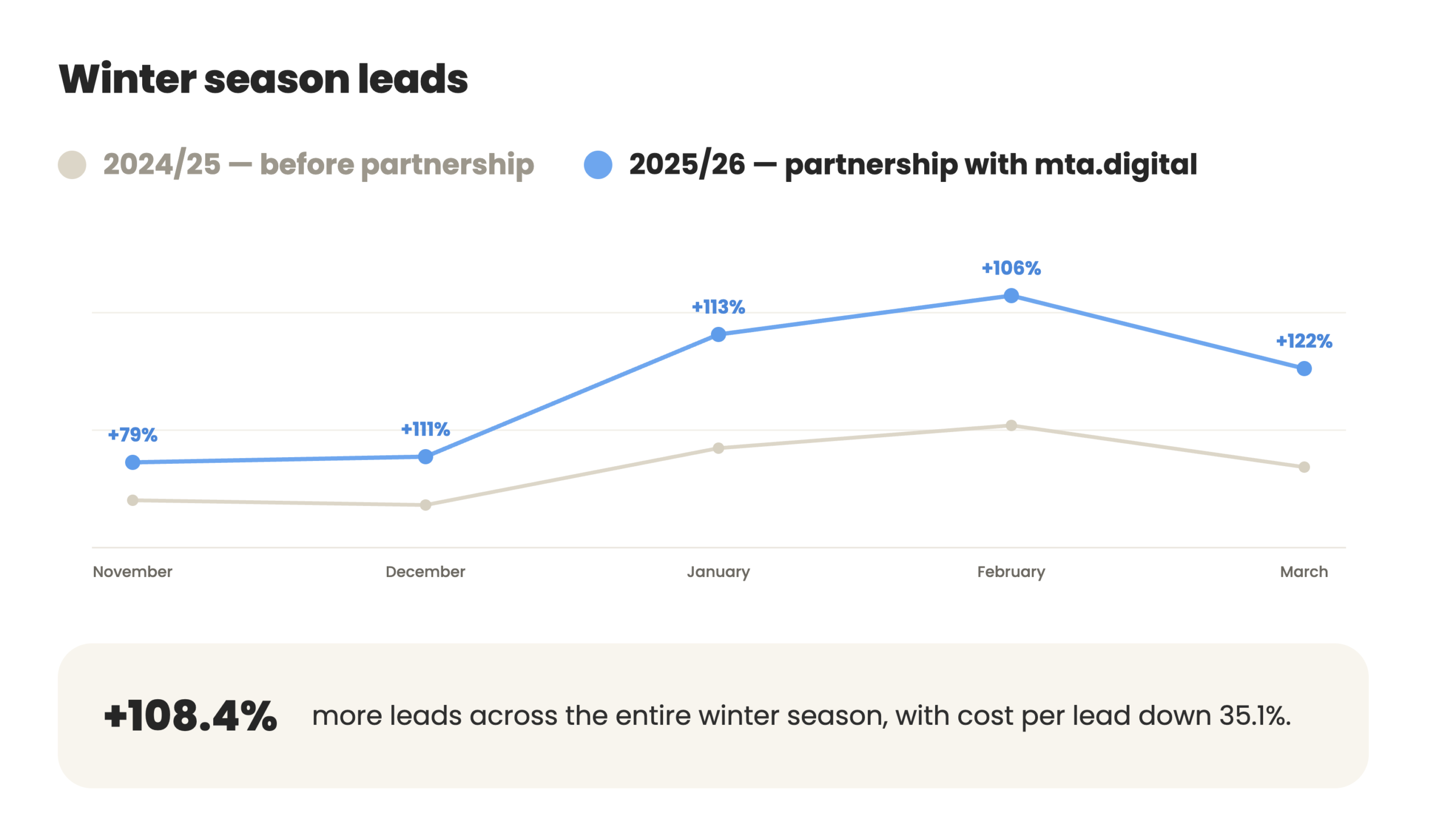
More than twice as many leads with a budget only a third higher and a CPL lower by over 35%. The account restructuring, unified analytics and the lead database built during the summer enrollment allowed us to enter the winter with campaigns that didn’t have to learn from scratch.
Both enrollment seasons combined: May 2025–March 2026 vs May 2024–March 2025
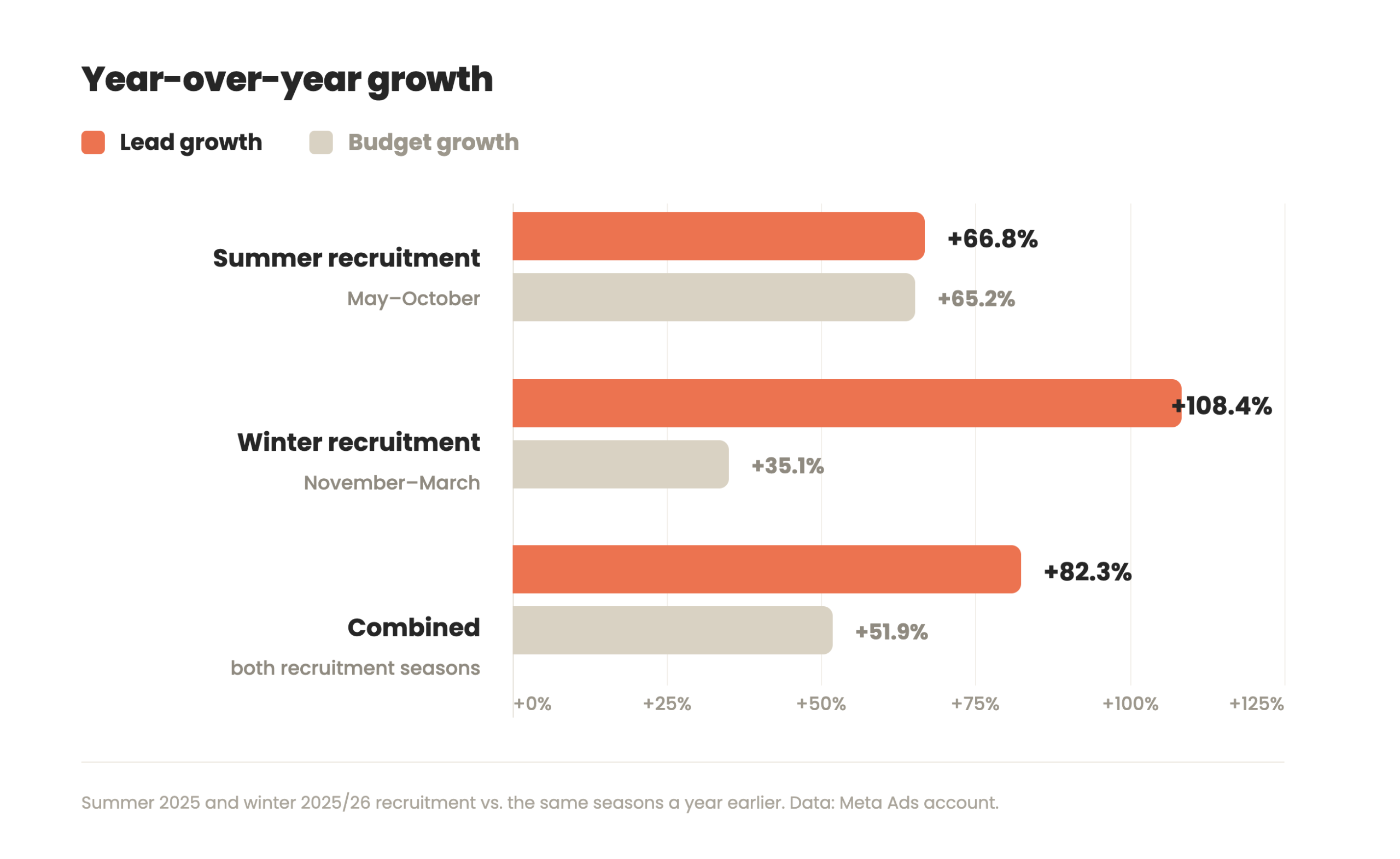
Across two full enrollment seasons: an 82% increase in leads with a 52% budget increase and a 17% drop in CPL. In other words — leads grew faster than spend.
Reach and brand awareness
Over the analyzed period, the campaigns reached 7.97 million unique users and generated over 116 million impressions and nearly 570 thousand clicks. However, we don’t measure campaign success by engagement levels — the goal we set together with the client was, above all, to stabilize spend and increase the number of leads. Reach and engagement have their value: they build brand awareness and feed the lead campaigns further down the funnel. But it’s school sign-ups, not impressions, that decide whether a campaign pays off for the client — and that’s where we look for proof of effectiveness.
What we could have done better
The client’s goals were achieved — but there are things we could have done better, looking back. We’re not hiding them, because it’s precisely the lessons from the first two enrollment seasons that are driving the results of the current one, which is shaping up to be the best in the history of this partnership.
Budget distribution within the season
For the first two enrollment seasons we worked with budgets set monthly on the client’s side — in practice spread relatively evenly. Only in the third season, once we had our own data from two full cycles, could we come in with a concrete recommendation: reduce spend in May and June and move the savings to July and August, the months with the highest sign-up potential.
We didn’t make that recommendation earlier — partly because neither we nor the client were yet confident in the quality of the historical data, which had been prepared in a completely different way. Even though the first enrollment season hit its target and was a success, better monthly allocation could have squeezed even more out of it.
Preparing for the season change
We treated the transitions between the summer and winter enrollment too loosely. Each season has a different demand structure, different flagship programs and different CPL dynamics — and the creative and budget plan for the switchover moment should be prepared in advance, not built on the fly.
No plan B for discontinued programs
During one of the seasons, a program that received a significant share of the budget was withdrawn from the offer. We didn’t have a creative backup ready — five or six tested creatives for alternative programs — so instead of immediately reallocating the budget and testing replacements, we lost several weeks of the season catching up on volume.
Today we maintain a reserve of tested backup creatives for every category, and we treat changes in the client’s offer as part of risk planning, not as a random event.
Summary
The success of the campaigns for Żak translated into real growth in the number of leads and a measurable improvement in cost efficiency. Thanks to a thorough account restructuring, unified analytics, a new approach to creatives and consistent testing, we built a stable, scalable system for generating school and course sign-ups.
Importantly, the effect wasn’t a one-off. The first enrollment season showed that the account can handle scaling without a CPL increase. The second — that the data and structure built back then make it possible to double the lead volume while lowering the cost at the same time. It’s a good illustration of the fact that the results of working with a performance agency are rarely fully visible after a single month; here it took a full enrollment cycle to see the scale of the change.
What’s next
The partnership continues. We’re currently running the third summer enrollment (May–October 2026), and even at this stage we can see it will be one of the best seasons in the account’s history.
We’ll update this case study with a full summary of this enrollment season once it ends — for now, everything indicates that the direction is right and the strategic assumptions are proving correct.