Andromeda in Meta Ads: what it really is and what it changes [2026]
Andromeda in 2026 is a hot topic, but plenty of half-explanations still surround it. That’s exactly why questions like what is Andromeda, how does it work in Meta Ads, does it change targeting, and what does it actually mean for today’s campaigns have become so important for marketers. The thing is, it isn’t a new feature in the Meta Ads panel — it’s part of a bigger shift in how Meta’s ad system works. For advertisers, that means one thing: today, simply “setting up the campaign” matters less and less, and what matters more and more is the quality of the signals you feed the system through your creative, your data, and your overall structure.
What you'll learn about Andromeda in Meta Ads
- what Andromeda is — Meta’s AI engine, and how it fits into the new ad ecosystem alongside GEM, Lattice, and Sequence Learning,
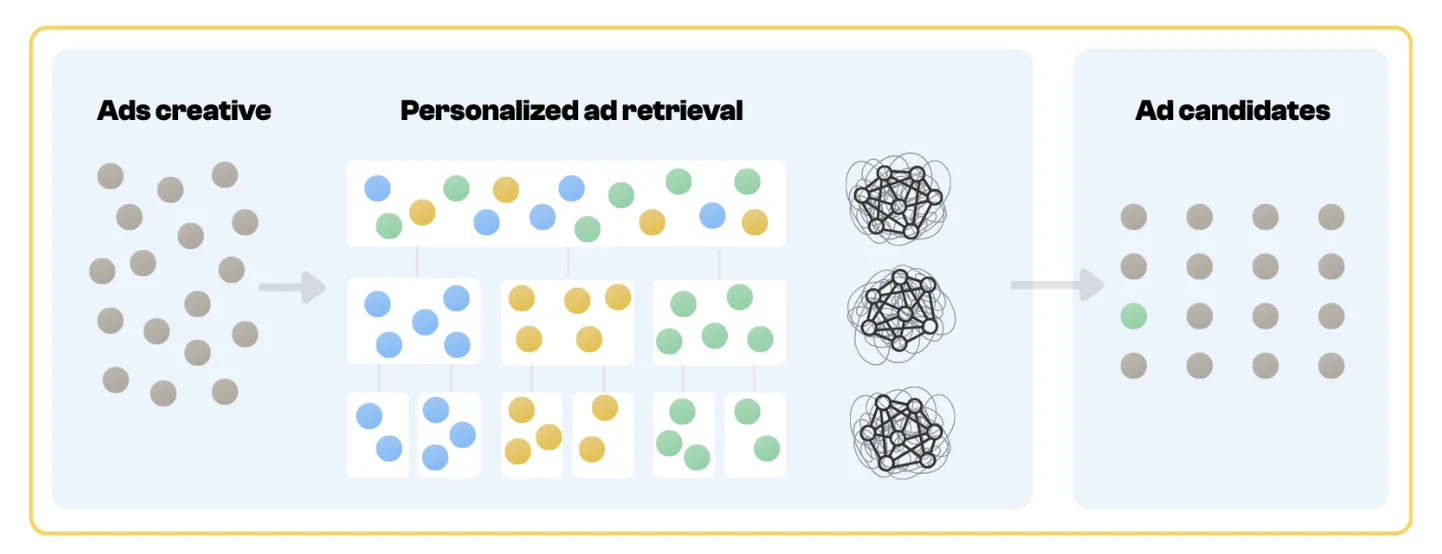
- how ad selection works in Meta Ads — what happens before a creative even reaches the auction,
- why creative is the new targeting, and what that means for campaign structure,
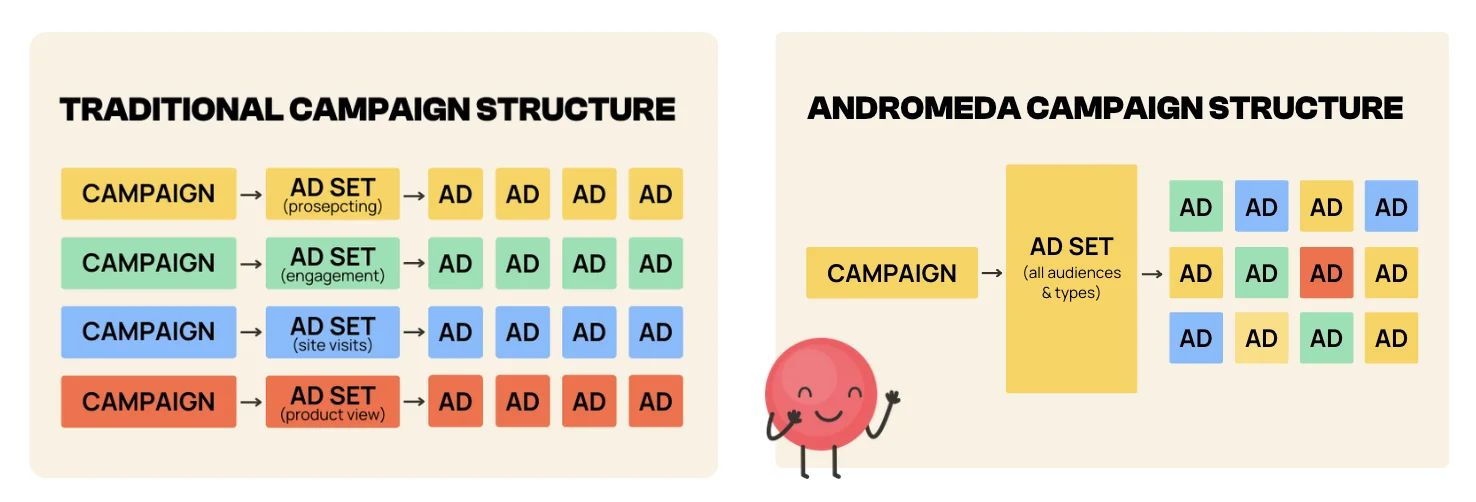
- how Andromeda affects Meta Ads campaign structure — why the algorithm now rewards broader setups,
- how Andromeda recognises duplicated creatives, and what that means for your creative strategy,
- what changes in a marketer’s daily work in the Andromeda era.
Key terms used in this article:
- Andromeda — Meta’s AI engine that filters ads before they enter the auction
- GEM (Generative Ads Recommendation Model) — generates ad variants per user
- Lattice — Meta’s unified ranking architecture
- Sequence Learning — a model that understands sequences of user behaviour
- Creative fatigue — the drop in an ad’s performance as exposure increases
- CAPI (Conversions API) — an interface that sends conversion data directly to Meta, independent of cookies
What Andromeda is — Meta's AI engine, not a panel feature
What is Andromeda in Meta Ads? Andromeda is Meta’s AI engine, launched in 2024, that filters ads in real time before they enter the ad auction. It works together with Lattice (the ranking architecture), Sequence Learning (predicting behavioural sequences), and GEM (Generative Ads Model). Together, they form an integrated AI ecosystem that changes the logic of Meta Ads from the inside — the algorithm gets better and better at identifying the right audiences from the creative and the signals on its own, relying less on manual targeting.
That’s it for the “definition,” but it’s worth stripping all the marketing aura away from Andromeda first. It isn’t a new campaign structure, a new tab, or a setting you can simply switch on in the panel. Andromeda isn’t rewriting the rules overnight. It’s more of a powerful AI engine that works in the background and helps Meta connect data across placements faster, and judge more precisely which ads have the best chance of working for a specific person at a specific moment.
That’s important, because it’s easy to build a narrative around Andromeda as if it were a single breakthrough. In reality, Andromeda, GEM, Lattice, and Sequence Learning are the result of the same evolution — one where algorithms now have more data, more context, and have to act faster, earlier, and more precisely than they did a few years ago.
💡 Andromeda isn’t a “new feature.” It’s part of a bigger AI ecosystem that changes how Meta judges and distributes ads.
How the new Meta Ads AI ecosystem works — Andromeda, GEM, and Lattice
A few years ago, Meta’s algorithms worked in much more isolated silos. Feed had its own “brain,” Instagram Reels learned separately, and the models responsible for clicks and conversions didn’t share insights in real time. That forced people to build more complicated funnels, fragmented campaigns, and to manually decide where and how to spend budget. The system learned more slowly, and information didn’t flow freely between placements and funnel stages.
Today, campaign management in Meta has shifted its centre of gravity. The complexity hasn’t gone away — it’s moved from the panel into the backend, where artificial intelligence does the work. Instead of many separate models, Meta has built a more integrated ecosystem that analyses millions of signals in a fraction of a second and sees the customer journey as one whole.
That’s where Andromeda comes in — not as a standalone curiosity, but as part of the new Meta Ads “brain.”
How Andromeda works inside the Meta Ads system
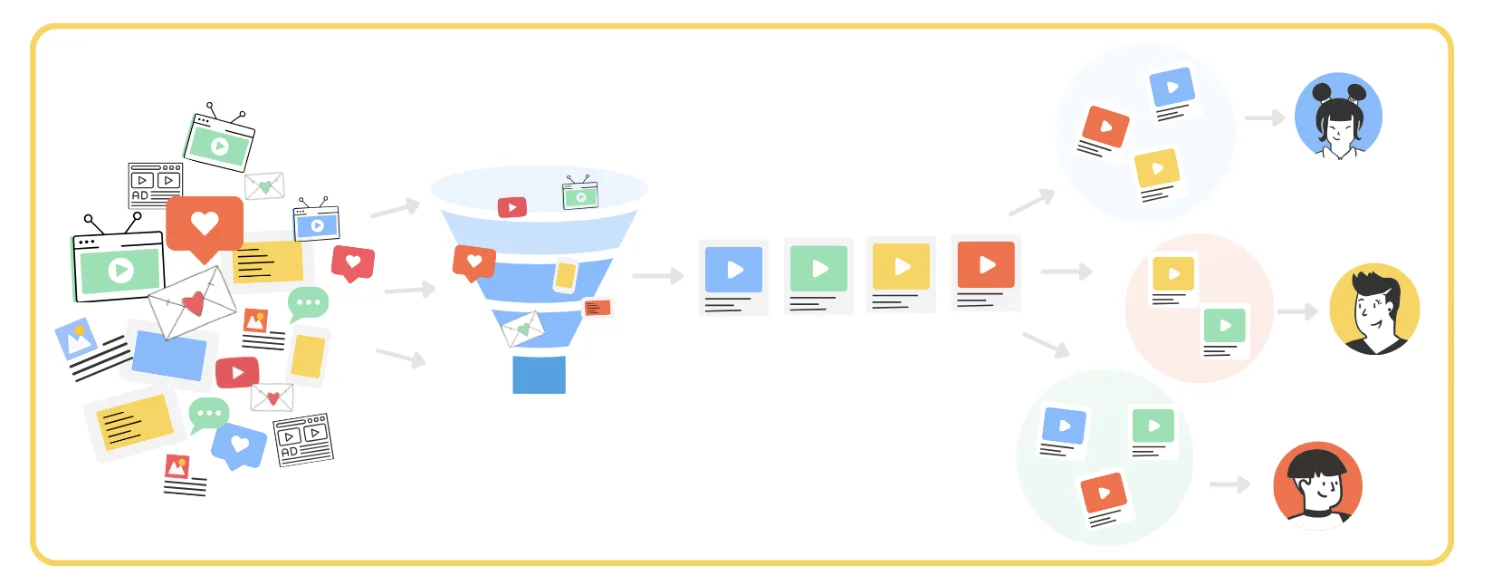
To understand this properly, start with one simple fact: before any creative is ever shown to a user, Meta’s machine has to do an enormous amount of analytical work. In every fraction of a second, there are millions of signals to process. And before the actual auction even starts, the system has to answer one question: which of these creatives is the best signal for this specific person, right now. That’s exactly what Andromeda is built on.
Some people call it the Meta Ads algorithm. More precisely, you could say Andromeda is a “powerful AI supercomputer” that ties the other systems together in real time and shifts targeting from reactive to predictive. The Meta team described the technical details on the Meta Engineering Blog. Put simply: instead of waiting for the user to take a few obvious actions and only then reacting, the system is getting better and better at predicting what their next step might be.
That’s exactly why Andromeda isn’t just a technological add-on. It changes how ads get waved through “to the next round.” And it’s why creative strategy in Meta Ads matters more than ever — that’s what feeds Andromeda the varied, high-quality signals.
What GEM, Lattice, and Sequence Learning are
And here we get to the key part you really shouldn’t skip:
👉 This isn’t a single change. It’s a whole interconnected setup that changes the logic of Meta Ads from the inside. Andromeda isn’t the lone hero of this story. In practice, it works alongside three other pillars of the system.
Lattice — the end of silos
Lattice unified separate models into one powerful ecosystem. As a result, insights from individual ad performance are passed between placements instantly. If an ad converts well in Reels, Feed can use that knowledge straight away. Lattice sees the customer journey as one continuous signal and optimises bids and creatives across the entire funnel in real time.
Sequence Learning — understanding behavioural sequences
Sequence Learning doesn’t judge a user by a single click. It learns the chronology and sequence of actions. It understands that if someone bought a phone and is now looking at cases, the natural next step might be a headphones recommendation. From a campaign perspective, that means less manual splitting into TOFU, MOFU, and BOFU, because the system gets better and better at predicting the next stage of the customer journey on its own.
GEM — the answer to creative fatigue
GEM, or the Generative Ads Model, is a generative engine that can spin thousands of variants out of one base ad on the fly, each one tailored to a specific user. It automatically adapts the format to the placement, changes the copy depending on intent, and dynamically juggles products. As a result, the base creative becomes more flexible and can keep working for longer without quickly burning out.
Together, these systems create an environment where Andromeda ties the data together, Lattice connects learning across placements, Sequence Learning predicts the user’s next steps, and GEM helps deliver better-matched message variants.
| System | What it is | What it does in the pipeline | What it changes for campaigns |
|---|---|---|---|
| 01 Andromeda ad selection engine | Meta’s real-time AI engine that ties the other systems together | Filters ads before they reach the auction — judges millions of signals at once | More weight on creative and signal quality, less weight on manual targeting |
| 02 Lattice unified architecture | A ranking architecture that replaced separate models for each campaign objective | Connects learning across placements — a result from Reels reinforces Feed and vice versa | Faster system learning, the end of silos between formats |
| 03 Sequence Learning sequence modelling | A model that learns the chronology of user actions, not just single events | Predicts the user’s next step based on the sequence of earlier behaviour | Predictive targeting instead of reactive, less manual path-mapping |
| 04 GEM Generative Ads Model | A generative engine that creates thousands of ad variants from one base ad on the fly | Adapts format, copy, and visual accents to a specific user and placement | A real answer to creative fatigue — personalisation at the system level, not by hand |
What Andromeda changes in Meta Ads campaign structure
The most important change is that Meta sees the world less and less in spreadsheets, and more and more in signals. If you drop a photo of a burger into a campaign, the algorithm doesn’t only wait for a manually set “food” interest. It scans the creative, recognises what’s in the image, and — based on millions of previous reactions — predicts who that specific view could stop in the feed right now.
The same applies to other categories. If you sell acupressure mats, you don’t have to build the whole strategy purely on manual interest selection like “yoga” or “healthy spine.” You can give the system two different ads: one showing relaxation in the bedroom, the other focused on back pain after a day at the office. Andromeda will separate these worlds on its own, because the two messages carry different signals and answer different user needs.
The conclusion? Creative is the new targeting. Not because campaign settings have stopped existing, but because in broad targeting, it’s the ad itself that helps the system answer: “who is this for?”
The change Andromeda introduces fits into a broader trend: the campaign setup itself is no longer the source of advantage. More on what this means in practice →
Why Meta rewards broader structures today
Because the connected algorithm learns better when it has more space to operate. Andromeda works like an aggregation engine that forces a simpler framework “to the next round.” Instead of analysing Feed and Reels separately and relying on manual targeting, Meta shifts the weight onto creative strategy. First, a multi-layered analysis of the visual message; only after that, ranking and distribution. The result is that winning auctions today requires completely different inputs, and the connected algorithm rewards the broadest structures.
It doesn’t mean you have to turn the account upside down. But it does mean that overly fragmented campaigns are getting in the way more often than they’re helping. Tight frames and derivative graphics simply drop out earlier, before the game has really started.
What does it change in a marketer's daily work
A great deal — and not just for media buyers. In the Andromeda era, Ads Manager becomes technically simpler, but more demanding strategically. Instead of spending hours clicking through audience groups and testing dozens of ad sets, more and more time is worth spending on the questions:
- what are you actually saying to the customer,
- how do you stop them in the first second,
- do your ads genuinely differ from one another,
- is the algorithm getting material it can really “play with.”
Creative stops being a campaign decoration. It becomes one of the main tools for steering where the campaign ultimately “lands.” For creative teams, that means more responsibility, but also more influence. For media buyers — much closer collaboration with creative is now essential.
Why Andromeda recognises duplicated creatives and limits their reach
This is another important thing that nicely illustrates the logic of the new system.
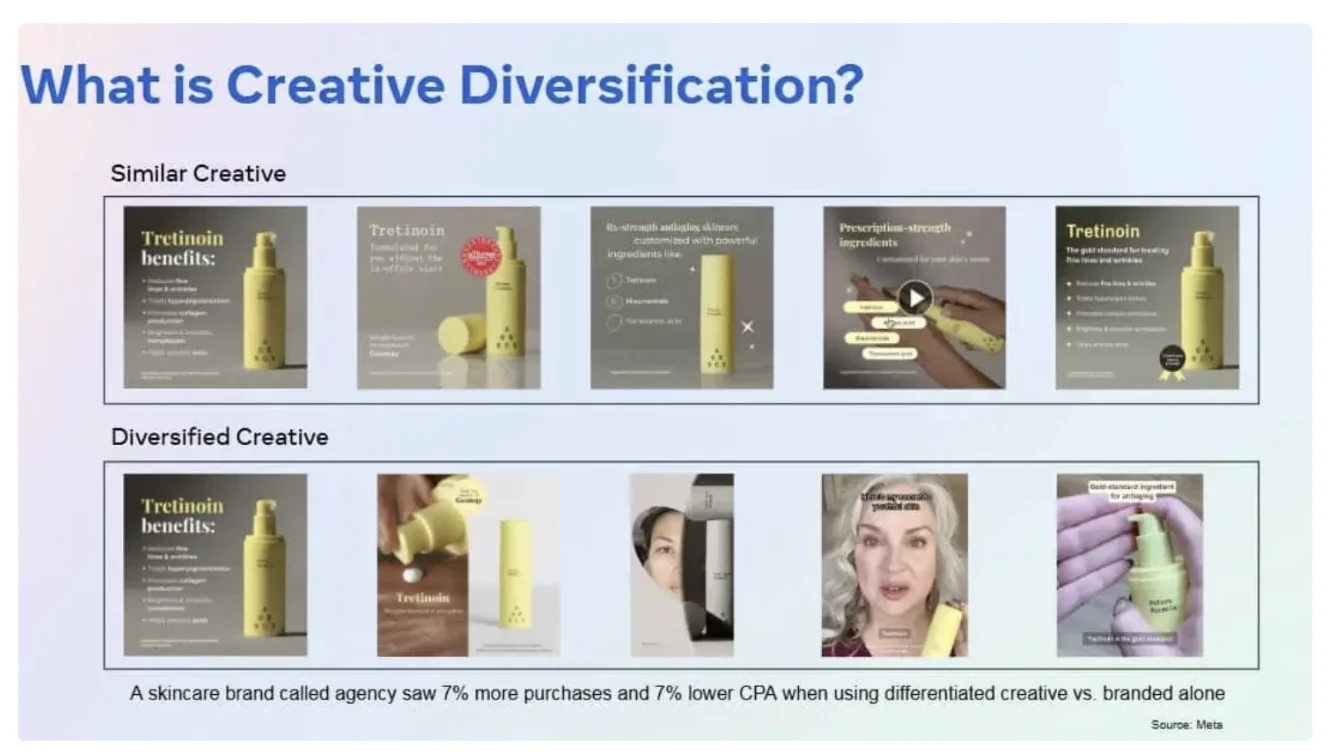
It’s very easy to assume that if you change the colour of a headline on a graphic, or slightly shift the layout around, you’ve got a new ad. In reality, the system can recognise these materials as a duplicated visual signal and treat them very similarly in the auction, throttling delivery. If you want to reach a new group of people, you have to give the algorithm something it hasn’t seen before: a different camera angle, a different protagonist, a different background, a different concept. It isn’t about producing more assets — it’s about delivering genuinely different signals.
Andromeda isn’t a new feature in the Meta Ads panel. It’s part of a bigger, connected AI ecosystem in which — together with Lattice, GEM, and Sequence Learning — it changes how ads are judged, connected, and distributed. The complexity hasn’t gone away — it’s moved from Ads Manager into the backend. And that means that today, manual campaign-steering matters less and less, while the quality of the data, creative, structure, and strategy you feed into the system matters more and more.
For marketers, that’s a very specific shift:
- less “system hacking,”
- less fragmented structures,
- more work on signals,
- a bigger role for creative,
- a bigger role for strategy,
- and greater importance of the creative + performance collaboration.
Because in the end, the conversation about Andromeda isn’t a conversation about one technology name. It’s a conversation about how Meta Ads (Facebook Ads) really works today — and why the winners aren’t the ones who click through the panel best, but the ones who understand best what kind of fuel they’re feeding the system.
About the author
Adrianna Roszak — a Meta Ads and TikTok Ads specialist with experience working with e-commerce brands. She builds ad campaigns that combine a technical approach to ads with a creative strategy grounded in testing and data. In her work, she focuses on making creative that responds to the real needs of audiences and works well with the algorithms of advertising platforms. She helps brands build effective, scalable advertising systems instead of one-off, random campaigns. Find her on LinkedIn.
See other articles


How to start selling on TikTok Shop – step by step