Mężczyzna w okularach w czarnej oprawce i szarej marynarce w kratę, uśmiecha się na żółtym tle.
Blazej Cybowski
Digital Marketing Strategist
10 min
TikTok

TikTok Shop for e-commerce: how to enter smartly — and not end up underwater

TikTok Shop is now live in a lot of markets — mature and crowded in some, brand-new in others — and every so often e-commerce gets a channel everyone suddenly talks about. The pattern repeats: first curiosity, then a gold rush, then the quiet realisation that the winners weren’t the loudest entrants but the ones who entered with a plan.

TikTok Shop has a twist, though — it isn’t just another shelf you put a product on. It fuses marketplace, social, affiliate, live commerce and discovery commerce into one, which is exactly why the most common mistake is treating it like a plain product-feed export. A bit like renting a shop on a busy street and forgetting to open the door.

One thing before we go further, because the whole guide rests on it: this isn’t rewritten from press releases. We’ve run TikTok Shop ourselves, including on the mature US market, so a lot of what follows we’ve tested rather than read in an announcement — and on TikTok Shop, announcements and reality often tell two different stories. Details also differ from country to country, so treat the specifics below as a map, not a fixed timetable.

What you'll learn from this article

  • what TikTok Shop really is, and how it differs from a classic marketplace,
  • who the channel makes sense for, and who’ll find it an uphill battle,
  • what logistics and payments look like in practice — without the marketing gloss,
  • what it really costs, and how to unlock a lower commission,
  • what the 100-product limit means for larger stores,
  • where the real sales leverage sits: live and affiliate,
  • and whether it’s worth entering right away.


TikTok Shop at a glance:

TikTok Shop is a selling feature built into the TikTok app — users buy without leaving the feed. It’s not another marketplace, it’s a content-first channel: selling starts with content, not with a search box. The commission depends on the market: 9% in the UK and EU, 6% in the US, new sellers start with a 100-product limit, and the biggest levers are live shopping and creator affiliate. The potential is large, but the ones who win are the ones who come prepared.

What is TikTok Shop? It's discovery commerce, not another marketplace

To understand this channel, you have to start with one shift that turns conventional thinking about selling on its head. In classic e-commerce the user starts with a need: they have a problem, they type a phrase into Google, compare offers, land on a shop. The order is always the same — need first, then product.

On TikTok Shop that order reverses. The user usually starts with content. They watch a video, curiosity kicks in, they tap the tagged product and buy — all without leaving the app. They aren’t searching for the product. They’re discovering it. The product can appear in a video, on a LIVE stream, on a brand’s profile, in the Shop tab or in recommendations — and every time it’s content that pulls the trigger, not the search box.

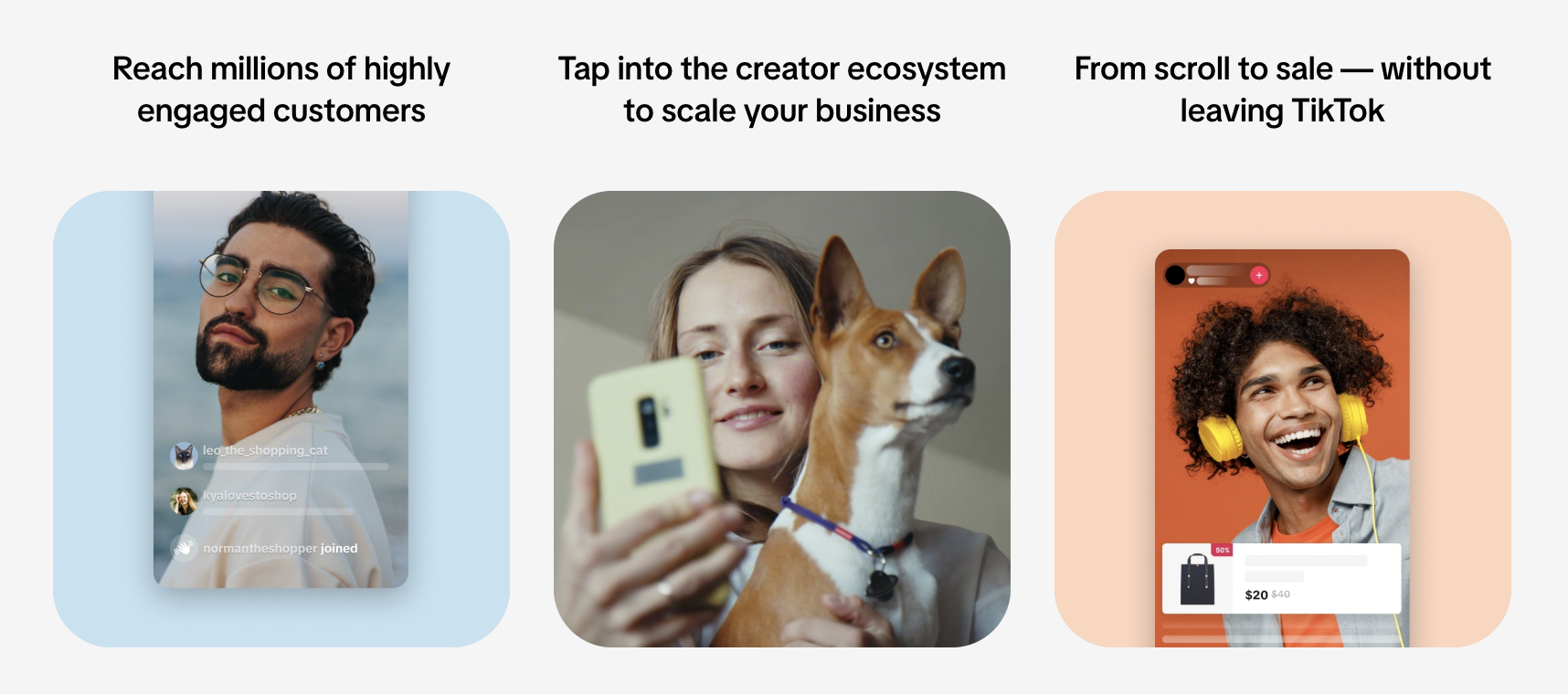
TikTok Shop sales formats in three panels: LIVE shopping, the creator ecosystem, and shoppable video with in-app checkout.
source: tiktok


That’s why TikTok Shop is so strong in the discovery-commerce model — selling driven by discovery, emotion, entertainment and recommendation. It isn’t a catalogue someone opens with a fixed intention. It’s a channel where the product has to be shown in context: how it works, who it helps, how it looks in use, and what story you can tell around it. Whoever understands this has an edge. Whoever treats TikTok Shop like another display shelf usually ends up disappointed.


💡 The simplest test: if your product can be understood in a few seconds of video — TikTok Shop is for you. If it needs 20 minutes of reading the spec sheet, it’ll be harder.


Who TikTok Shop makes sense for — and who it doesn't

Not every business will make money here — and that’s fine, because no channel is for everyone. The categories that do best are easy to show in a short video, where the purchase can be triggered by an impulse or a recommendation. Rather than deal in generalities, let’s look at the concrete criteria that decide whether your offer fits the channel:

CriterionWorks well when…Uphill battle when…
Gross marginhigh (private label, D2C, bundles)low, hard to defend
Presentation in videoproduct understood in a few secondsneeds a long, technical demo
Decision processimpulse buy, on a recommendationlong and analytical
Categorybeauty, fashion, accessories, gadgets, petheavily regulated, no ready documentation
Catalogue sizenarrow SKU selectionhundreds of SKUs (the 100 limit starts to hurt)
Price and availability controlfulllimited
Who TikTok Shop makes sense for — criteria for matching your offer to the channel

The second-to-last row matters more than it looks — we’ll come back to it at the 100-product limit. And if your offer falls mostly into the right-hand column, don’t write it off straight away: sometimes it’s enough to pick a few items from the catalogue that do fit TikTok Shop, and start with those.


Payments and logistics — how it really works

Here you have to separate two things, because platform messaging likes to treat them together, while practice has its own opinion on the matter.

  • Payments work as they should. Proceeds from sales go straight to the linked bank account — no workarounds.
  • Logistics looks a little different from what the announcements suggest, and this is where markets diverge the most. In some countries there are partnered carriers, or even Fulfilment by TikTok; in others, the “official partner” trumpeted in the press doesn’t yet translate into a real, one-click integration. Where that native integration is missing, the seller enters tracking numbers manually in the order status. Those statuses are then passed back to the platform, so the buyer still sees the parcel and can track it — but the automation many people expect simply isn’t there yet.


⚠️ This is a good moment to remember one rule: platform announcements can be optimistic, so plan your operations around what actually exists, not around the press release. It’s not a reason to worry — it’s just worth knowing where you stand. And because integrations roll out market by market, always check what’s actually live where you sell.


What does it really cost? A 9% commission — and how to go lower

The standard commission depends on your market: 9% in the UK and EU markets, 6% in the US (where it also covers payment processing). For profitability calculations, take the rate for your market – and if you sell in several, the highest one – as your starting point.

The lower rates — 2% and 4% — that have been circulating are entirely real. You don’t get them automatically from a welcome email, though: they’re unlocked through a gamification system in the panel. TikTok sets tasks for the account, and completing them lowers the commission and opens up further promotions available to that account. In practice, 4% requires adding a certain number of products to the catalogue, and 2% requires uploading products and running the shop across several markets. So it’s worth digging into that part of the platform and ticking off tasks, because it’s real money to recover.

Even so, when calculating profitability it’s safer to start from 9% and treat the lower rates as a target to unlock, not an assumption to bank on — especially as some promotions are time-limited.

On top of that comes a line item that’s easiest to miss: default promotions on the account. At the start there can be a “free shipping” offer switched on — except “free” here means “paid for by the seller”. Once you add up the commission and the shipping top-up, a low-margin seller can end up “underwater”, even if sales look like they’re growing on paper. It sounds alarming, but it’s disarmed in a few clicks.


👉 Check the promotion settings on your account before you list your first product. It’s one of the most common causes of thin margins at launch — and one of the easiest to avoid.


The full calculation — platform commission, creator commission, discounts, logistics, returns — we break down in a separate piece: TikTok Shop commission and costs — what really stays in your pocket.

The 100-product limit and tiers — what it means for larger stores

New sellers start with a 100-product limit and a daily order cap (at the lowest tier that’s around 20 orders a day). You unlock higher tiers by building your shop’s rating and credibility: on-time delivery, service quality, reviews. It’s gamification baked into the platform — the better you perform, the more you can do.

For a small shop with a dozen or so SKUs the barrier to entry is genuinely low — a business like that can be up and running in no time. For a larger e-commerce operation the limit means two things: a lower average basket value, and the need to communicate clearly that this isn’t the full range. It’s not an insurmountable flaw — it’s more of an invitation to do what’s worth doing anyway: choosing your best products instead of dumping the whole catalogue in one go.

Questions of integration with your store platform, ERP or order manager, the lack of an official plugin, and stock synchronisation we take apart here: TikTok Shop integration with e-commerce and the 100-product limit.

How to get started — the short version

We describe the full step-by-step process separately, but the skeleton looks like this:

  1. Verify your business. You need a registered business and consistent details — company registration number, tax ID, legal representative, bank account, warehouse and return addresses. The data is validated, and discrepancies delay verification. The exact documents required depend on your country.
  2. Set up an account in TikTok Seller Center and choose your selling market.
  3. Prepare your products — correct category, brand (note: brand is a required field in the feed), description, photos, price, stock, and in some categories additional documents. What exactly has to go into a listing, and where offers most often trip up, we break down in the piece on the TikTok Shop product listing and categories.
  4. Configure logistics and order handling before anything sells.


⚠️ Cross-border selling has a catch. Registering for a given market usually means a local entity and local tax registration in that country — you can’t register for a market “the quick way” from abroad. The natural path is to register in your home country and run separate listings per market (different names, descriptions, often a different assortment). In the EU, TikTok’s newer “Sell Across Europe” feature is starting to let sellers reach several EU markets from a single registration — but availability varies, so check what applies to you.


The details — registration, verification, the foreign-entity case — are in the piece: How to start selling on TikTok Shop step by step.

Where the real leverage is: live and affiliate

Here we get to the heart of it, the part that’s easy to forget in the euphoria of setting up an account. Configuring the shop and listing products is only half the journey — and the easier half. Real results are driven by two things.

  • Live commerce. TikTok clearly rewards streams featuring products — you can see a genuine lift in reach for both organic content and lives. The platform wants this part of the business to grow, so it rewards it with visibility. For smaller creators, live can even be the main source of traffic, brand awareness and direct sales. We expand on this in: Live commerce on TikTok Shop.
  • Creator affiliate. Through the TikTok Shop affiliate programme you make products available to creators who promote them for a commission on sales — and TikTok users often trust a creator’s recommendation more than a classic ad. It’s especially powerful for impulse products with a healthy margin: beauty, apparel, accessories. How to set it up and how much to offer creators — in: Creator affiliate on TikTok Shop.


Should you jump into TikTok Shop right away?

In most cases, yes — but not with your whole catalogue and not with a big launch budget. The best approach is a fast, controlled test.

How urgent “fast” is depends on your market, though. If you’re in a country that only just opened, the early-adopter window is real: lower competition in many categories, creators actively hunting for products to promote, and a platform pushing hard to grow a new ecosystem. That window is noticeably tighter a year later. In a mature market like the UK or the US it’s the opposite — the early bonus is gone and the game is optimisation, not novelty. Either way, launching without stock, descriptions, margins and customer service in place brings more problems than benefits, so “fast” never means “gung-ho”.

From our experience — on the mature US market and on newer ones alike — the conclusion is the same: start fast, but smart. Pick 10–30 products with the best potential, work out profitability at the full commission for your market (9% in the UK/EU, 6% in the US), prepare complete listings, set up your stock integration, and only then scale what actually sells at a positive margin. It isn’t complicated. It just requires preparation to run ahead of excitement.


TikTok Shop is a separate sales-and-content channel, not another product-feed export. Treat it seriously and it repays you with real growth — not just a pretty GMV chart.

FAQ

Where is TikTok Shop available? In a growing number of markets. It’s mature in the UK and the US, with a wave of European markets opening through 2025–2026 and further expansion elsewhere. Availability and individual features roll out market by market, so it’s worth checking what’s live where you plan to sell — and, in newly opened markets, treating the start as a controlled test to enter early.

How much is the commission on TikTok Shop? It depends on the market: 9% in the UK and EU, 6% in the US (5% for some jewellery categories). Lower promotional rates for new sellers are real, but time-limited – for margin calculations it’s safer to assume the standard rate for your market.

Is TikTok Shop integrated with couriers? It depends on the market. Some have partnered carriers or even Fulfilment by TikTok; in others there’s no direct, automatic integration yet despite earlier announcements, and tracking numbers are entered manually, with statuses passed back to the platform.

How many products can you list at the start? New sellers start with a 100-product limit and a daily order cap (around 20 at the lowest tier). The limits grow with the shop’s rating and credibility.

Can a foreign company sell on TikTok Shop in another market? Registering for a given market usually requires a local entity and local tax registration. A foreign company typically registers in its home country and runs a separate listing per market. In the EU, the “Sell Across Europe” feature is beginning to ease this — check current availability.

Which products does TikTok Shop work best for? Impulse, visual products that are easy to show in a short video — beauty, fashion, accessories, gadgets, “before and after” products — with a healthy gross margin.

Is it enough to list products in order to sell? No. Configuring the shop is half the journey. Real results are driven by content, live and creator affiliate.

About the author

Błażej Cybowski – A marketing strategist specialising in growing large e-commerce brands and scaling sales. Day to day he works with ad accounts across many international markets, combining marketing strategy with business analysis and customer experience. He also runs his own online store, which gives him a solid understanding of e-commerce challenges from an entrepreneur’s perspective. He’s passionate about new technologies, AI and the practical use of innovation in marketing. Find him on LinkedIn.

Table of contents

See other articles

Illustration of a seller registering a TikTok Shop account step by step
TikTok

How to start selling on TikTok Shop – step by step

There's a moment in the life of every new sales channel when everyone's talking about it, nobody really knows it yet, and you have an irresistible urge to just register and see what comes of it. TikTok Shop is in exactly that moment. And honestly? The urge is well founded: the channel has potential, the barrier to entry can be surprisingly low, and the first well-prepared sellers gain a real edge while the competition is still deliberating.
Black-and-white illustration of a smartphone showing a balance of USD 79,541, with a piggy bank, scattered banknotes and falling dollar coins — a symbol of turnover versus what really remains after costs on TikTok Shop.
TikTok

TikTok Shop commission and costs – what really stays in your pocket?

There's a number that tempts you with its simplicity: selling price minus product cost. You type two values into a spreadsheet, out comes a lovely margin, and for a moment the world feels tidy. The trouble is that on TikTok Shop this formula has more characters than you'd expect – and several of them write themselves into the script without warning.
Black-and-white illustration representing connecting TikTok Shop with an online store.
TikTok

TikTok Shop integration with e-commerce – WooCommerce, the feed and the 100-product limit

There's a promise everyone hears when they connect a new sales channel: "one click and everything syncs itself." It sounds lovely on a slide. In practice, with TikTok Shop, it's a touch more… manual.There's no single magic button that does everything for you, but that doesn't mean you're doomed to key in every product by hand until the end of time. You just need to know the available options and consciously pick the one that fits the scale of your store.

It’s time for your brand.
Click and let’s start growing together.