Creative strategy in Meta Ads: a step-by-step process [2026]
Creative strategy in Meta Ads is now one of the most important foundations of an effective ad campaign. In a world of AI, Andromeda, and algorithms that judge ads faster and faster, simply producing graphics and video is no longer enough. For Meta Ads campaigns to be scalable, optimisable, and genuinely able to grow, you need a process: from research and hypotheses, through the brief and creative tests, all the way to insights and iteration. Today, creative strategy isn’t an add-on to performance marketing — it’s the element that organises your messaging, gives each creative a role, and feeds the algorithms the quality signals they need to act on.
What you'll learn about creative strategy in Meta Ads
- what creative strategy really is, and why it isn’t just about “ideas for ads”,
- why producing assets alone isn’t enough if there’s no process behind it,
- what a sensible way of working looks like: from research and hypotheses, through the brief, production, and tests, to insights and iteration,
- why creative strategy matters even more today in an environment of AI and systems like Andromeda,
- how to connect creative work with performance instead of treating them as two separate worlds,
- and why scaling a campaign starts not with the graphic, but with a good question: what exactly are we testing, and why.
What is creative strategy in Meta Ads?
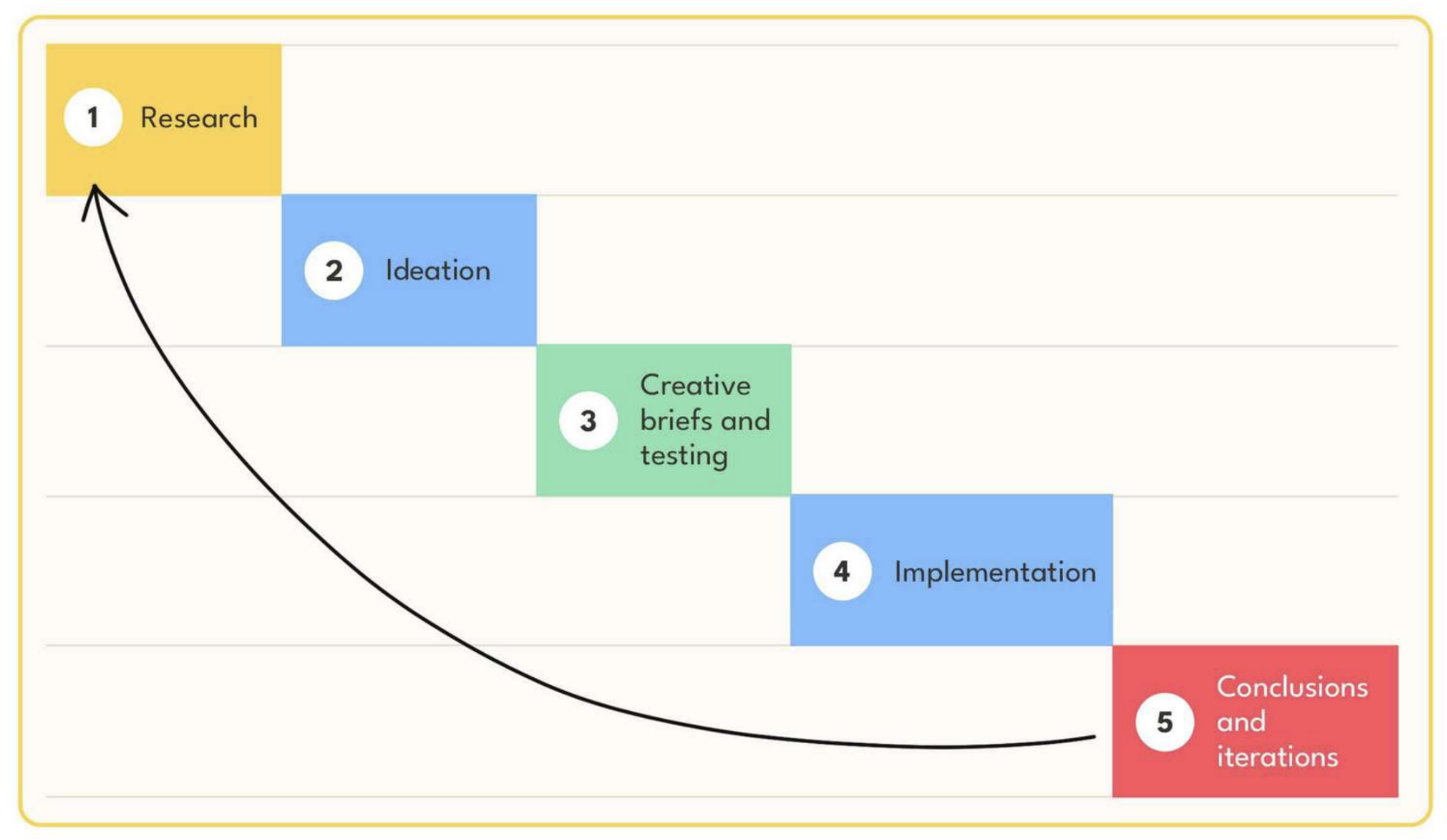
It’s a repeatable process for designing ad campaigns, built on six stages: research → concept → brief → production → test → iteration. Its goal is to feed Meta’s algorithms (Andromeda, GEM, Lattice) varied, high-quality signals through your creative — instead of producing assets at random. Creative strategy organises your messaging, gives each creative a role, and makes campaign results predictable and scalable.
Creative strategy in Social Ads — the foundation of a campaign, not an add-on to production
You can have a capable team, produce graphics and video regularly, test new formats — and still not know why your campaign results sometimes deliver and sometimes fall flat completely. Usually this isn’t a problem of “too few creatives.” The problem starts earlier — when creative work isn’t embedded in a process. Today, in a world of Meta Ads, Andromeda, and algorithms that filter messages faster and faster, creative strategy isn’t an add-on to the campaign. It’s its foundation.
This is probably the most important starting point.
Producing assets isn't creative strategy — where's the difference
In many companies it looks much the same: a promotion is coming up, a new campaign is launching, so creatives need to be prepared. The questions come up: how many assets to make, what should be on the graphics, what headline to use, whether we’ll need video. The problem is that if, at this stage, you don’t have data, hypotheses, context, and a testing plan, you’re not really designing a campaign. You’re simply producing materials.
And that’s not the same thing. Which is exactly why you can have a great team, plenty of ideas, and smooth production, and still operate in an unstable environment. One time “something lands,” the next it doesn’t. One campaign delivers, and with the next you’re starting from scratch again, with no answer to the question of what actually worked and why.
💡 Creative strategy doesn’t start with the question “what graphic do we make?” It starts with: who are we talking to, what are we communicating, and why this in particular?
Creative strategy as a process: research, brief, tests, iteration
Put simply, creative strategy is a process that organises creative work so it isn’t done blindly. It’s not about one “big idea” or an aesthetic vision for the campaign. It’s about a system of work in which individual graphics, videos, or UGC stop being separate entities and become part of a bigger whole.
A well-designed creative strategy:
- gives each creative a role,
- organises your messaging,
- forms hypotheses,
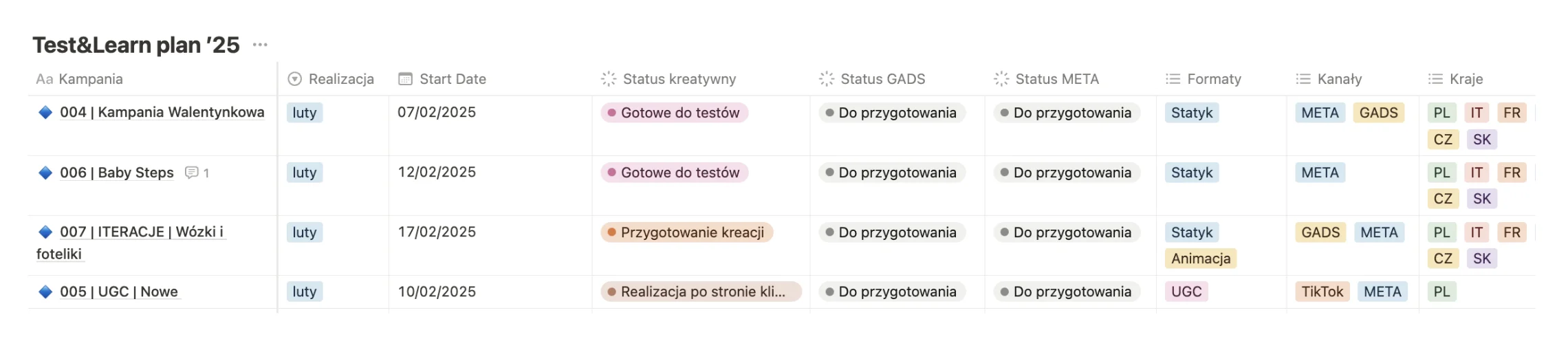
- designs tests,
- and provides a reference point for later analysis.
This matters, because without it creatives very easily become a random collection of assets that are hard to compare, judge, and scale afterwards. And then even good results can be hard to repeat.
Creative strategy in the era of Andromeda, GEM, and Meta Ads algorithms
Because the environment in which campaigns are distributed has changed.
In a world of Meta Ads and systems like Andromeda or GEM, the platform judges whether an ad makes sense faster and filters messages earlier. Before a creative even reaches a user, the system analyses an enormous number of signals and tries to answer the question of which ad will be the best signal for a specific person at a specific moment.
This means it’s no longer enough to “have lots of ads.” You need ads that communicate something clearly, genuinely differ from one another, and were designed with a specific role in the campaign. That’s exactly why creative strategy is no longer an add-on for the more organised teams. It becomes a precondition for working sensibly with the algorithm.
It’s also worth understanding why simply setting up a campaign is no longer enough, because in practice all these threads lead to one conclusion: if the system takes over more and more operational decisions, then on the human side, the importance of strategy, signal quality, and a sensible process grows.
💡 The more decisions the system takes over, the more important it becomes what signals you feed it in the creative.
Without creative strategy, good Social Ads creatives are down to chance
This is the point where many teams run out of breath.
Because from the outside everything can look fine: there are banners, there are videos, there are new concepts, there are tests, things are happening. It’s just that without creative strategy, this activity very easily becomes a series of random decisions. There’s no single reference point. There’s no shared logic. There’s no answer to the question of why we’re testing this direction rather than another.
Strategy isn’t about guessing which idea will be best. Its job is to form hypotheses, organise the messaging, and design tests so that the resulting data means something. Only then can you reach the answers to three genuinely important questions: what works, why it works, and how to scale it further.
Without that layer, it’s very easy to:
- burn through budget,
- repeat the same mistakes,
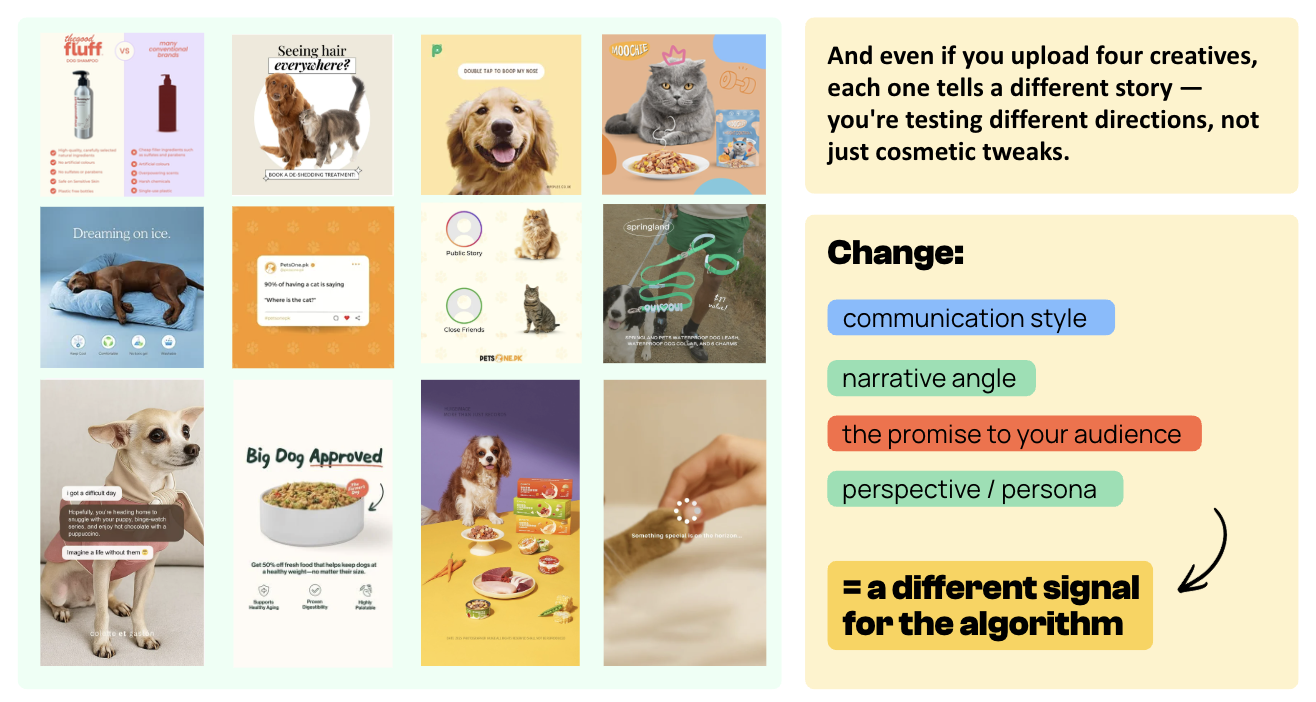
- mistake cosmetic changes for a real test,
- and start every campaign from scratch.
⚠️ When you don’t have a process, every new campaign looks like a fresh start. And then it’s hard to talk about stability, learning, or scaling.
The creative strategy process step by step — from research to iteration
The simplest answer: as a repeatable process.
In its simplest form, you can lay it out like this: Research → Concept → Production → Test → Insights → Iteration. This isn’t a framework “for the slide deck.” It’s a very practical way of working that lets you build campaigns that are predictable, analysable, and easier to scale.
Let’s walk through the stages.
Research — analysing the brand, target audience, and competitor messaging
Research isn’t just a quick look at the competition or gathering inspiration. It’s the stage of gathering context: about the brand, its language, positioning, target audience, market, audience problems, customer behaviour, reviews, and competitor messaging. The point is to understand the starting position — not to copy solutions, but to find insights that genuinely have a chance of working.
Today this stage can be sensibly supported by AI — we cover it in detail in our article on where AI really helps in creative marketing. Tools can quickly analyse customer reviews, comments, or benchmarks, but an insight only emerges when you combine that data with the campaign context, the funnel stage, and the audience’s real situation. AI can speed up research, but it won’t replace strategic thinking.
💡 Without research, strategy very quickly turns into guesswork.
Creative hypotheses and the brief — defining your campaign test assumptions
This is the stage that’s hardest for many teams, because this is exactly where you have to combine research data with creative thinking.
Based on the information gathered, you form creative hypotheses — specific assumptions about which narrative, emotion, insight, or argument might work best. These define the story we tell, the emotion we play on, and exactly what we want to test in the campaign. As a result, tests stop being random, and creatives have a clearly defined goal.
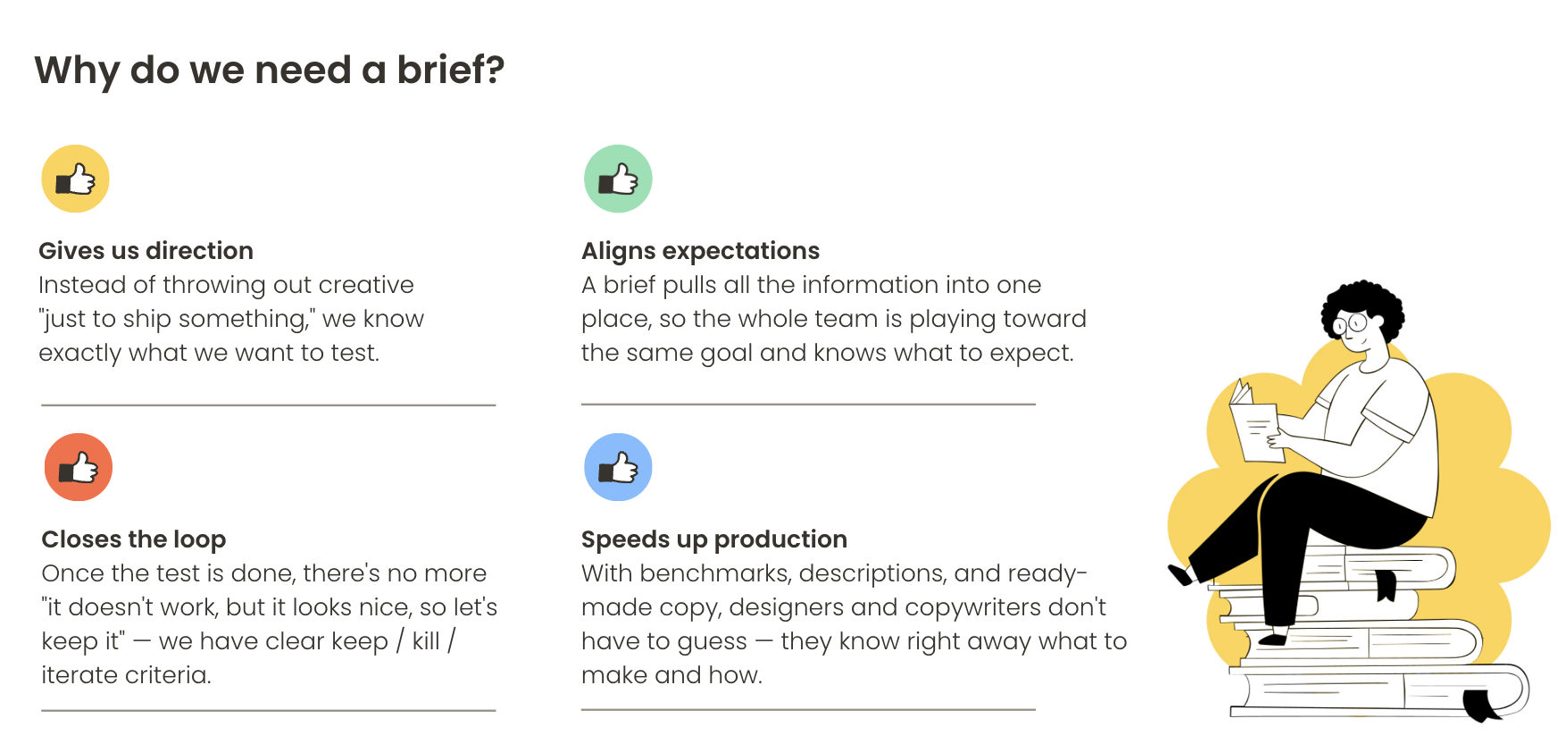
This is also the moment to write everything down in a creative brief. A good brief isn’t paperwork for paperwork’s sake. It’s a document that organises the campaign and explains to the whole team what we’re doing, why we’re doing it, and on what assumptions. It should include, among other things:
- the campaign objective,
- audience personas or segments,
- the funnel stage,
- the main communication angles,
- formats,
- test assumptions,
- brand constraints,
- and the evaluation criteria.
👉 The creative brief isn’t an attachment to the campaign. It’s the document that ties strategy, production, and testing into one whole.
Creative production — communication variants for different awareness stages
This is the stage that looks most creative from the outside, but really it should be a consequence of earlier decisions.
If the research and hypotheses are done well, production isn’t about searching for an idea from scratch — it’s about translating the strategy into specific assets. And here something very important comes up: a single creative is not a test. You need structured variety, matched to the audience’s stage of awareness and to what you actually want to compare.
That means that instead of creating five almost-identical banners, it’s better to build several genuinely different directions:
- education vs hard USP,
- emotion vs proof,
- social proof vs demo,
- problem insight vs offer message.
It’s worth mentioning the 5 stages of customer awareness here, because that model helps you design different roles for your creatives, not just different versions of the same layout. Thanks to it, one ad can spark reflection, another can name the problem, the next can show the solution, and yet another can counter objections or close the decision. If you want to avoid the typical pitfalls when testing, take a look at the 10 most common mistakes in Meta Ads creatives, which recur in most campaigns.
💡 Production shouldn’t be hunting for “one perfect creative.” It should deliver different, sensibly designed signals.
Creative tests — verifying hypotheses with campaign data
When creatives go live in the campaign, you have to set aside subjective opinions and let the data show what actually makes sense. Testing is the moment of verification, where we observe how users react and let the data judge what works — even if it doesn’t always match what we “like best”.
This is especially important today, when algorithms eliminate ill-fitting creatives faster and reward messages that carry a clear signal more strongly. In that environment, it’s not enough to say “this looks good.” You need to know:
- whether that narrative captured attention,
- whether the given angle worked at the right funnel stage,
- whether the format was right,
- and whether the result made sense not just at the CTR level, but across the whole funnel.
⚠️ The fact that the team likes a creative doesn’t yet mean it works. In performance testing, what matters isn’t taste — it’s relevance.
Post-test insights — analysing CTR, traffic quality, and funnel impact
This is where the campaign’s whole future plays out. Because if there’s no analysis after the test, then there wasn’t really a learning process either. You have to answer the questions: which concept delivered the result, which narrative made the most business sense, what’s worth repeating, and what to discard.
This is also the moment to look more broadly than at a single metric. Click-through rate alone may not be enough. Sometimes an ad attracts attention but doesn’t build quality traffic. Sometimes a weaker CTR has a better impact on deeper funnel stages. That’s why creative strategy doesn’t end with reading the result — it ends only when you can interpret it.
👉 A test without insights doesn’t lead to scaling. It only leads to another start from scratch.
Creative iteration — a repeatable testing cycle as the foundation of scaling
This is exactly where creative strategy shows its greatest value.
The best results don’t come from a single “golden shot,” but from a repeatable cycle: you test, draw insights, improve, create new variants, and test again. It’s this repeatability — not a one-off success — that builds a long-term advantage. Without iteration, there’s no scaling.
Systems like Andromeda won’t “deliver” the campaign for you, but they’ll make excellent use of an environment in which they receive organised, varied, and constantly improved signals. Strategy sets the direction, the creative builds the tension, and the technology helps tie it together into a coherent, scalable whole.
💡 Scaling doesn’t start with a bigger budget. It starts with whether you can repeatedly draw sensible insights from your creatives.
Creative strategy as the foundation of performance marketing in Social Ads
Because a campaign is no longer a solo race won by a single element.
Objectives, budgets, formats, settings, and creatives now work as a system of connected vessels. Even the best-configured campaign won’t hold up if the creative doesn’t do its job. Creative strategy makes those creatives stop being random and start playing a defined role in the whole system — at different funnel stages, for different intentions, and for different levels of user awareness.
That’s why creative tests aren’t an add-on to performance today. They’re its core. Especially in an environment where algorithms heavily influence how ads are distributed and optimised.
And that’s exactly why creative strategy shouldn’t sit at the end of the process as a “nice bonus.” It should be one of the first elements you start campaign planning with.
What does creative strategy change in the work of media buyers and creative teams?
A great deal.
For media buyers, it’s a signal that you can no longer think of the creative as something “alongside the campaign.” Today you have to work with it much more closely, because the ad is what delivers some of the most important signals to the system. For creative teams, it means more responsibility, but also more influence — because the creative stops being a campaign decoration and becomes one of the tools for steering where the campaign ultimately “lands.”
For decision-makers, in turn, it’s a reminder that campaigns don’t get better simply from “making more assets.” They get better when someone builds a process, names the hypotheses, organises the roles of the creatives, and turns creative work into a system rather than a series of one-off sprints.
Creative strategy isn’t a luxury for brands that “have time to get organised.” It’s the foundation of an effective campaign — especially today, when algorithms judge ads faster, filter messages earlier than before, and rely more and more on the signals coming from the creative itself.
If you want to build campaigns you can analyse, improve, and scale, you can’t start with the question: “what graphic do we make?” You have to start earlier — with research, hypotheses, the brief, tests, and insights.
Because a good creative can capture attention. But it’s a good creative strategy that lets you know why you’re making it, what you want to test, and what you’ll do with the result.
✅ In short: creative strategy isn’t an add-on to the campaign. It’s what makes creatives stop being random and start genuinely delivering results.
About the author
Agnieszka Rapacz — As a creative strategist and graphic designer, she designs ad creatives that combine technology with an intuitive understanding of audiences and how algorithms work. In her work she relies on creative strategy, testing, and analysing results, creating creatives that support sales and campaign scaling. She makes sure ads are not only aesthetic but, above all, effective — basing them on data without losing her instinct and creative intuition. Find her on LinkedIn.
See other articles


How to start selling on TikTok Shop – step by step