Illustration of a person working on an ad creative, surrounded by icons of an idea, analysis, and a positive reaction, symbolising strategic ad design as an important signal for the Meta Ads algorithm.
Uśmiechnięta młoda kobieta o blond włosach do ramion, z kolczykiem w nosie, ubrana w czarną koszulkę, na żółtym tle.
Agnieszka Rapacz
Creative Designer & Strategist
15 min
Creatives
Meta Ads

Creative is the new targeting in Meta Ads. Myth or new reality? [2026]

“Creative is the new targeting” — this slogan swept through the paid social world in 2026. Not so long ago, your edge in Meta Ads often started with the settings: precise targeting, campaign splits, exclusions, and placements. Today that centre of gravity has clearly shifted. Ad systems analyse more signals faster, earlier, and more broadly than before, and the creative itself is no longer just the “packaging” of an ad. More and more, it’s the creative that tells the algorithm who this message is for, in what context it makes sense, and when it’s worth showing.

What you'll learn from this article

  • where the phrase “creative is the new targeting” came from, and why it isn’t just an industry slogan,
  • what has actually changed in Meta Ads as systems like Andromeda, Lattice, GEM, and Sequence Learning have developed,
  • why the algorithm today looks not only at campaign settings, but at the ad itself,
  • what signals the creative sends, and how they help match the message to the audience,
  • why “more creatives” doesn’t always mean “more tests”,
  • how to tell genuine creative diversification from cosmetic changes,
  • and what all of this means in practice for media buyers, strategists, and creative teams.


What does “creative is the new targeting” mean?

In short: it describes a real shift in Meta Ads — the algorithm relies less and less on manual campaign settings (targeting, exclusions, micro-structures), and more and more on the signals coming from the ad itself. The creative tells the system what problem it addresses, what language it speaks, what awareness stage the audience is at, and in what context it makes sense. The ad is no longer just a carrier for the message — it has become a source of data for Meta’s algorithm (Andromeda, GEM, Lattice, Sequence Learning).

Creative as a Meta Ads algorithm signal — where did the phrase come from?

“Creative is the new targeting” is one of those lines that raced across LinkedIn, slide decks, and industry discussions. The trouble is, it’s very easy to treat it as a catchy slogan. And that would be quite an oversimplification.

Because the point isn’t that campaign settings suddenly stopped mattering. Nor is it that media buying has become redundant, or that all you have to do is upload some nice-looking ads and wait for results. It’s something more specific: the platform relies less and less solely on manual settings, and more and more on the signals coming from the ad itself.

That means that before the system decides who to show a given message to, it analyses not just the audience or the campaign objective, but also what’s actually in the creative. What problem it shows. What language it speaks. What emotions it stirs. Whether it educates, sells, compares, builds trust, or closes the decision.


💡 The ad is no longer just a carrier for the message. Today it’s also a source of data for the algorithm.


And that’s exactly why this phrase is no longer just industry shorthand. It describes a real shift in how campaigns work.


What changed in Meta Ads 2026: Andromeda, Advantage+, and the end of manual targeting

Put simply: the complexity hasn’t disappeared. It has simply moved from Ads Manager to the backend.

A few years ago, many decisions were made by a human. It was the human who manually split funnel stages, narrowed audiences, set placements, tested fragmented structures, and tried to “deliver” results through ever more precise campaign control.

Today’s ad systems work differently. They analyse far more signals, connect data from different places faster, and judge earlier which message makes the most sense for a specific person at a specific moment. You can read more on this here.

That’s exactly why winning campaigns less and less often comes down to “hacking the system”, and more and more to working with it. And for that collaboration you need more than a correctly set budget. You need material the system can read as a meaningful, clear, and varied signal.


👉 The panel is simpler operationally today, but campaigns are more demanding strategically.


Andromeda in Meta Ads — the AI engine that selects creatives before the auction

A lot of misunderstanding has grown up around Andromeda (which we cover in more detail in this article), so it’s worth setting the record straight. It isn’t a new campaign type, a new tab, or some magic option to switch on. It’s an AI engine that helps Meta connect data faster and more accurately, and judge which ads make the most sense for a specific user.

From a marketer’s perspective, the key thing is that the system does more and more of the work before the auction itself even happens. Before an ad appears on screen, the algorithm tries to answer one question: which message has the best chance of working right now?

And this is exactly where the creative grows in importance.

Because if the system is to match the message to the audience with broader targeting and fewer manual “hints”, then the ad itself has to carry more meaning than before. It has to be more unambiguous, more rooted in a specific problem, and more legible to the platform.

What does it mean that the creative "signals" the audience?

This is the heart of the whole shift.

When we say creative is the new targeting, it doesn’t mean an image will replace your entire media strategy. It means the ad itself communicates a great deal:

  • what problem it addresses,
  • in what context it shows the product,
  • what language it speaks,
  • what vibe it has,
  • whether it’s built on education, an offer, social proof, or a demo,
  • and which moment in the buying decision it fits.

For a human, that’s simply the message. For the algorithm, it’s also a set of signals that help match the ad to the user’s situation.

Take a simple example. You’re selling an acupressure mat. You can prepare one ad showing the evening wind-down and post-work ritual, and another focused on back pain after long hours at the desk. The product is the same. But the signal the ad sends — is not.

In the first case you’re talking about relaxation, self-care, a calm evening, and recovery. In the second, about tension, strain, discomfort, and a real problem that needs solving. These are two different entry points, two different worlds of association, and two different moments of audience readiness.


💡 The same product can send completely different signals — depending on how you tell its story.


And that’s exactly why the creative helps the system seek out different audiences without you manually splitting the campaign into dozens of micro-segments.


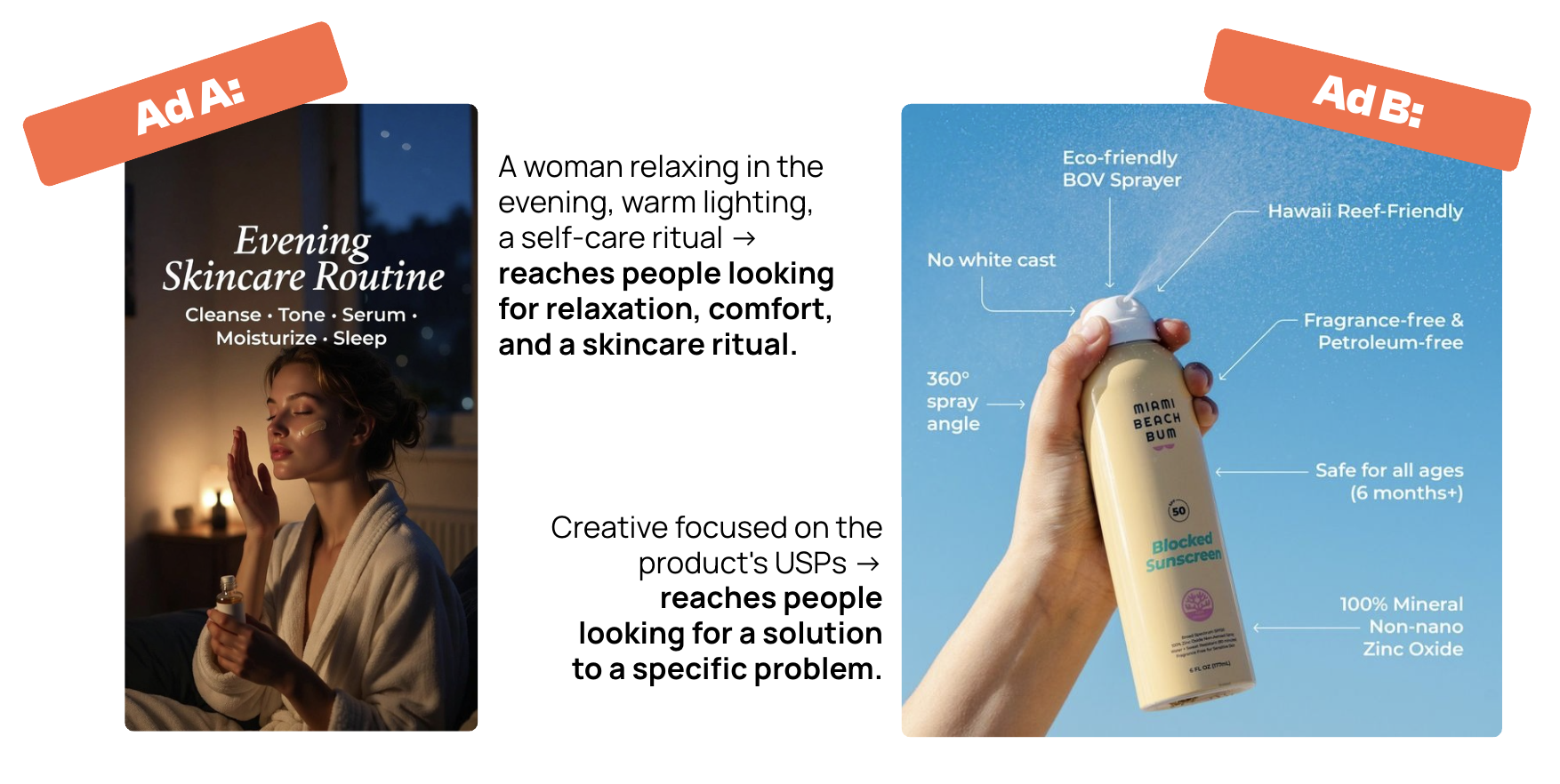
Comparison of two Meta Ads creatives: the first shows an evening skincare ritual and speaks to people looking for relaxation, the second presents product features and reaches audiences looking to solve a specific problem.
source: Pinterest


Broad targeting in Meta Ads — when the creative replaces precise targeting

This is really important: broad targeting doesn’t mean chaos. It means greater trust in the system — but only if you give it good fuel.

If the audience is broad, it’s the creative that helps the algorithm “catch” the right people. Not because it’s aesthetic. Because it’s legible. It shows a specific problem, a specific promise, a specific moment, and a specific reason to stop.

A nice graphic isn’t a strategy. A clear signal is.

Broad targeting in Meta Ads is now one of the most common settings recommended by the platform itself. Instead of narrow groups with 5–7 stacked interests, we leave minimal constraints: gender, age, country. Sometimes we add a lookalike audience (1–10%) built from customers or people with the highest basket value. But broad targeting isn’t a “mindless setting”. Its effectiveness depends on one thing — the signal density of the creative. That is, how many legible signals the ad delivers to the algorithm: problem, context, tone, decision stage. Without those signals, broad targeting is chaos. And that’s exactly why, in the new setup, “nice-looking” isn’t enough. The ad has to not only look good, but above all communicate something clearly. Name the problem. Counter an objection. Show the result. Make the promise credible. Build tension. Or help the audience make a decision.


👉 The broader the targeting, the more the clarity of the message matters.


Meta sees more than you think

This is where many teams fall into a trap. It’s very easy to assume that, since we’ve prepared 10 or 15 versions of an ad, we’ve run a proper creative test. The thing is, from the system’s perspective those ads don’t have to be 10 or 15 different signals at all. If they differ only in background colour, a slight layout shift, or a minor copy tweak, the platform may treat them as variations on the same idea.

And then you don’t get real learning. You get a few very similar versions of one message, all competing for the same scrap of attention.

This is an important moment, because this is exactly where many brands confuse “lots of assets” with genuine test variety. Yet the sheer number of files guarantees nothing. If they all rest on the same idea, you’re still moving within a single hypothesis.


⚠️ Five similar ads often aren’t five tests. They’re one test in five outfits.


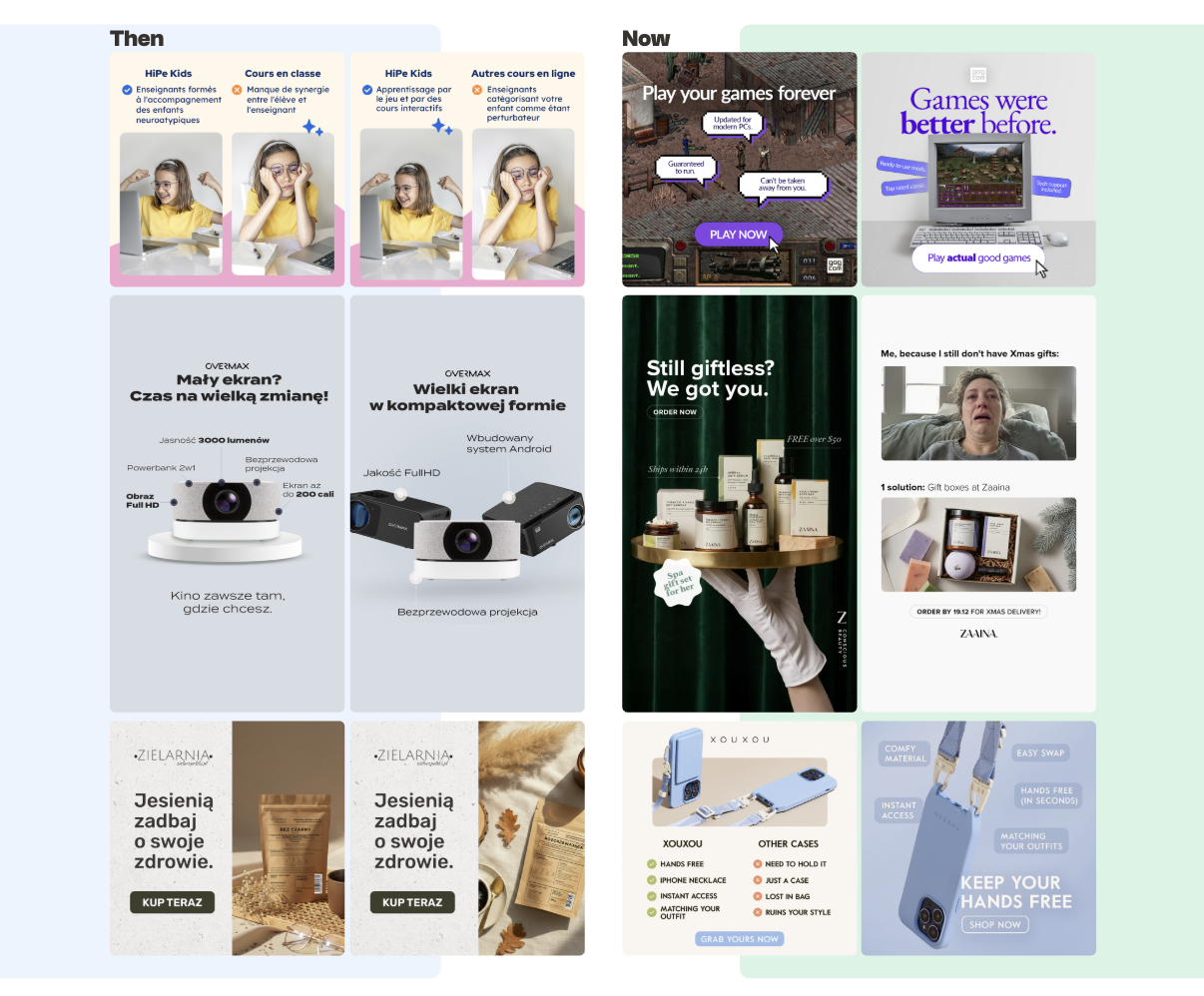
Comparison of past and present Meta Ads creatives: on the left, static graphics built on a similar layout and a simple product message; on the right, more varied formats, styles, and communication angles tailored to different audiences.


More creatives doesn't mean better

This is one of the most important distinctions in the whole topic. The point isn’t simply to pile on more assets. The point is to add different communication angles. Different narratives. Different promises. Different proof. Different emotions. Different levels of audience readiness.

When you create your ads, it’s worth keeping the 5 stages of customer awareness in mind.

Because real creative diversification isn’t about changing the background, the button, or the order of elements. It’s about creating messages for different moments in the buying decision.

  • You speak differently to someone who’s only just starting to realise they have a problem.
  • Differently to someone already looking for possible solutions.
  • Differently to an audience comparing options.
  • And differently again to someone who knows the product but still has objections or needs one last nudge.

That’s exactly why the topic of the 5 stages of awareness organises creative work so well. It helps you move away from “let’s make more versions” thinking and towards: “what different roles should our ads play?”


💡 Real variety begins when the meaning of the message changes — not just its look.


In practice it might look like this:

  • one creative built on a pain point,
  • a second on education and naming the problem,
  • a third on an “old way vs new way” comparison,
  • a fourth on social proof and building trust,
  • a fifth on a strong CTA for people close to a decision.

These are genuinely different signals. And that’s exactly what the system needs.


Five examples of Meta Ads creatives matched to different stages of customer awareness: from a relaxed, lifestyle message, through education and product comparison, to proof of effectiveness and a sales-focused message encouraging purchase.
source: Pinterest


UGC, static, carousel, reels — how creative format affects the algorithm

It’s worth remembering that variety doesn’t end with the message itself. It also applies to format.

Yes, UGC is hugely popular today — and rightly so. It can look natural, sits closer to a real user experience, holds attention well, and often performs very strongly. It gives a sense of authenticity, lowers the distance, and often “lands” in the feed more naturally than a classic ad.

But that doesn’t mean you should drop statics. Quite the opposite. Static creatives are still a very strong asset, and time and again they can be the real dark horse of the ad set.

Because there are situations where the static wins:

  • it showcases the product better,
  • it shows the USP more clearly,
  • it communicates a benefit, price, or promotion faster,
  • it’s easier to scan in a second,
  • and it gives a more unambiguous signal than dynamic video.

Sometimes the user doesn’t need motion, storytelling, and a few seconds of narrative. Sometimes they need one strong frame, one specific line, and one clear reason to click. And speaking of production — AI genuinely changes the pace of testing. See where AI helps in creative marketing, and where it falls short.


💡 That’s why the best approach isn’t “UGC instead of statics”, but UGC alongside statics.


Combining static creatives with video, reels, carousels, or demos gives the algorithm different types of signals and increases your chance of reaching new audiences. Format shouldn’t be a choice made out of habit. It should follow from what you want to test.

For example:

  • if you’re testing authenticity and closeness — UGC may be spot on,
  • if you want to show product advantages clearly — a static or carousel may win,
  • if you’re fighting for that first moment of attention — a short video may give a stronger start.


Don't test cosmetics. Test contrast.

This is a point that makes a huge difference today. Changing the background, a slight colour correction, shifting the model, or rearranging the order of elements doesn’t create a new creative. If the idea and composition are similar, the ads will compete with each other instead of working complementarily.

That’s why sensible testing should be built on contrast:

  • emotion vs argument,
  • education vs sales,
  • demonstration vs social proof,
  • product in use vs product in an aesthetic frame,
  • problem vs solution.

A creative test in Meta Ads rests on a few metrics that show how the creative performs in the first few seconds:

  • Hook rate — the share of users who stayed with the ad after 3 seconds. It measures the strength of the first frame.
  • Thumb-stop ratio — the percentage of people who stopped scrolling and watched the ad for longer than 2 seconds. It’s an indicator of visual appeal.
  • Hold rate — the share of viewers who watched the whole ad. It shows whether the narrative holds attention to the end.

These metrics reveal where the test hypothesis wins and where it loses. If two creatives have a comparable hook rate but a different hold rate, you know the problem isn’t in “grabbing attention”, but in holding it. The conclusion is precise. Without these metrics, you’re testing blind.

The greater the difference in the meaning of the message, the greater the chance you’re learning something real. Many teams fall into the trap of testing cosmetics — and that’s just one of the 10 most common mistakes in Meta Ads creatives worth knowing.


A set of various Meta Ads creatives for cosmetics and gift brands, showing the testing of multiple communication angles: from product benefits, before-and-after results, and comparisons, to skincare routines, social proof, and seasonal sales messages.
creative sources: MTA Digital and inspiration from Pinterest


What does this change in a team's work?

A great deal. Ads Manager is becoming technically simpler, but strategically more demanding. That means the specialist’s role doesn’t disappear — it just shifts. Less and less is about micromanaging settings, and more and more about the quality of the signals delivered to the system: data, campaign structure, the feed, the creative, and the quality of the variants.

For media buyers, this means less thinking along the lines of “how do I outsmart the system?”, and more questions like:

  • do the ads genuinely differ from one another,
  • are we testing real hypotheses, not cosmetics,
  • do we know what each creative is meant to communicate,
  • can we explain why something worked,
  • are the format and message matched to the audience’s awareness stage.

For creative teams, in turn, it means greater responsibility, but also greater influence. Because if the ad becomes one of the main tools for steering where a campaign “lands”, then the creative is no longer an add-on to the campaign. It co-determines its effectiveness.


✨ The creative stops being a campaign’s decoration. It becomes one of its main mechanisms.


That doesn’t mean strategy has stopped mattering. Quite the opposite. This may well be the most important takeaway.

The more automation there is on the platform side, the more important the foundations on the human side become. Because the algorithm may analyse signals faster, but it doesn’t know your business goals and doesn’t understand the brand the way your team does. This is where it’s worth mentioning what creative strategy is, as it makes the whole process much easier.

So before you start thinking about the number of ads, it’s worth going back to a few basic questions:

  • who exactly are we speaking to,
  • what problem do we want to name,
  • what awareness stage is the audience at,
  • what do we want to test,
  • how will we know a given direction made sense.

Without that, even the best tools will only speed up the chaos.


How to design creatives that genuinely help the algorithm?

To wrap up, let’s put it in practical terms.

  • Design for contrast, not cosmetics: Don’t make five versions of the same ad. Make three genuinely different directions.
  • Change the meaning, not just the look: A new background colour isn’t a new hypothesis. A new insight, a new promise, or a new argument — that is.
  • Think of the creative as a signal: Every ad should clearly answer: who is this for, what problem does it address, and which buying-decision stage does it fit.
  • Combine different formats: UGC, static, carousel, demo, short video — each of these formats can trigger different reactions and give the system different data.
  • Think in awareness stages: Create ads for different moments in the buying decision, not just different versions of the same layout.
  • Iterate fast, but deliberately: New angles, short test cycles, clear conclusions, and sensible fixes — that’s exactly what builds an edge.


Is creative the new targeting?

Yes — but only when we understand the sentence correctly.

It doesn’t mean media strategy stops existing. Nor does it mean it’s enough to make “nice ads” and hope the system delivers the result on its own. It’s about something far more specific: in a world of integrated algorithms, the ad itself has become an important source of signals. It’s the creative that helps the system understand the problem, the context, the intent, and how well the message fits the audience.

That’s why your edge no longer comes mainly from the number of sliders in the panel. It comes from the quality of your thinking, the quality of your hypotheses, and the quality of your creative. From whether you can give the algorithm material that’s genuinely varied, genuinely legible, and genuinely rooted in strategy.


✅ In short: the winner today isn’t whoever sets the most in the panel. It’s whoever can deliver better signals to the system.


Because the system can speed up selection. It can reject mismatched messages faster. It can connect signals better. But it still won’t do the most important thing for the brand: it won’t invent a meaningful conversation with a human being on its behalf.

About the author

Agnieszka Rapacz — As a creative strategist and graphic designer, she designs ad creatives that combine technology with an intuitive understanding of audiences and how algorithms work. In her work she relies on creative strategy, testing, and analysing results, creating creatives that support sales and campaign scaling. She makes sure ads are not only aesthetic but, above all, effective — basing them on data without losing her instinct and creative intuition. Find her on LinkedIn.

Table of contents

See other articles

Dorota Puzio, Google Ads Specialist at MTA Digital
Google Ads Analytics

Google Ads is under-reporting your conversions. And you probably don’t know it.

Conversion tracking in Google Ads is failing more and more often. Some orders never reach the panel, ROAS shows up lower than it really is, and the algorithm learns on increasingly patchy data. Google has responded with a new solution — Google Tag Gateway — which is meant to "recover" those lost conversions. But will it actually help, or is it another piece of hype that ends in prettier numbers in the report but not in your pocket? We're checking, no sugar-coating.
An illustration of a robot analysing information from a book and a panel with a brain icon and a progress bar, symbolising using AI to organise knowledge, do research, and support a marketer's work.
Creatives Meta Ads

AI in creative marketing: where it really helps and where it doesn’t deliver out of the box [2026]

AI in creative marketing has well and truly become part of teams' daily work — from ChatGPT and Claude for research, to Midjourney, Flux, and Arcads for creative production. It helps with research, speeds up brainstorming, supports brief-writing, makes creative variation easier, and shortens the path from idea to first concept. The problem is that two extreme narratives still circle generative AI: either "it'll do everything for you" or "it's useless." The truth is somewhere in between. AI really can take work off a team's plate and speed up specific stages, but it doesn't replace strategy, it doesn't understand the business goal for you, and it rarely delivers a finished asset without iteration, fixes, and quality control.
Portrait of Agnieszka Rapacz, Creative Strategist at MTA Digital and author of the article, on an orange background with yellow graphic elements.
Creatives Meta Ads

The 10 most common mistakes in Meta Ads creatives that hurt campaign results [2026]

Mistakes in Meta Ads creatives hurt campaign results more often than wrong settings, a poorly chosen budget, or off-target audiences. Very often the problem starts much earlier — at the creative stage. That's where it's decided whether an ad will carry a clear message, or just become another asset dropped into the campaign with no real role. Today, in a world of Meta Ads, automation, and systems that judge an ad's relevance faster and faster, the creative isn't an add-on to performance work. It's one of the most important elements shaping the result.

It’s time for your brand.
Click and let’s start growing together.