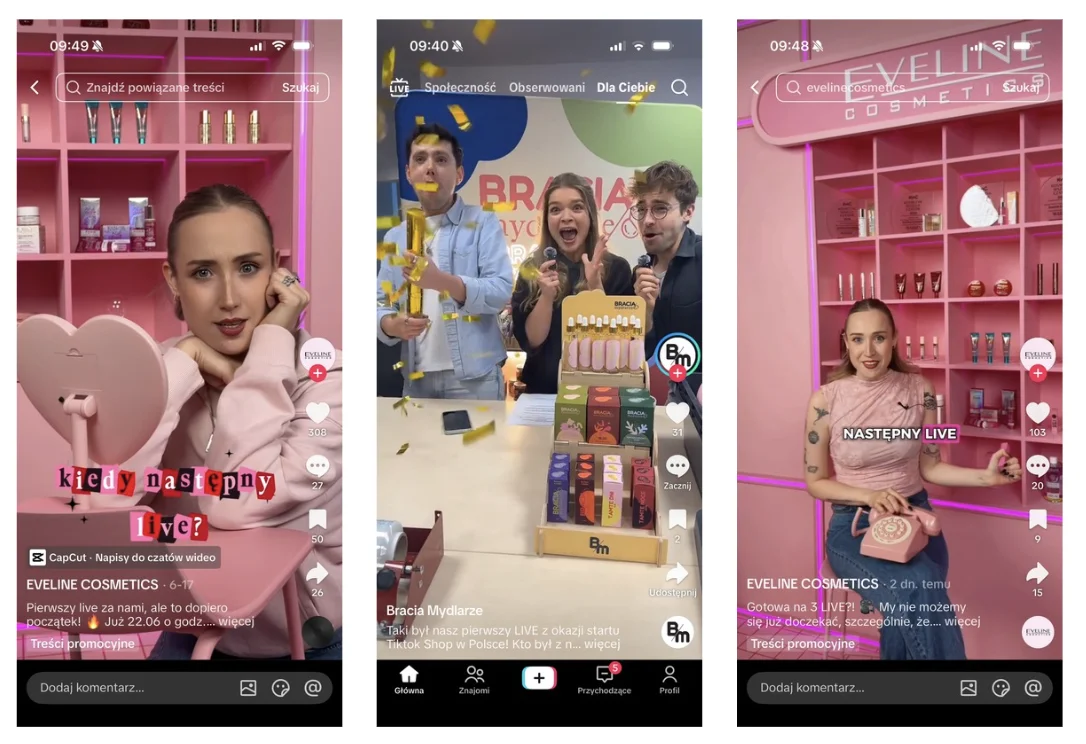
Live commerce on TikTok Shop: why live is half the battle (actually, more)
Before you think “selling live? That sounds like 90s teleshopping”, you’re right. Live commerce is, at heart, the same age-old idea: someone shows a product, talks about it with a glint in their eye, and you buy before the moment passes. The difference is that this time you’re not watching it on TV at three in the morning, but while scrolling your phone in the checkout queue, and that TikTok has turned the idea into one of the strongest selling mechanisms it offers.
And this is exactly where many sellers slip up: they set up an account, list products, tick off “TikTok Shop: done”, and wait. Then they’re surprised nothing happens. Because TikTok Shop without content and live streams is a bit like an open shop where nobody’s behind the counter and nobody invites you in. All the energy of this channel sits in what happens live.
What you'll learn from this article?
- what live commerce is and why it works on TikTok in particular,
- why the platform rewards streams featuring products,
- where live commerce is heading, using Korea as an example,
- why configuring the shop is only half the journey,
- how to run a live that actually sells,
- which products live works best for.
In brief: live on TikTok Shop at a glance
Live commerce is selling live, directly in the TikTok app: the host shows a product, and viewers buy during the stream without leaving the live. TikTok clearly rewards streams featuring products with higher reach, because it wants this part of the business to grow. Configuring the shop is only half the journey, real results start when you run lives regularly and work with creators. It works best for impulse, visual products that are easy to show.
What live commerce is
Live commerce is selling conducted live, straight in the app. The host, whether a brand, a seller or a creator, shows products in real time, answers questions from the chat, demonstrates how something works, and encourages the purchase. The viewer doesn’t have to go anywhere: tagged products are available to buy during the stream, with a single tap.
What sets live apart from an ordinary video is the interaction and the sense of the moment. On a live, it’s happening “now”. A question in the chat gets answered live, the offer is sometimes time-limited, and the “we’re in this together” atmosphere does the rest. It’s selling that feels more like a conversation than a catalogue, and that’s exactly why it can convert better than a static product listing.
Why TikTok pushes live so hard
There’s no mystery here, and TikTok doesn’t hide it: it wants live commerce to grow, so it rewards it with reach. In practice you can see it plainly, streams featuring products, and content linked to a live, get noticeably better traction than average content. The platform simply prefers to show what it cares about.
For you that means something very concrete: live is currently one of the cheapest ways to earn organic reach on TikTok. At a time when reach almost everywhere has to be fought for with budget, that’s no small thing, it’s an advantage worth using while the window is open. Because like every promotional window on a new channel, it will eventually narrow.
💡 Live isn’t only about sales, it’s also reach and brand awareness. Even if a single stream doesn’t generate record takings, it builds recognition and “feeds” your organic content. These effects add up.

The shopping of the future? Look at Korea
If you’re wondering whether live commerce is a passing fad or a lasting shift, the best answer comes from a market that’s several years ahead of us. In South Korea, live selling long ago stopped being a curiosity and became an everyday way to shop, driven by the biggest platforms (Naver Shopping Live, Coupang Live, Kakao), with fashion and beauty as the categories that rule the streams. According to industry data, more than half of online shoppers in Korea already use live commerce, and the figure keeps rising.
The most interesting part, though, is how seamlessly the online and offline worlds blend there. An increasingly popular model is streams run straight from shops and showrooms: a host or influencer walks into a clothing store, tries on one item after another, shows them up close, talks about the fabric and cut, and at the same time viewers buy the featured products live, without leaving the app. The physical shop becomes a film set, and the clothes rail a shop window. Fashion platforms like Musinsa and beauty ones like Olive Young are developing their own live channels, tying physical stores and streaming into one whole.
And here’s the honest takeaway: whether we like it or not, this is the direction shopping is heading, and McKinsey’s data on the scale of live commerce backs it up. The line between “going to a shop” and “watching and buying online” is getting thinner and thinner. Many markets are only at the start of this road, which means that by moving into live commerce now, you gain an edge before it becomes a standard everyone has to fight over.
Configuration is half the journey, the rest happens live
Let’s say it plainly, because it’s the most important sentence in this whole article: getting onto TikTok Shop, configuring the shop and listing products is only half the journey. A necessary step, yes, but the easier half.
More important for results is the second step: running lives regularly. They drive both the channel itself and, indirectly and directly, sales in the shop. You see it especially with smaller sellers and creators, for whom live can even be the main source of traffic, brand awareness and orders. A small scale isn’t a barrier here, sometimes the opposite: an intimate live with an authentic host converts better than a polished production with no soul.
In other words: if you treat TikTok Shop as “a shop window and that’s it”, you leave the best part of this channel on the table.
How to run a live that sells
A good live isn’t a lucky break, it’s a repeatable format. A few things that make the difference:
- Prepare an outline, not a rigid script. Viewers can tell when someone’s reading off a card. Have a plan of products and points, but leave room for conversation.
- Show, don’t tell. Live is the kingdom of demonstration: before and after, a test, an unboxing, use in real time. The more you can see, the better.
- React to the chat. A question in the chat is a ready-made selling opportunity. “Does it suit oily skin?”, and there’s your cue to show the product in action.
- Give a reason to buy now. An offer only during the stream, a bundle available on the live alone, a limited number of units. A sense of the moment is the fuel of live commerce, as long as it’s honest, with no artificial pressure.
- Be regular. One live won’t build a habit with viewers. A fixed day and time work like a favourite programme, people know when to come back.
- Have a watertight process. Stock levels, order handling and shipping have to keep up with the sales from a live. Even the best stream won’t help if orders get stuck.
👉 Start with short, regular streams instead of waiting for the “perfect” big live. Ten intimate lives where you learn beat one polished one that never happens.
Live + creators = a reach multiplier
You don’t have to host every live yourself. This is where affiliate comes in: creators can run streams with your products, and viewers often trust them more than a classic ad. A well-matched creator on a live combines two of TikTok Shop’s strongest levers at once, the reach of the stream and the credibility of a recommendation. How to set it up, we break down in the piece on creator affiliate on TikTok Shop.
Which products live works best for
Like all of TikTok Shop, live rewards products you can show and grasp in a few moments:
- cosmetics and skincare (demonstration, the “before and after” effect),
- fashion and accessories (try-ons, live styling),
- gadgets and home products (a working demo),
- impulse products with a good margin and an interesting use context.
If your product needs a long, technical explanation, live can still work, but it’s simpler to start with what sells “at first glance”.
What next
Live doesn’t work in a vacuum, it fits best with the rest of the channel:
- switch on affiliate so creators run lives with your products → creator affiliate,
- work out profitability before you hand out live-only offers → TikTok Shop commission and costs,
- make sure your stock keeps up with sales → integration with e-commerce,
- polish the listings you show live, because that’s where the viewer lands right after tapping in a live → product listings and categories.
You’ll find the whole picture of the channel in the guide: TikTok Shop for e-commerce. And if you’re only just starting, begin with how to start selling step by step.
FAQ
What is live commerce on TikTok Shop? It’s selling conducted live, directly in the app. The host shows products, answers questions from the chat, and viewers buy the tagged products during the stream.
Why does TikTok promote lives? The platform wants live commerce to grow, so it rewards streams featuring products with higher reach. For a seller, it’s one of the cheapest ways to earn organic reach.
Do I have to host lives myself? No. Streams can be run by partner creators through affiliate, often with more reach and credibility than a brand profile.
How often should I go live? Regularity works better than one-off events. A fixed day and time build a habit with viewers and improve results over time.
Which products does live work best for? Visual, impulse products that are easy to demonstrate: cosmetics, fashion, accessories and gadgets with a good margin.
What do you need to run product lives on TikTok Shop? An active seller or creator account, added products, and meeting the platform’s requirements for hosting LIVE. Hardware-wise a phone and a stable connection are enough, regularity and a stream outline make more difference than a professional studio.
About the author
BÅ‚ażej Cybowski – A marketing strategist specialising in growing large e-commerce brands and scaling sales. Day to day he works with ad accounts across many international markets, combining marketing strategy with business analysis and customer experience. He also runs his own online store, which gives him a solid understanding of e-commerce challenges from an entrepreneur’s perspective. He’s passionate about new technologies, AI and the practical use of innovation in marketing. Find him on LinkedIn.
See other articles


How to start selling on TikTok Shop – step by step