The 10 most common mistakes in Meta Ads creatives that hurt campaign results [2026]
Mistakes in Meta Ads creatives hurt campaign results more often than wrong settings, a poorly chosen budget, or off-target audiences. Very often the problem starts much earlier — at the creative stage. That’s where it’s decided whether an ad will carry a clear message, or just become another asset dropped into the campaign with no real role. Today, in a world of Meta Ads, automation, and systems that judge an ad’s relevance faster and faster, the creative isn’t an add-on to performance work. It’s one of the most important elements shaping the result.
What you'll learn from this article
which mistakes in working with Meta Ads creatives most often hurt campaign results,
why “more assets” doesn’t mean better testing,
how Andromeda, GEM, and Lattice affect how creatives are judged in Meta Ads,
what creative fatigue is and how to avoid it,
how to tell genuine contrast from cosmetic changes in creatives,
where the collaboration between strategy, creative, and media most often falls apart,
how to set up an A/B creative testing process in 2026,
what to do instead — a checklist of 5 rules for working with creatives.
The most common mistakes in Meta Ads creatives — a quick answer
The most common mistakes in Meta Ads creatives in 2026 are: treating the creative as an add-on to the campaign, mistaking virality for strategy, too few genuinely different variants, testing cosmetics instead of contrasts, dropping everything in at once, no analysis of results, copying big brands without context, sticking to old templates, feedback that’s too slow, and focusing solely on performance without building the brand. Each of these mistakes weakens the signals the creative sends to Meta’s algorithm — and in the era of Andromeda, GEM, and Lattice, it’s exactly the quality of those signals that decides how effective a campaign is.
Where mistakes in Meta Ads creatives come from — the root of the problem
You can have a good budget, a sensible product, and a correctly set-up campaign, and still not deliver results. Very often the problem then isn’t the algorithm — it’s the creative work itself. Because the truth is fairly brutal: many campaigns don’t lose because of a “bad system”, but because of mistakes made much earlier. At the brief, concept, testing, sign-off, and conclusion stages. And in an environment where platforms judge the quality of signals faster and select ads earlier, those mistakes hurt even more.
Creative work is rarely about one spectacular mistake. Far more often the problem is the small decisions, shortcuts, and habits that, over time, dismantle the point of testing, make it harder to draw conclusions, and mean that even a good budget has nothing to work with. Some of these mistakes come from rushing. Some from habit. Some from the thinking that “let’s launch the campaign first and sort the creatives out along the way.” And that’s exactly when the trouble starts.
Below, I’ve gathered the mistakes that most often hurt campaign results — not because they sound spectacular, but because they regularly break the process from the inside.
Mistake 1: The creative as an add-on to the Meta Ads campaign
This is one of the most costly mistakes. If the creative only appears at the end of the process, the campaign is standing on weak foundations from the start. Strategy, objective, audience, and test hypotheses should lead to the creative, not the other way round. Otherwise you end up with material that may look fine but carries no specific message, and the creative isn’t working on the hook rate — that first second of attention.
This matters especially today, because campaign effectiveness less and less often rests on settings alone. What matters far more is what signal the ad itself sends: what problem it shows, what language it speaks, what it promises, and at what stage of the buying decision it’s trying to catch the audience. That’s exactly why creative strategy isn’t an add-on to performance. It’s its starting point.
💡 The creative shouldn’t be the last task in a campaign. If it appears at the end of the process, it very often works from a weak creative brief and an even weaker hypothesis from the start.
Today, simply setting up the campaign is no longer enough. Even the best-configured campaign won’t hold up if it’s fed random communication instead of a deliberate creative.
Mistake 2: Mistaking virality for creative strategy
“Let’s make something viral” sounds impressive, but little comes of it. Virality isn’t a plan. It’s sometimes the result of well-designed communication, but on its own it answers none of the questions: who are we speaking to, what are we testing, what mechanism do we want to check, and how will we know a given direction actually works?
Without that, it’s very easy to fall into producing content that’s meant to impress but builds no knowledge. And yet a good creative shouldn’t just “get clicks”. It should also help you understand whether emotion, a rational argument, a product demo, social proof, or perhaps a strong pain point works better. Only then does testing make sense.
👉 Virality isn’t a strategy. Strategy begins when you know who you’re speaking to, what you’re testing, and how you’ll know a given direction made sense.
Mistake 3: Too few creative variants for A/B testing in Meta Ads
Three banners usually aren’t a test. They’re more like hoping one variant catches on. For testing to make sense, you need not just a number of assets, but above all genuine variety. Without it, it’s hard to tell coincidence from a real pattern.
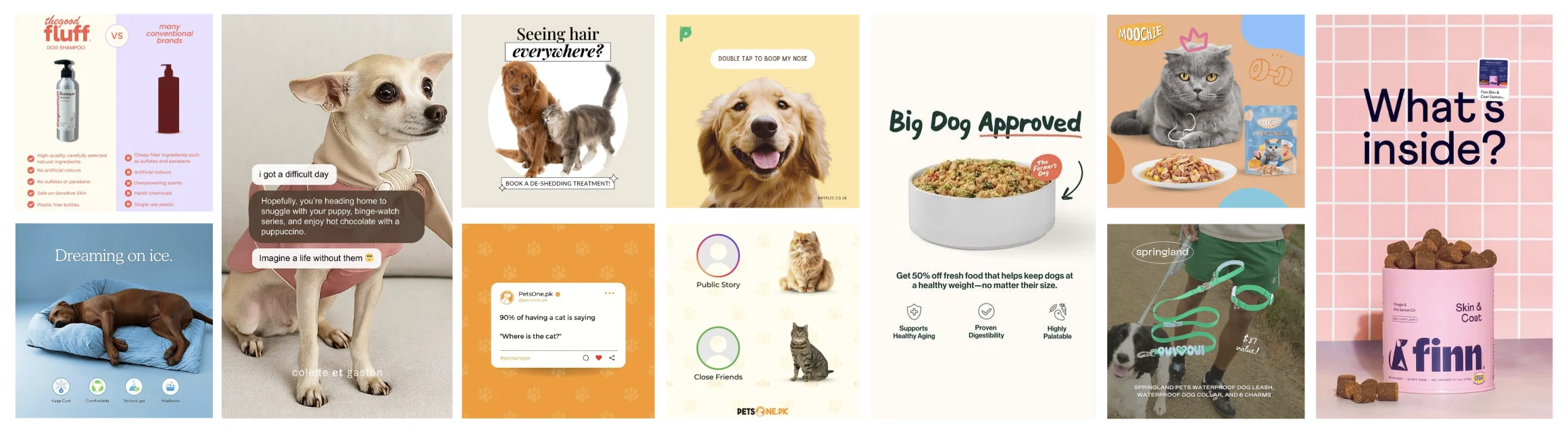
This matters all the more because a lot changed in 2026 in how systems analyse creatives (which you can read more about here). They don’t look at ads the way a human does. From that perspective, small changes within a single layout are often still the same message. So if you’re only varying the background colour, the order of elements, or the odd sentence, you might feel you’re testing several creatives when, in practice, you’re testing one hypothesis in a few cosmetic versions.
source: Pinterest
⚠️ Three banners usually aren’t a test. They’re more like hoping one variant “catches on”.
That’s why, instead of asking “how many assets do we have?”, it’s much better to ask: “do these ads genuinely differ from one another in meaning?” This is also the point where the conversation about the creative as a signal for the system — rather than just an aesthetic carrier — begins.
Mistake 4: Testing cosmetics instead of creative contrasts
This is one of the most common problems in campaigns. Brands and creative teams often produce many variants, but most of them differ only in detail. And that’s not enough to draw proper conclusions. If you want to find out what really works, you have to test different communication angles, not just different versions of the same idea. Because today creative is the new targeting in Meta Ads — it’s the creative that signals to the algorithm who to reach.
In practice, contrasting directions works much better: emotion versus argument, education versus offer, problem versus solution, UGC versus static creative, demo versus social proof. Only then do you see what type of message resonates with the audience and at what stage of the funnel, by testing the thumb-stop ratio of different formats.
💡 Don’t test details. Test the different mechanisms behind how an ad works. It’s contrasts that give you knowledge, not yet another version of the same layout.
This is exactly where it really helps to think about the creative through the lens of the stages of customer awareness. A different message works for someone who’s only just noticing the problem than for someone who already knows the product but is still hesitating. When you design a campaign this way, it’s much easier to build genuinely different test directions, not just visual variations.
Mistake 5: Dropping all your creatives in at once — chaotic testing
When too many variants go into a campaign at the same time, testing quickly loses its point, which speeds up ad fatigue in the audience. It looks like “a lot is happening”, but afterwards it’s hard to say what actually affected the result. Which element worked? Which direction was stronger? Did the format win, the narrative, the timing, or perhaps just the accidentally greater exposure of one ad?
Creative tests need structure. They need an order, priorities, and a decision about exactly what we’re checking. Otherwise the report looks like a busy scoreboard that tells you little for the future.
👉 Chaos isn’t testing. If you drop everything in at once, you usually lose conclusions faster than you gain data.
A rhythm works much better: a batch of creatives, observation, analysis, a swap, the next iteration — in other words, simply the creative strategy process. This not only organises the process but also gives the system a real chance to learn something from your signals.
Mistake 6: No analysis of results or conclusions from creative tests
This is the mistake that kills the whole point of creative work. Because even if a brand tests something but doesn’t stop afterwards to look at the results, it starts from scratch every time. It doesn’t build knowledge — it just produces more assets.
A well-designed creative process doesn’t end with publishing the ad. It runs in a rhythm: research, concept, production, test, conclusions, iteration. And it’s that last stage that’s so often skipped, even though it’s the one that decides whether a campaign has a chance to grow. Without analysis, there’s no scaling. Without conclusions, there’s no process. There’s only the constant production of “something new”.
⚠️ No analysis means no scaling. Without conclusions, every new campaign basically starts from zero.
This is also the moment where creative and performance meet most strongly. Because if a test doesn’t end with an answer to “why did this work?”, then it was really just a publication, not a test.
Mistake 7: Copying big brands' creatives without context
Inspiration is necessary. So are benchmarks. The problem starts when we treat someone else’s solutions as a ready-made recipe. The fact that something works for a big brand doesn’t mean it’ll work on a different budget, a different business model, a different category, or a different stage of growth.
The biggest trap is copying the form without understanding the mechanism. You see a specific layout, shot, narrative, or editing style and try to recreate the effect without knowing what was actually meant to be doing the work there: brand recognition, trust, social proof, or perhaps simply media scale.
A good benchmark gives you a starting point. It doesn’t give you a ready-made answer.
Mistake 8: Old creative templates and creative fatigue
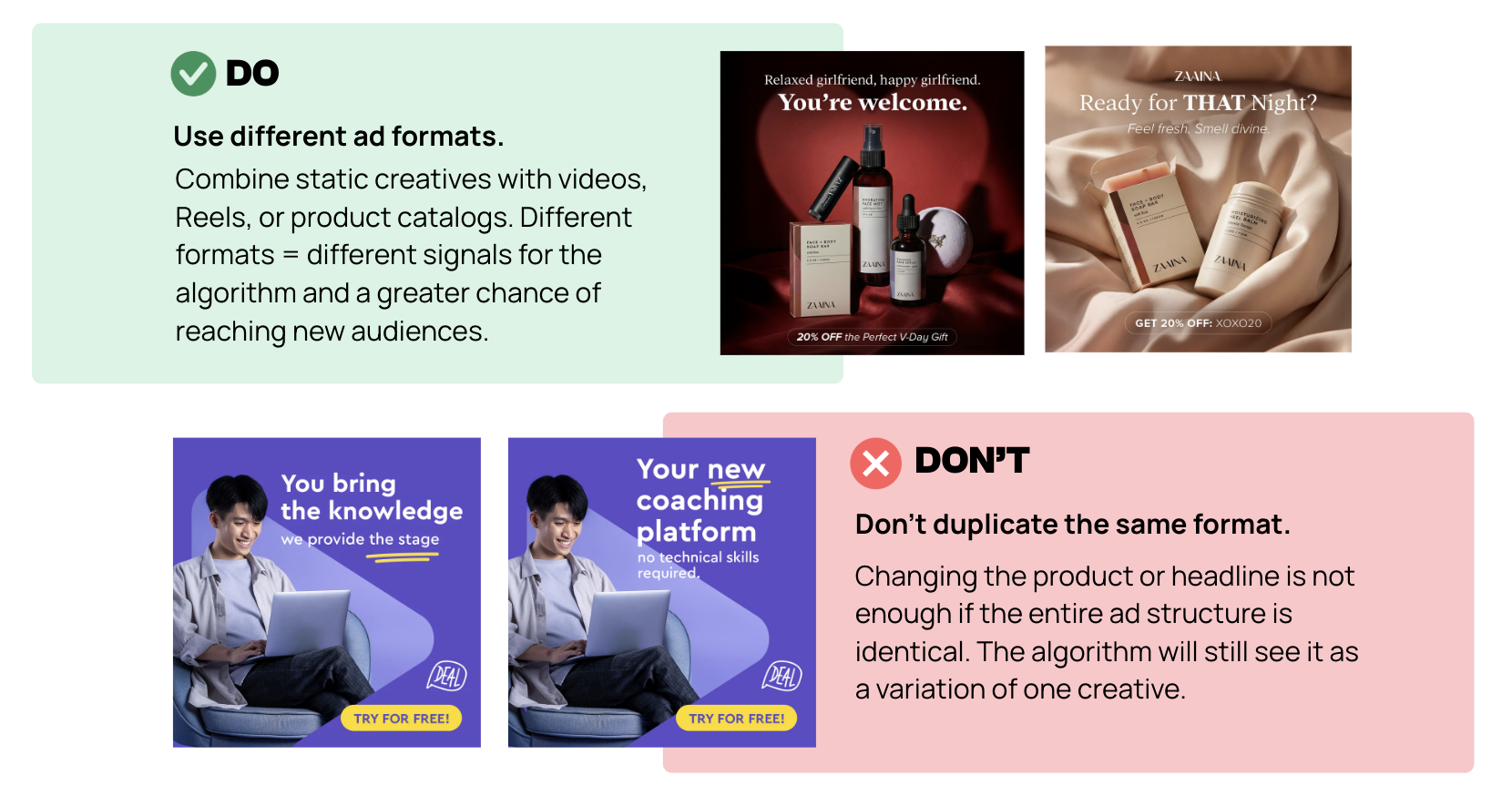
Old templates give a sense of safety, but in ad campaigns they very quickly turn into stagnation, which leads to creative fatigue — a drop in a creative’s effectiveness over time. What worked a year or two ago doesn’t have to work the same way today. Audiences change, formats change, the pace of content consumption changes, and so does the very way ad systems select messages.
source: Meta Ads Library
This is especially important in an environment where systems like Andromeda, Lattice, GEM, and Sequence Learning judge an ad’s relevance and message fit faster and faster. The more derivative the creatives, the smaller the chance they’ll get real room to work — a topic we expand on in the article on whether creative is the new targeting. Today, the winner isn’t whoever repeats the same motif the longest. The winner is whoever can deliver meaningful, varied signals. The technical details are described on the Meta Engineering Blog.
an example of different creative variants made at MTA Digital
💡 Consistency isn’t always stability. In campaigns, it very often just means stagnation wrapped in a familiar template.
That’s exactly why openness to new formats, new communication angles, and new tools isn’t an “optional extra” today. It’s part of a healthy testing process.
It’s also very easy to confuse pretty with effective. “The boss likes it” isn’t a creative strategy. An ad isn’t meant to please the person on the brand’s side the most. It’s meant to work on the audience. And that doesn’t always go hand in hand with the aesthetic preferences of decision-makers. The thing is, a user doesn’t respond to a creative because it’s “elegant” or “premium” in the team’s eyes. They respond when the message touches their situation, problem, need, or objection. If that filter disappears, the campaign starts being built around taste, not around what works.
👉 The user doesn’t buy what the team likes. They buy what speaks to their situation, need, or objection.
That’s why rawer, less “polished” formats — but ones closer to real experience — work so well today. The most refined ad doesn’t always win. Often the most relevant one does.
Mistake 9: Slow feedback and lengthy creative sign-offs
Campaigns run at a fast pace. The creative should too. If feedback comes back after a few weeks, the testing process simply falls apart. By the time the fixes reach the campaign, the context is often different, the data is old, and the team is working on a delayed loop.
That doesn’t mean everything has to be done chaotically. Quite the opposite. The more organised the process, the easier it is to act fast without losing quality. The problem isn’t the pace itself, but the lack of an iteration rhythm.
If creatives sit in sign-off too long, even the best idea can simply miss its moment.
Mistake 10: Performance without brand — the short-term thinking trap
Focusing solely on the short-term sales result can undercut a campaign just as effectively as having no strategy. Because if every creative is only meant to “sell here and now”, you very quickly run out of room to build recognition, trust, and a sensible start to a relationship with the audience.
The best campaigns don’t choose between performance and brand. They combine the two. Some creatives are meant to catch attention and open the topic. Some to educate. Some to disarm objections. Some to close the decision. And that’s exactly why designing a campaign around the stages of customer awareness gives much better results than throwing every message into one bag.
⚠️ Sales without brand context only works up to a point. After that, all that’s left is promotions, discounts, and an ever-harder result to close.
If you want a campaign to deliver not just today but also in a few months’ time, the creative has to work not only on the click, but also on how the brand registers in the audience’s mind.
How to avoid mistakes in Meta Ads creatives — a checklist
To sum up, working with creatives isn’t all unicorns and painting pretty pictures. It’s also about avoiding mistakes:
#
Mistake
What happens
How to fix it
01
Creative as an add-on
The creative appears at the end of the process, with no brief or hypothesis
Creative strategy BEFORE production
02
Virality instead of strategy
“Let’s make something viral” with no hypothesis or goal
Strategy: who, what we’re testing, how we measure
03
Too few variants
3 banners aren’t a test, they’re hope
5–8 genuinely different creatives per ad set
04
Testing cosmetics
Changing the colour, background, layout — that’s not a new creative
A test with no conclusions = a publication, not a test
Cycle: research → concept → test → conclusions → iteration
07
Copying big brands
Form without mechanism — you copy the layout, lose the point
Benchmark as a starting point, not an answer
08
Old templates
“It always worked” → creative fatigue
Openness to new formats and angles
09
Slow feedback
2–3-week sign-offs = a missed moment
An iteration rhythm of 1–2 weeks
10
Performance without brand
Only “sell” = audience burnout
Mix: brand + education + performance across awareness stages
The 10 most common mistakes in Meta Ads creatives — overview, diagnosis, fix. ← swipe to see more →
We don’t produce ads just to “put something out there”
Good creative work starts from a simple premise: we don’t produce ads just to “put something out there”, but to learn something and make better decisions on that basis.
That means several things at once:
First, creative strategy has to come before production, not after.
Second, tests should compare different ideas, not just minor variations.
Third, every test must have a clear “what for” and “who for”.
Fourth, conclusions have to feed back into the next briefs and iterations.
And fifth, creative and performance should work in one process. If you’re looking for specific formats to test, take a look at our UGC service too, which helps deliver authentic, varied signals to the algorithm.
Most mistakes in creative work don’t look dangerous at first glance. They’re more like small decisions, shortcuts, and habits that, over time, start to cost more and more. Too little variety. Too much cosmetics. Publishing too fast. Too little analysis. Too much taste, too little strategy.
And yet an effective creative doesn’t start with whether the ad is pretty. It starts with whether it’s there for a reason. Whether it answers a specific decision stage. Whether it can be tested. Whether it adds a new signal. Whether it helps you understand the audience and leads to the next decisions, instead of leaving the team with the question: “okay, but what does this tell us?”.
About the author
Agnieszka Rapacz — As a creative strategist and graphic designer, she designs ad creatives that combine technology with an intuitive understanding of audiences and how algorithms work. In her work she relies on creative strategy, testing, and analysing results, creating creatives that support sales and campaign scaling. She makes sure ads are not only aesthetic but, above all, effective — basing them on data without losing her instinct and creative intuition. Find her on LinkedIn.
Table of contents
See other articles
Meta Ads
Meta One – what it offers, how much it costs and is it worth it? [2026]
Have you ever pasted a link into an Instagram caption, only to sigh and add "link in bio"? Same here. The good news: Meta is finally letting you add clickable links to posts. The less good news: nothing comes for free... I've pulled together the key facts about Meta One: what's changing, what stays the same and when a paid plan actually makes sense.
TikTok Shop for e-commerce: how to enter smartly — and not end up underwater
TikTok Shop is now live in a lot of markets — mature and crowded in some, brand-new in others — and every so often e-commerce gets a channel everyone suddenly talks about. The pattern repeats: first curiosity, then a gold rush, then the quiet realisation that the winners weren't the loudest entrants but the ones who entered with a plan.
How to start selling on TikTok Shop – step by step
There's a moment in the life of every new sales channel when everyone's talking about it, nobody really knows it yet, and you have an irresistible urge to just register and see what comes of it. TikTok Shop is in exactly that moment. And honestly? The urge is well founded: the channel has potential, the barrier to entry can be surprisingly low, and the first well-prepared sellers gain a real edge while the competition is still deliberating.