The 5 stages of customer awareness: how to build a funnel with ad creative [2026]
The sales funnel no longer starts in the ad panel — it starts in the audience’s head. Whether a customer stops on your ad, recognises their problem, comes to trust the brand, and finally buys depends more and more on what you communicate at each stage of their awareness. That’s why an effective funnel is built today not only through targeting, but above all through creative.
What you'll learn about the 5 stages of customer awareness
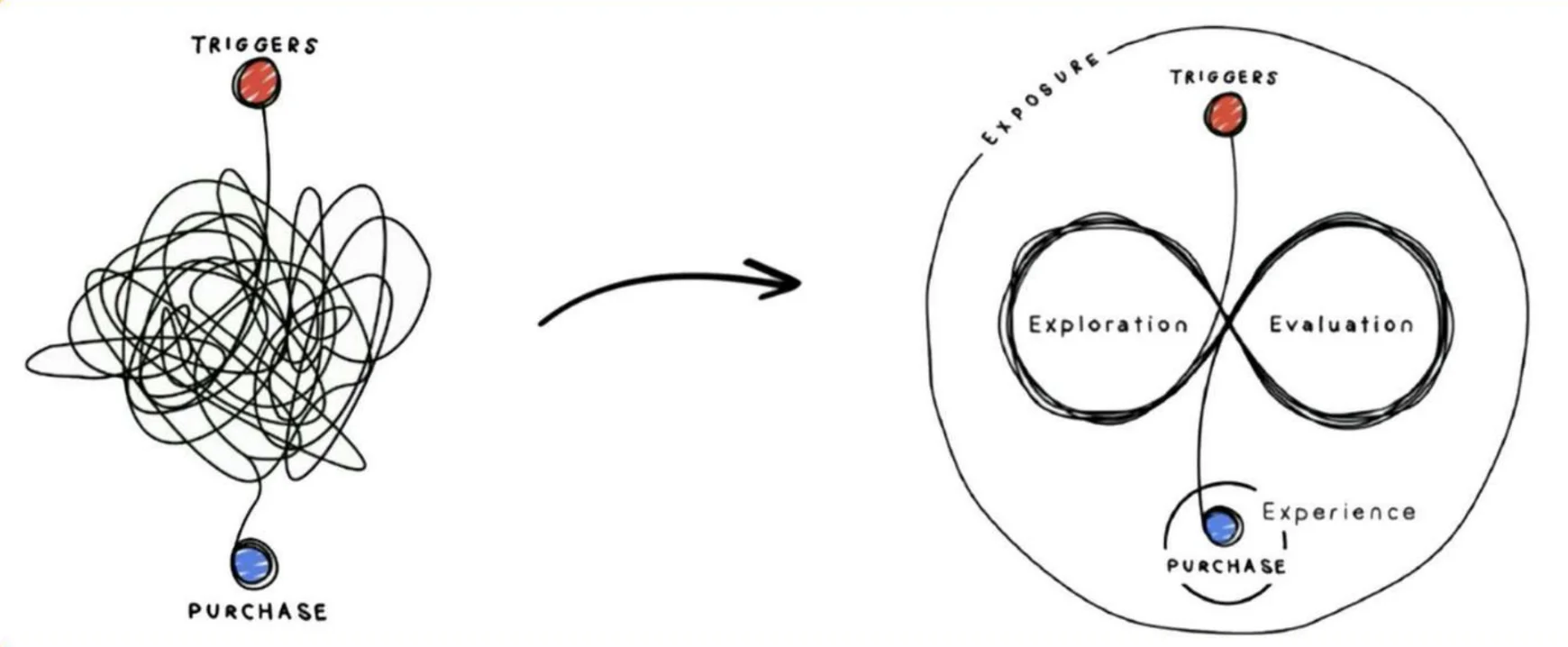
why the customer buying journey is rarely linear, and what that changes in how you design campaigns,
what the 5 stages of customer awareness are, and what the model looks like in practice,
what role the creative should play at each stage — from sparking reflection to closing the buying decision,
why the funnel is increasingly built through messaging and creative rather than just settings in Ads Manager,
how to create ads that give algorithms varied signals, instead of repeating the same message in a few similar versions,
how to avoid the most common mistake: confusing the number of creatives with genuine variety of communication.
What is the 5 stages of customer awareness model?
It’s a marketing framework from 1966 by Eugene Schwartz that splits the customer journey into five stages: Unaware (unaware of the problem), Problem Aware (aware of the problem), Solution Aware (comparing options), Product Aware (knows the product but has objections), and Most Aware (ready to buy). Each stage calls for a different ad creative — from problem-awareness to directly sales-focused.
Why does the classic sales funnel stop working without deliberate creative?
Not so long ago, the sales funnel in social ads campaigns was, for many people, mainly a technical puzzle: splitting up campaigns, narrowing audiences, manually steering traffic, and mapping out the messaging into separate stages in the ad panel.
Today, that way of thinking increasingly isn’t enough.
Not because funnel strategy has stopped mattering. Quite the opposite. It’s simply that the environment campaigns run in has changed. Ad systems analyse signals faster, judge whether an ad makes sense earlier, and increasingly “read” the creative itself: its context, emotion, promise, problem, language, and format. That’s why the creative is no longer an add-on to the campaign — it’s becoming one of the most important tools for guiding the audience through the buying decision.
Because an ad is still a moment of direct contact between the brand and a person. And that moment is usually very short — sometimes literally a fraction of a second. So if you want to build an effective funnel, you have to think not only about who you’re showing the ad to, but also about what exactly you’re saying to the audience at their particular stage of thinking.
What is the 5 stages of customer awareness model? It’s a framework describing five successive levels a customer moves through on the way to a purchase: from complete unawareness of the problem (Unaware), through awareness of the problem (Problem Aware) and of the solution (Solution Aware), to awareness of a specific product (Product Aware), and finally readiness to buy (Most Aware). The model was developed by Eugene Schwartz in 1966 in the book “Breakthrough Advertising“; today it’s a foundation of creative strategies in e-commerce and performance marketing.
What the customer buying journey looks like across the 5 stages of awareness — a real-life example
Before we get to the stages, think back to your last purchase — or, even better, recall the moment your back started to hurt.
At first, you usually don’t think: “okay, I’m buying a specific product.” First you try to understand what the problem actually is. Maybe you’ve been sitting at your desk too long. Maybe it’s a matter of poor posture. Maybe an uncomfortable chair is to blame. Or maybe everyday life has simply started to take its toll.
So you start searching. You read, you scroll, you check. You come across articles about back pain. Then sit-stand desks. Ergonomic chairs. Somewhere along the way an ad for an acupressure mat pops up. You click. You read reviews. You compare manufacturers, prices, materials, promises, and promotions. One option seems sensible, then a moment later something else convinces you more.
And that’s exactly the point: your path isn’t simple or linear. It’s made up of several moments in which what changes is exactly what you’re looking for, what arguments you need, and what catches your attention: one person will be stopped by a message about relaxation and rest, another by a message about back pain after desk work. These aren’t two “nice variants” of the same ad. They’re two different contexts, two different entry points, and two different moments of decision. And that’s what most buying decisions look like.
A customer very rarely travels the road from “I saw the ad” to “I’m buying” in a single step. Most often they move between different levels of awareness: first they realise there’s a problem, then they understand the possible solutions, compare options, get comfortable with their objections, and only at the end are they ready to make a decision. That’s why a single campaign shouldn’t speak to everyone the same way.
💡 The buying journey is rarely linear. And since the way the customer thinks changes, the message you direct at them has to change too.
source: Google
Why is the 5 stages of awareness model more important today than the classic TOFU/MOFU/BOFU?
In a world of automated ad systems like Andromeda, it’s no longer enough to “just have a few creatives.” Algorithms filter ads faster and try to match them to a specific person and a specific moment. They take into account not only campaign settings but also the signals coming from the ad itself: what problem it shows, what language it uses, whether it’s educational, sales-focused, based on social proof, or perhaps building emotion or urgency.
That’s why, in practice, “creative is the new targeting” doesn’t mean settings stop mattering. It means rather that, with broad targeting, it’s the creative that helps the system understand who this message is for and what stage of the journey the audience is at.
For this to work, you need a framework that organises the messaging. For us, that framework is exactly the 5 stages of customer awareness model. It’s a different take on the traditional TOFU/MOFU/BOFU or the classic AIDA model. It overlaps with the concept of the customer journey, but adds a specific instruction for the creative at each level of awareness — from cold to hot lead. It’s a simple, logical way to design creatives so they build the funnel naturally — instead of artificially “assembling” it in the ad panel.
The 5 stages of customer awareness model — step by step
Stage 1. Unaware — the customer unaware of the problem
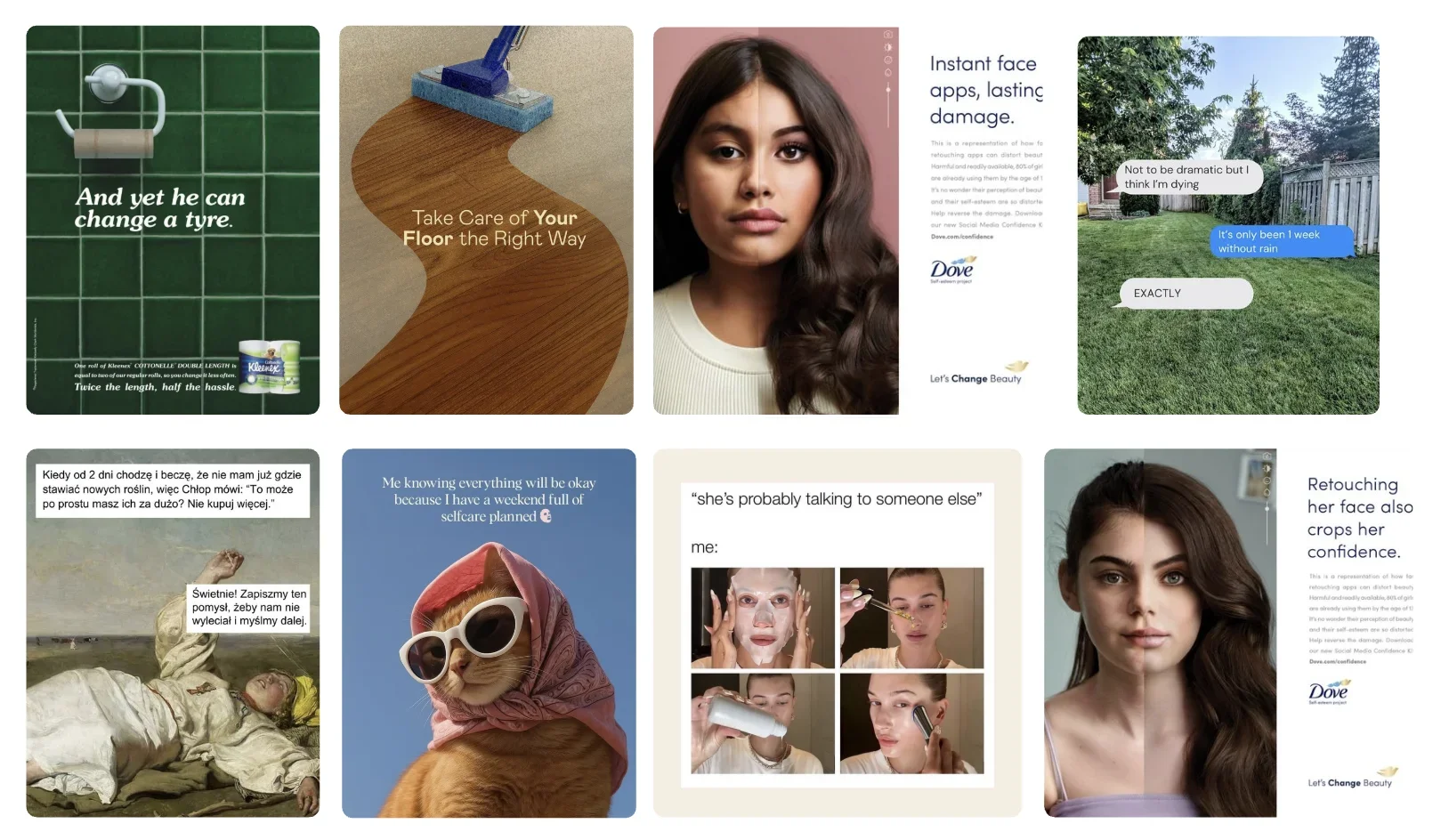
At this stage, the audience doesn’t yet know they have a problem. They’re not looking for anything. They’re not comparing offers. They’re not typing in product names. They go about their life until something stops them for a moment and triggers a thought: “hey, actually… that’s me.”
Here you’re not selling the product yet. You’re selling attention to the problem.
This is the stage where the creative has to break the scroll and plant a thought. Show a situation the audience identifies with. Name something they hadn’t put into words before. Confront them with a discomfort, a pattern, a mistake, or a loss they hadn’t noticed.
If we go back to the back-pain example, at this stage you don’t start with an ad for a specific mat or chair. You start with a scene that’s familiar: a few hours at the laptop, a tense neck, fidgeting in the chair, that feeling of exhaustion at the end of the day. The message isn’t yet “buy this.” It’s more like “it doesn’t have to be this way.” Or: “maybe the problem isn’t where you think it is.”
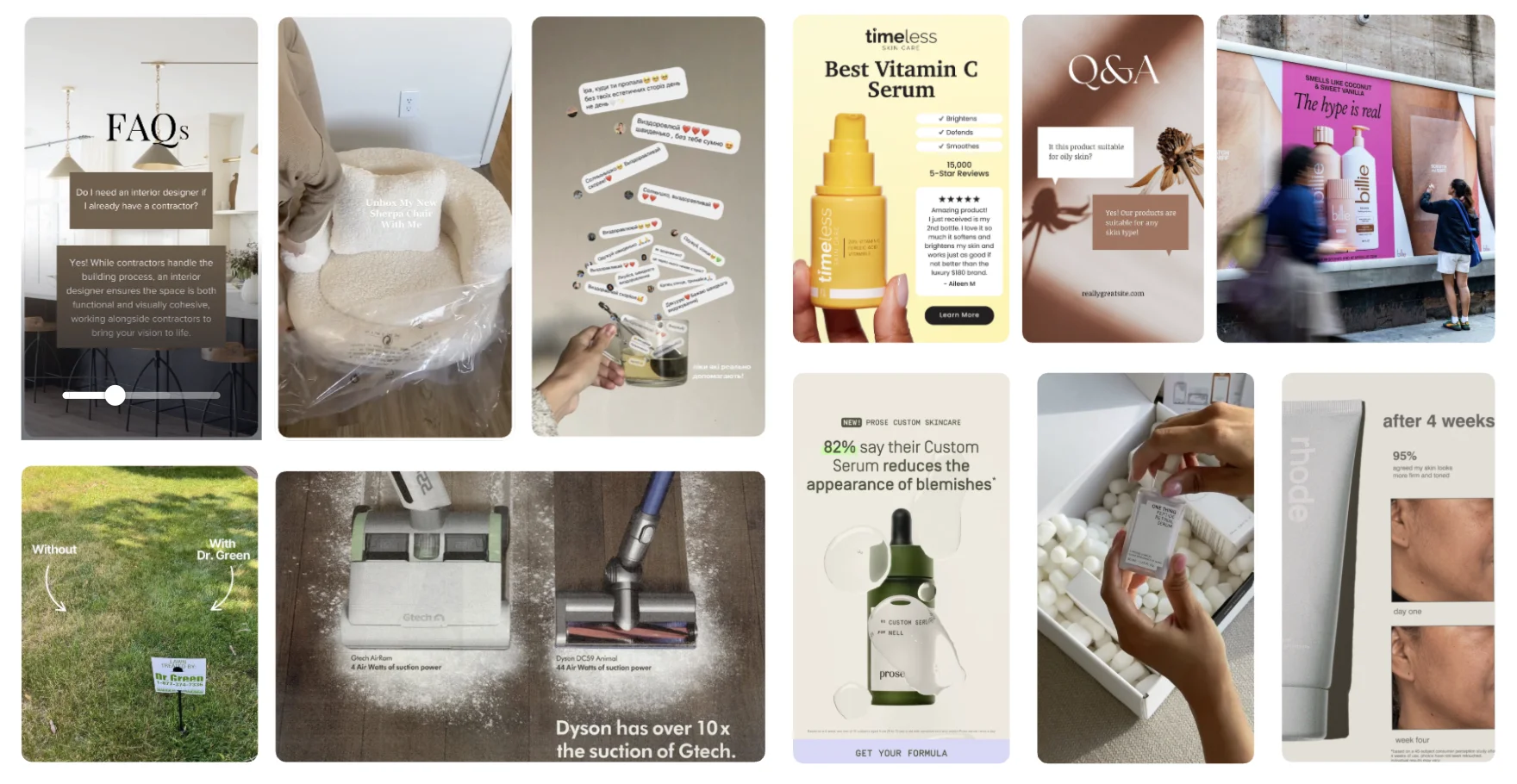
source: Meta Ads Library, Pinterest
The model in practice — selling shampoo in e-commerce
A customer is scrolling Instagram on a Monday morning. She isn’t looking for shampoo. She isn’t thinking about her hair. She’s just seen a pasta-recipe clip and a post about a TV series. Your shampoo brand doesn’t exist for her — and, more importantly, she doesn’t even know she has the problem your product solves.
The creative that works here can’t open with “Buy anti-hair-loss shampoo.” Instead: a 15-second video that starts with a shower shot — a handful of hair in the drain. Caption: “3 in 5 women over 30 lose more hair than they should. Didn’t you know?” No product in the frame. No price. No “buy now” CTA. Just surfacing a problem the customer can recognise as her own.
What not to do here: don’t show the product, don’t talk about ingredients, don’t offer a discount. A customer unaware of the problem will ignore the offer — not because she doesn’t want it, but because she doesn’t understand why she’d need it.
✅ Creative goal: spark reflection and surface the problem.
✅ Role of the message: stop the scroll and trigger “that sounds familiar”.
✅ What to avoid: jumping to the offer and the product too quickly.
Stage 2. Problem Aware — the customer aware of the problem, but not the solution
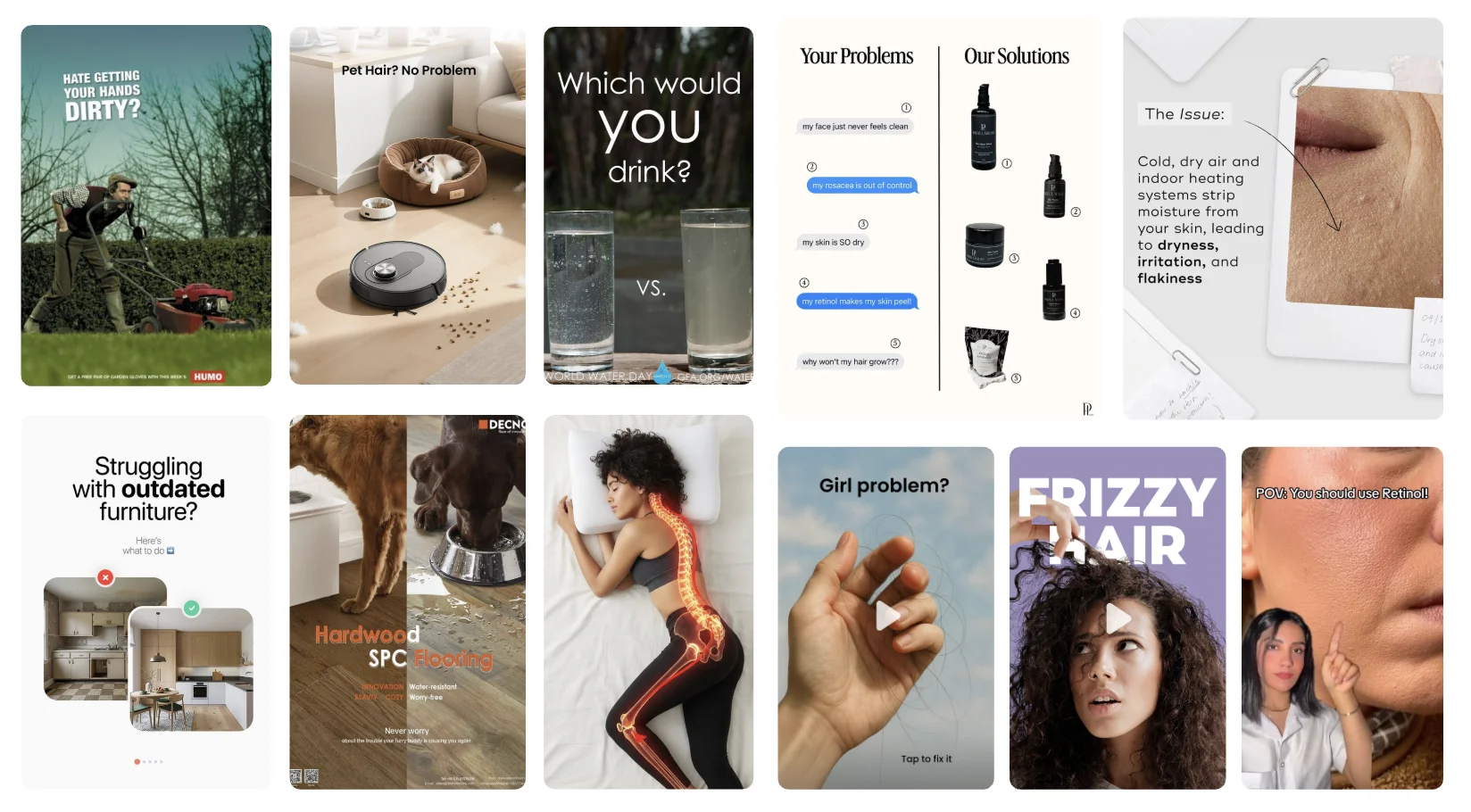
Here the audience already knows something is hurting. Literally or figuratively. They recognise the discomfort, frustration, blocker, or need, but still don’t know exactly how to solve it. This is the moment they start looking for causes, type their first searches into Google, read posts, watch reels, and consume educational content.
At this stage the creative should lead with empathy and name the problem in the audience’s own language. It’s not yet about burying them in product features. It’s about showing that you understand their situation. That you know what annoys them, what they’re fed up with, what they keep telling themselves, and why this topic matters to them.
In practice, what works very well here are educational creatives, simple graphics with one well-aimed message, UGC, short clips, or formats that say outright: “we know what this looks like” or “see where this problem comes from.” This is the moment to hit the pain point and help the audience better understand their own frustration.
💡 At the Problem Aware stage, the customer doesn’t need the product yet. First they need the feeling: “someone really understands what I’m dealing with.”
If we stick with the back example, you can now talk about the tension after sitting work, about strain, about bad habits, about a lack of recovery, or about why “just waiting it out” doesn’t solve the problem.
source: Meta Ads Library, Pinterest
The model in practice — selling shampoo in e-commerce
Now the customer has noticed that she really is losing a lot of hair. She googles: “why does hair fall out after pregnancy”, “what to do about thinning hair”, “is hair loss normal”. She knows something’s wrong — but she doesn’t yet know there’s a shampoo that can help her.
The creative at this stage is education. A carousel: “5 reasons you’re losing more hair than a year ago” — each slide a different reason (stress, diet, hormones, poor care). The last slide: “Reason no. 5: you’re using a shampoo that literally strips your hair.” Only here, at the end, does a reference to a solution appear. Not to your product — to the product category.
What not to do here: don’t send her to the shop yet. A customer who lands on the product page at this stage will bounce — because she doesn’t yet know what she’s looking for.
✅ Creative goal: name the problem and build relevance.
✅ Role of the message: tap into the audience’s emotion and frustration.
✅ What to avoid: overloading with product, specs, and overly technical language.
Stage 3. Solution Aware — the customer aware of the solution and comparing options
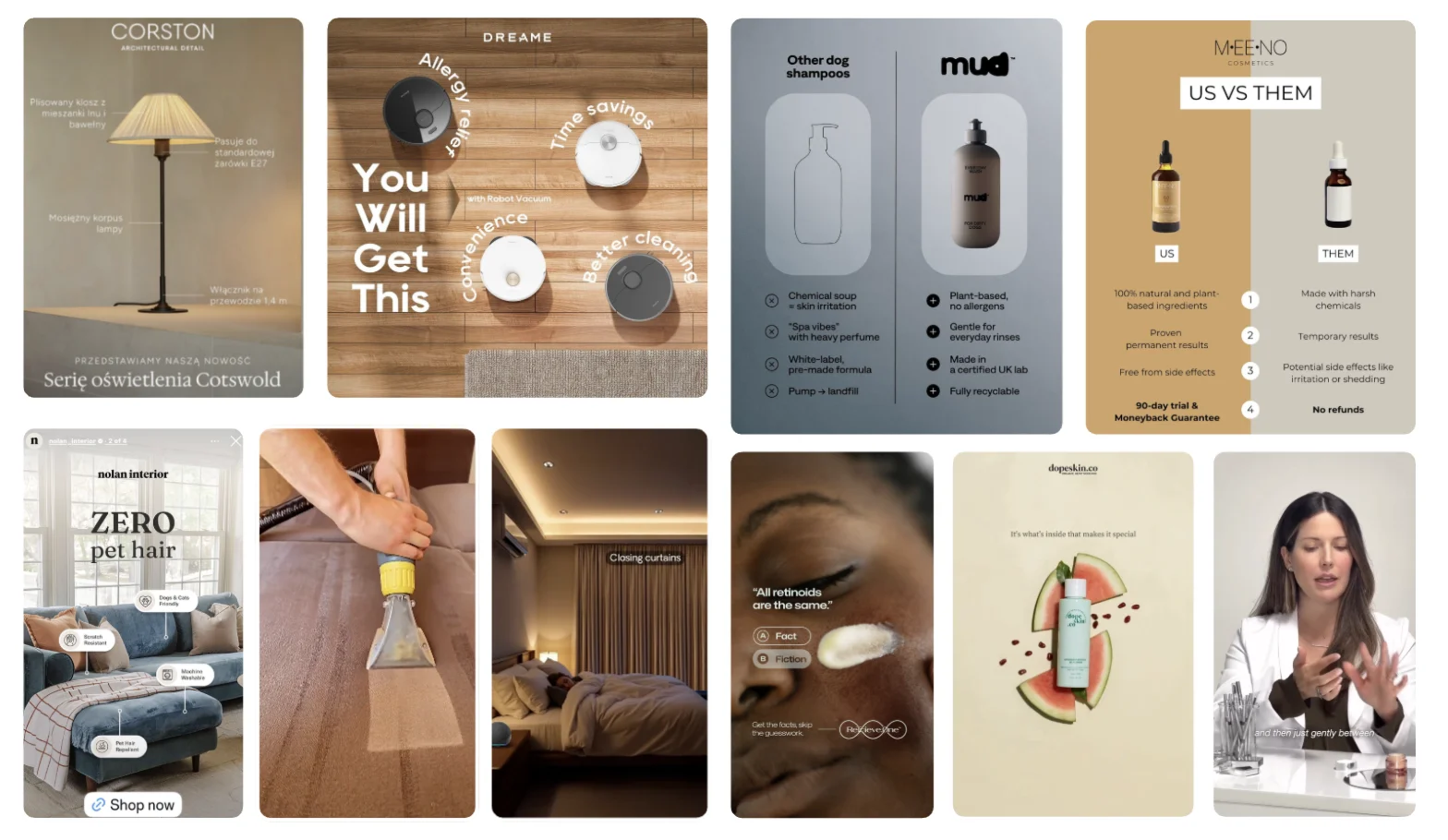
This is the moment the audience already knows what type of solution they’re looking for. They understand the category. They realise there’s more than one way out of the problem. They start comparing options, looking for arguments, telling the “old way” from the “new way”. But they’re still not sure that your brand is the best choice. This is where stronger product education begins.
This is a good place for creatives like:
“us vs the competition”,
“the old way vs the new way”,
specific numbers, comparisons, and case studies,
showing why this solution makes sense.
At this stage, the audience no longer responds just to the fact that you understand their problem well. Now they want to know what actually works. They’re looking for proof. They want to compare promises. They’re weighing up whether a given option is genuinely better, more convenient, more logical, more effective, or a better fit for their situation.
Back to our example: someone already knows they want to take care of their back. Now they’re considering different solutions — maybe a sit-stand desk, maybe a new chair, maybe an acupressure mat, maybe exercise, maybe several things at once. Your creative should help them understand what role your product plays and why it’s worth considering right now.
source: Meta Ads Library, Pinterest
The model in practice — selling shampoo in e-commerce
The customer now knows there are strengthening shampoos, biotin shampoos, SLS-free shampoos. She searches: “best shampoo for hair loss”, “biotin shampoo reviews”. She knows the solution exists — she just doesn’t know yet that it’s yours.
Now the creative can be more concrete: “Not every anti-hair-loss shampoo works the same way. Here’s what to look for in the ingredients.” A blog post, a video comparing ingredient types, or an ad in the form of a mini-guide. Your brand shows up as an expert, not a salesperson. With a CTA at the end: “Check out our shampoo with an active biotin + keratin complex → See the ingredients” — a link to the product page, not to checkout.
What not to do here: don’t offer 20% off your “first purchase.” At this stage, the customer responds to knowledge, not to a promotion — a discount here can lower the product’s perceived value.
✅ Creative goal: show the logic of the solution and the edge of the category or brand.
✅ Role of the message: educate, compare, justify.
✅ What to avoid: generalities and empty promises with no specifics.
Stage 4. Product Aware — the customer aware of your product, but with objections
This is where it gets really interesting. The audience already knows your product or brand. They’ve been on the site. They recognise the offer. They may have come back to it a few times already. But they’re still hesitating. Not because they don’t understand what you’re selling. Only because they have objections. And it’s those objections that block the decision.
They usually sound very specific:
“Will this work for me?”
“Is it worth the price?”
“Won’t this be another purchase I regret?”
“Can I trust this?”
“And what if it doesn’t work out after all?”
This is the stage where the creative should counter objections, not just “look nice”. This is where social proof, screenshots of reviews, testimonials, FAQs right inside the ad, unboxings, close-ups of the product, money-back guarantees, free delivery, and other elements that give the audience a sense of safety come into play. It’s no longer the moment for building curiosity alone. It’s the moment for reducing risk.
👉 At the Product Aware stage, the prettiest creative doesn’t win. The one that best answers the customer’s doubts does.
For the acupressure mat, this could be user reviews, showing the build quality, information about materials, real-life usage scenarios, answers to the most common questions, or a “is this for me if…” format. All so the customer doesn’t have to fill in the worst-case scenario for themselves.
source: Meta Ads Library, Pinterest
The model in practice — selling shampoo in e-commerce
The customer has already been on your product page. She’s read the ingredients. She’s compared you with the competition. She may have already seen your shampoo on an influencer. But she hasn’t bought yet. She goes back to Instagram and sees your ad.
This is the moment for social proof — and specific social proof at that. Not a generic “our customers are happy”, but: “Ania, 34, after 6 weeks of use: I pull hair out of the shower drain every week, and there’s 3× less of it” — a before/after photo, UGC with a comment. A comparison creative with your product as the solution works great here, with a CTA: “Read the reviews and order”.
What not to do here: don’t explain what biotin is anymore — the customer already knows. Repeating the education at this stage wastes her time and your budget.
✅ Creative goal: counter objections and increase the sense of safety.
✅ Role of the message: prove, reassure, confirm.
✅ What to avoid: repeating generic benefits without answering the real “but”.
Stage 5. Most Aware — the customer ready to buy (the last step of the funnel)
This is the final stage. The audience knows the brand, understands the product, and trusts it enough to be very close to a decision. Sometimes they already have the product in their basket. Sometimes they’re just waiting for an impulse. Sometimes they need one last argument to move them from “I’ll think about it” to “I’ll take it”.
Here the communication should be short, specific, and to the point. This is the place for:
a time-limited offer,
a discount code valid for 24h,
free delivery,
an abandoned-basket reminder,
a strong CTA,
subtle or stronger FOMO.
This stage doesn’t need an elaborate narrative. It needs a trigger. The audience doesn’t have to read yet again why it’s worth looking after their back or what an acupressure mat even is. They already know. Now you have to help them close the decision.
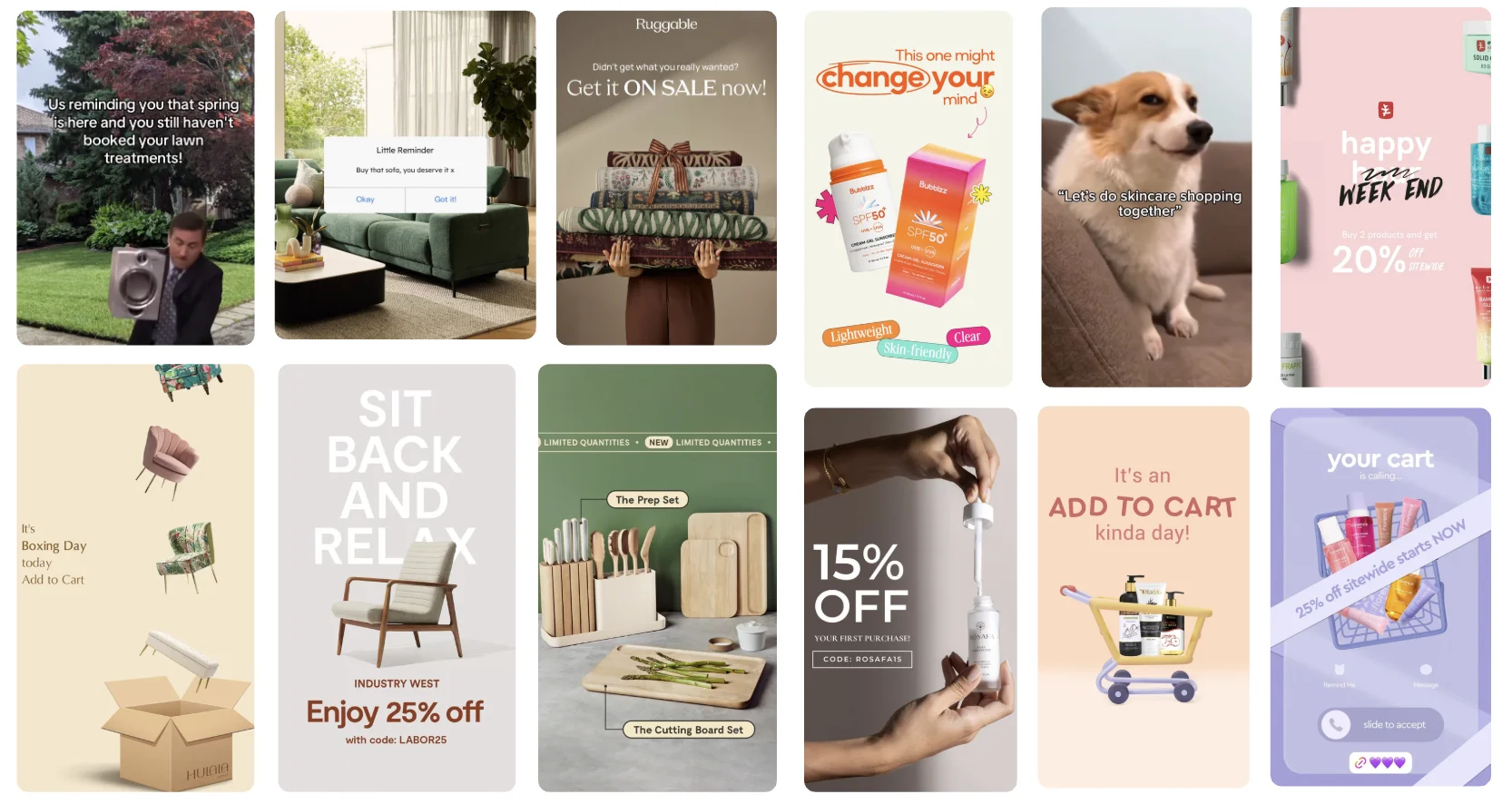
source: Meta Ads Library, Pinterest
The model in practice — selling shampoo in e-commerce
The customer has added your shampoo to her basket. Or she’s come back to the product page for the third time this week. She knows what she wants — she just needs one last impulse to click “order”.
What works here is a specific offer with a sense of urgency. “Free delivery today if you order by 8 p.m.”“12 left in stock.”“Order today and get a mini conditioner free.” Or dynamic retargeting: the ad shows exactly the product she viewed, with a CTA “Back to your basket → −10% today only”. At this stage the creative can and should be directly sales-focused — the customer has already given you every signal that she’s ready.
What not to do here: don’t serve the same ad you’d show a customer at the Unaware stage. This is the mistake most shops make — the same creatives go out to everyone, and they’re all “buy now.” The Most Aware customer needs an impulse, not education. The Unaware customer needs a story, not a discount code.
✅ Creative goal: close the purchase.
✅ Role of the message: trigger action here and now.
✅ What to avoid: dragging the message out and going back to too-early education stages.
What does the 5 stages of awareness model give you in practice in performance marketing?
Above all, it organises how you think about creative. Instead of dropping a few similar assets into the campaign and hoping “something catches,” you start designing messages with a specific role. One is meant to spark reflection. The second to name the problem. The third to show the solution. The fourth to counter objections. The fifth to close the decision. As a result, each creative has its place and its purpose.
Stage
Creative goal
Role of the message
What to avoid
01 Unaware unaware of the problem
Spark reflection, surface the problem
Stop the scroll and trigger “that sounds familiar”
Jumping to the offer too soon
02 Problem Aware aware of the problem
Name the problem and build relevance
Tap into the audience’s emotion and frustration
Overloading with product and technical language
03 Solution Aware comparing options
Show the logic of the solution and the brand’s edge
Educate, compare, justify
Generalities and empty promises
04 Product Aware knows the product, has objections
Counter objections and increase the sense of safety
Prove, reassure, confirm
Repeating benefits without answering the “but”
05 Most Aware ready to buy
Close the purchase
Trigger action here and now
Dragging it out and going back to education
The 5 stages of customer awareness — how to match your creative to each funnel stage
It’s also a huge difference from the algorithms’ perspective. If you feed the system varied messages, emotions, arguments, and contexts, you increase the chance it will match the ad better to a specific person and a specific moment. It’s a way to build the funnel naturally through creative, instead of artificially “assembling” it solely in the ad panel.
💡 A good campaign isn’t a collection of random ads. It’s a set of messages that answer the different stages of customer awareness.
The most common mistake when building a funnel with creative: confusing the number of ads with variety of communication
It might seem that, since we need more messages, all we have to do is prepare more versions of the same ad. Change the background. A different text colour. Nudge the layout slightly. Swap out one sentence. The problem is that, to the system, this is often still the same signal, not a new test. Similar creatives don’t build real knowledge — what you need to change is the meaning of the message, not the cosmetics. How to design this process operationally — from research to iteration — is something I cover in creative strategy in Meta Ads.
So if you want to build a funnel through creative, don’t ask:
“how many assets shall we drop into the campaign?”
Better to ask:
“do these ads genuinely differ in awareness stage, insight, emotion, or argument?”
Because five similar ads aren’t five funnel stages. They’re often one hypothesis in a few versions. And it’s hard to draw sensible conclusions from that. You’ll find more pitfalls like this in the 10 most common mistakes in Meta Ads creatives. And if you’re after inspiration, you can easily find it in the Meta Ads Library, or even on Pinterest.
How to use the 5 stages of customer awareness model in everyday campaign work?
The simplest way: first you ask yourself what stage of thinking the audience is at. Then you match the role of the creative to it. Only at the end do you choose the format, copy, layout, and execution. Not the other way around.
Because if you start with “let’s make a nice graphic,” it’s very easy to create something that’s visually correct but completely indifferent to the audience. And yet an effective ad isn’t meant to be merely aesthetic. It’s meant to be relevant. It’s meant to provoke a reaction. It’s meant to fit the moment the customer is in. If you use AI to design variants, it’s worth knowing where AI really helps in creative marketing, and where a human is still needed.
To sum up, the 5 stages of customer awareness aren’t theory for theory’s sake. They’re a very practical tool that helps you design communication in a more organised, logical, and effective way.
Especially today, when ad systems work faster, filter messages earlier, and rely more heavily on the signals coming from the creative itself.
If you want to build a funnel that genuinely works, it’s no longer enough to “have ads.” You need a creative strategy in place, and ads that answer the different moments of the buying decision. From first noticing the problem, through education and comparing options, to closing the sale.
Then strategy sets the direction, the creative builds the tension, and technology helps tie it together into one coherent whole. And if you’re not sure whether your creatives answer the 5 stages of customer awareness, get in touch — we’ll be glad to help!
About the author
Agnieszka Rapacz — As a creative strategist and graphic designer, she designs ad creatives that combine technology with an intuitive understanding of audiences and how algorithms work. In her work she relies on creative strategy, testing, and analysing results, creating creatives that support sales and campaign scaling. She makes sure ads are not only aesthetic but, above all, effective — basing them on data without losing her instinct and creative intuition. Find her on LinkedIn.
Table of contents
See other articles
Meta Ads
Meta One – what it offers, how much it costs and is it worth it? [2026]
Have you ever pasted a link into an Instagram caption, only to sigh and add "link in bio"? Same here. The good news: Meta is finally letting you add clickable links to posts. The less good news: nothing comes for free... I've pulled together the key facts about Meta One: what's changing, what stays the same and when a paid plan actually makes sense.
TikTok Shop for e-commerce: how to enter smartly — and not end up underwater
TikTok Shop is now live in a lot of markets — mature and crowded in some, brand-new in others — and every so often e-commerce gets a channel everyone suddenly talks about. The pattern repeats: first curiosity, then a gold rush, then the quiet realisation that the winners weren't the loudest entrants but the ones who entered with a plan.
How to start selling on TikTok Shop – step by step
There's a moment in the life of every new sales channel when everyone's talking about it, nobody really knows it yet, and you have an irresistible urge to just register and see what comes of it. TikTok Shop is in exactly that moment. And honestly? The urge is well founded: the channel has potential, the barrier to entry can be surprisingly low, and the first well-prepared sellers gain a real edge while the competition is still deliberating.